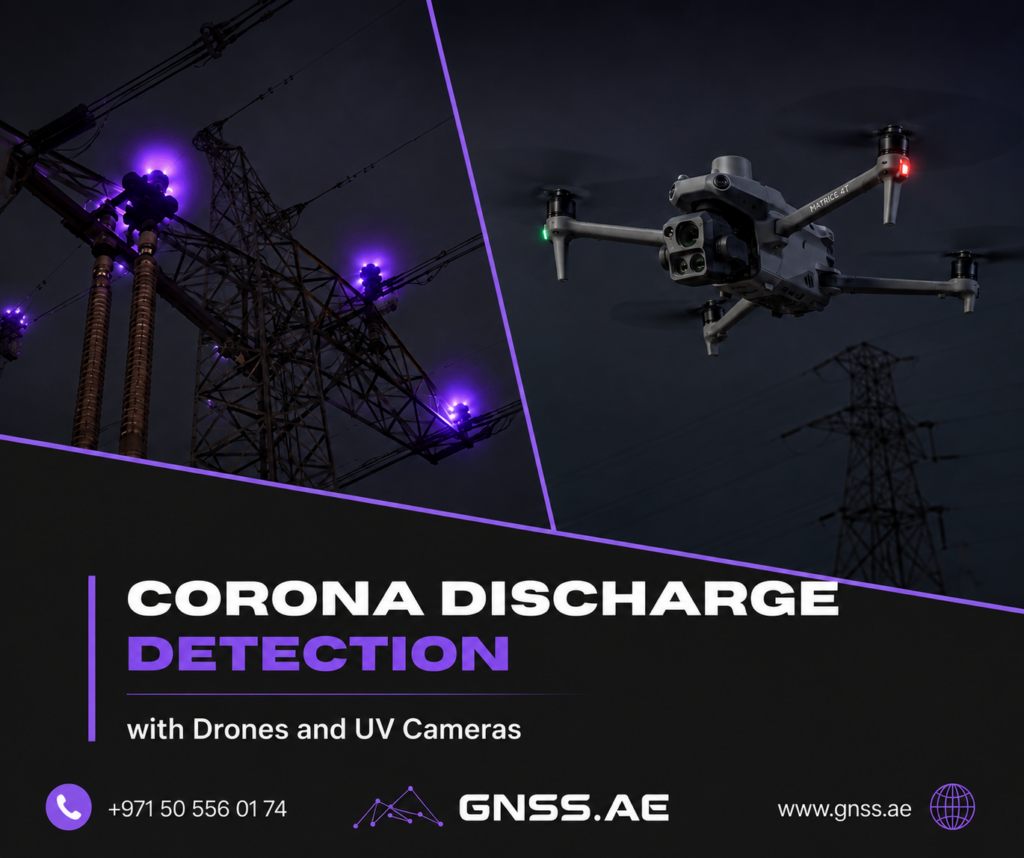
Long before engineers began inspecting power lines with ultraviolet cameras, sailors were already familiar with one of the most striking manifestations of corona discharge.
During thunderstorms, a blue or violet glow would sometimes appear around the tips of ship masts. The phenomenon became known as St. Elmo’s fire and was surrounded by superstition for centuries. Today, we understand the physics behind it much better.
The same basic process can occur around high-voltage electrical equipment. There, however, corona discharge is more than an unusual visual phenomenon. Persistent or abnormal discharge can indicate electrical stress and contribute to the deterioration of equipment over time.
Finding it early is therefore an important part of power infrastructure inspection. One increasingly practical way to do this is to combine ultraviolet imaging with drones.
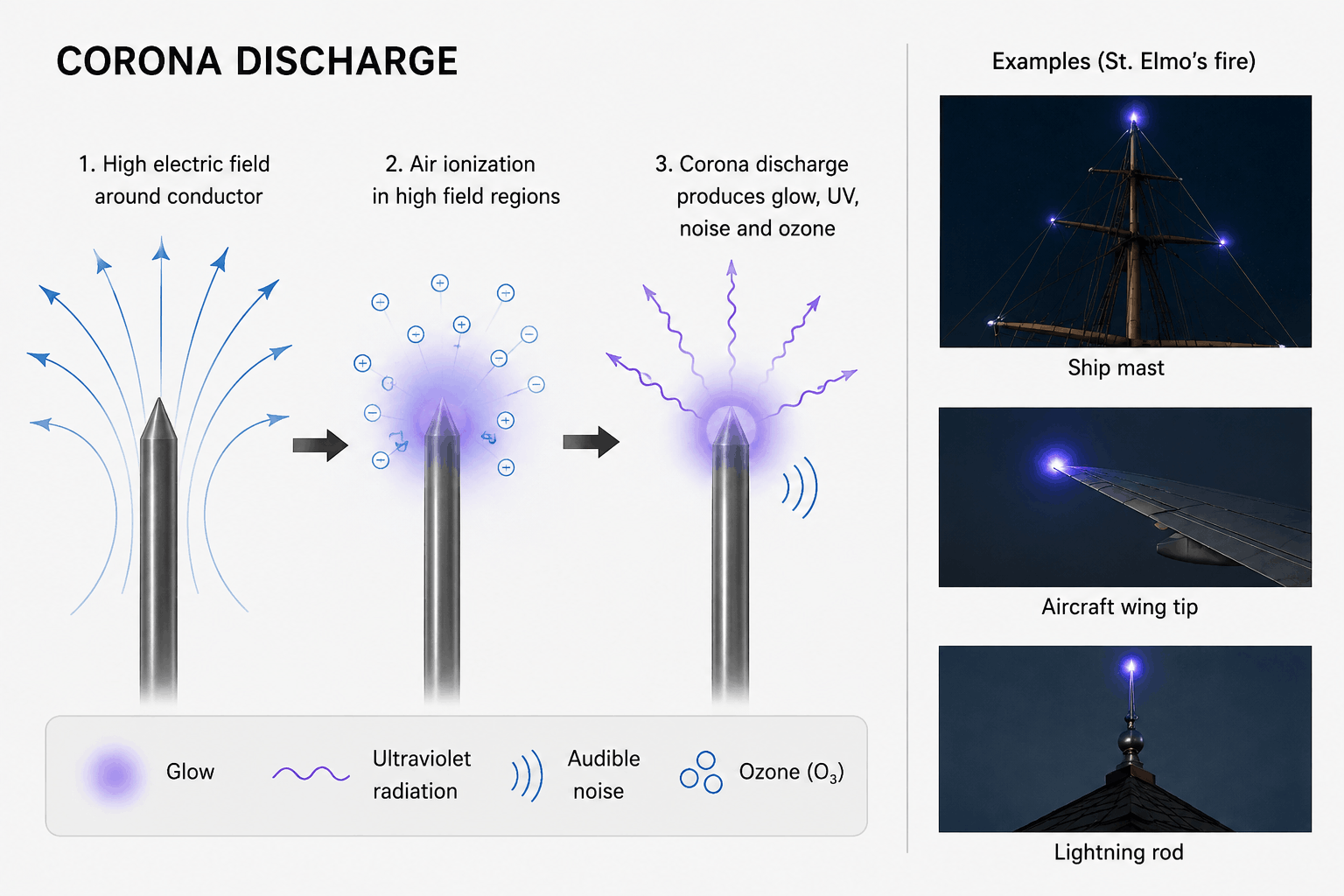
Corona discharge occurs when the electric field around a conductor becomes strong enough to ionize the surrounding air.
Instead of producing a complete electrical breakdown between two conductors, as happens with an arc or spark, the discharge develops locally around an area of high electric field strength. It is particularly likely near sharp edges, points, irregular surfaces and other locations where the electric field becomes concentrated.
The discharge can produce a faint blue or violet glow, along with ultraviolet radiation, audible noise and ozone.
St. Elmo’s fire is an atmospheric example of this process. The World Meteorological Organization describes it as a luminous electrical discharge that can emanate from elevated objects such as lightning conductors, wind vanes and ship masts, as well as from aircraft wing tips.
In other words, the strange glow sailors once saw above their ships and the corona engineers detect around high-voltage equipment are related manifestations of the same underlying phenomenon: ionization of the surrounding air in a strong electric field.
High-voltage systems naturally create strong electric fields, so corona can occur around transmission lines, substations and other electrical equipment.
Its presence and intensity depend on several factors, including voltage, geometry, surface condition and the surrounding environment.
Potential locations include conductors, insulators, connectors, bushings and fittings. Contamination, rain, damaged components, poor electrical contacts and structural defects can also alter the local electric field and increase discharge activity.
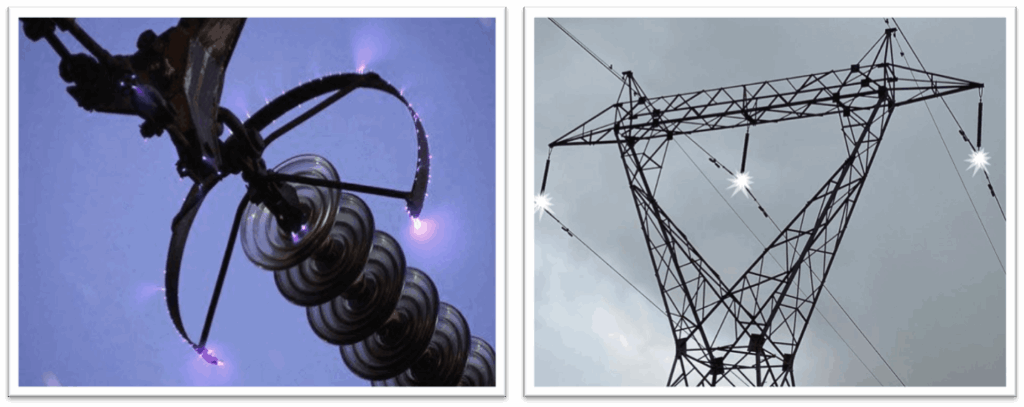
A damaged conductor provides a straightforward example. A smooth conductor distributes the electric field relatively evenly. When individual strands become damaged or fractured, sharp points can concentrate the field over a much smaller area. Under the right conditions, the surrounding air begins to ionize and corona appears.
From an inspection perspective, this makes corona useful. It can reveal electrical activity associated with a developing condition that may not be obvious during a conventional visual inspection.
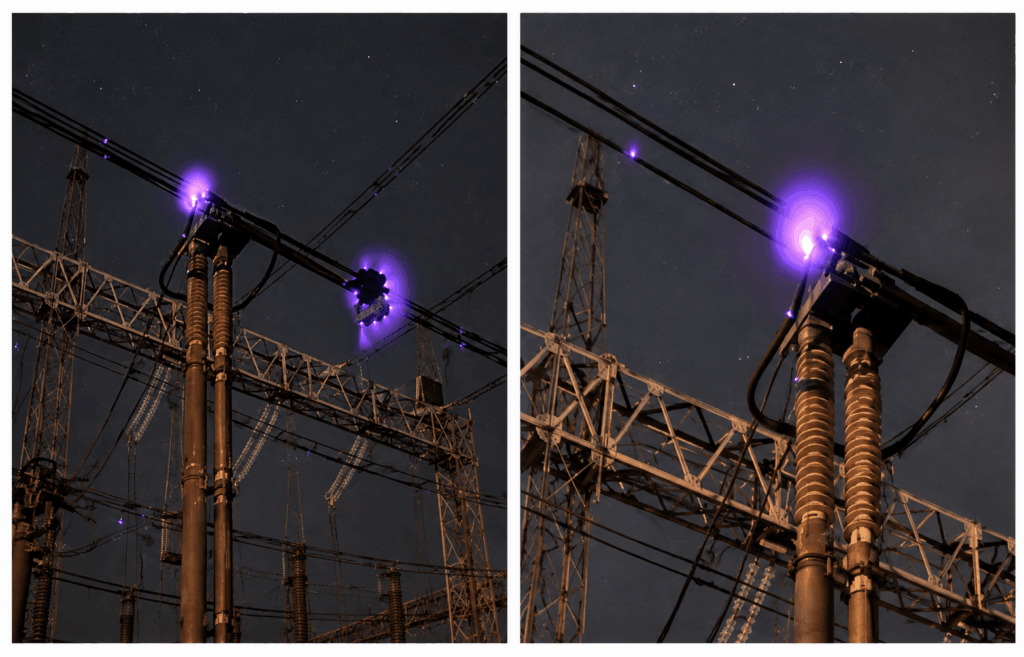
Not every instance of corona means that a component is about to fail. Unwanted or persistent corona, however, can contribute to several problems in high-voltage systems.
The discharge consumes energy and can produce audible noise, electromagnetic interference and ozone. More importantly from an asset maintenance perspective, sustained electrical activity can contribute to the deterioration of insulating materials and other components.
Research on high-voltage equipment has associated corona with insulation aging, cracking and eventual insulation failure.
This can create a gradual maintenance problem. A relatively small electrical anomaly may continue for months or years before the resulting damage becomes severe enough to cause an obvious failure.
Early detection of abnormal discharge can therefore be valuable. Rather than waiting for visible damage, overheating or equipment failure, maintenance teams can identify areas of electrical activity and investigate the underlying cause.
Some corona discharge is visible to the human eye in darkness. Under normal daytime inspection conditions, however, the emitted light can be extremely difficult to distinguish.
Corona also does not necessarily produce a strong thermal signature
This limits what conventional RGB and infrared cameras can reveal. A component may look normal in visible light and may not yet show significant heating, even while electrical discharge is taking place.
Corona provides another signal that can be detected: ultraviolet radiation
Electrical corona emits radiation across part of the ultraviolet spectrum. For outdoor inspection, one region is particularly useful — approximately 240 to 280 nanometers.
This wavelength range is commonly known as the solar-blind UV band. Solar radiation in this part of the spectrum is strongly absorbed by the atmosphere before reaching the Earth’s surface. A detector designed for this band therefore operates against a much darker daytime background than a conventional optical camera.
As a result, weak UV emissions from electrical discharge can be isolated more easily, even during daylight hours.
Modern systems can combine ultraviolet detection with a conventional visible image. The UV channel detects emissions from the electrical discharge, while the RGB channel provides the visual context needed to determine where that activity is occurring.
The resulting image can show a cluster of UV activity directly over the corresponding insulator, conductor or fitting.
Some systems add infrared imaging as well. That gives inspectors three complementary views of the same asset:
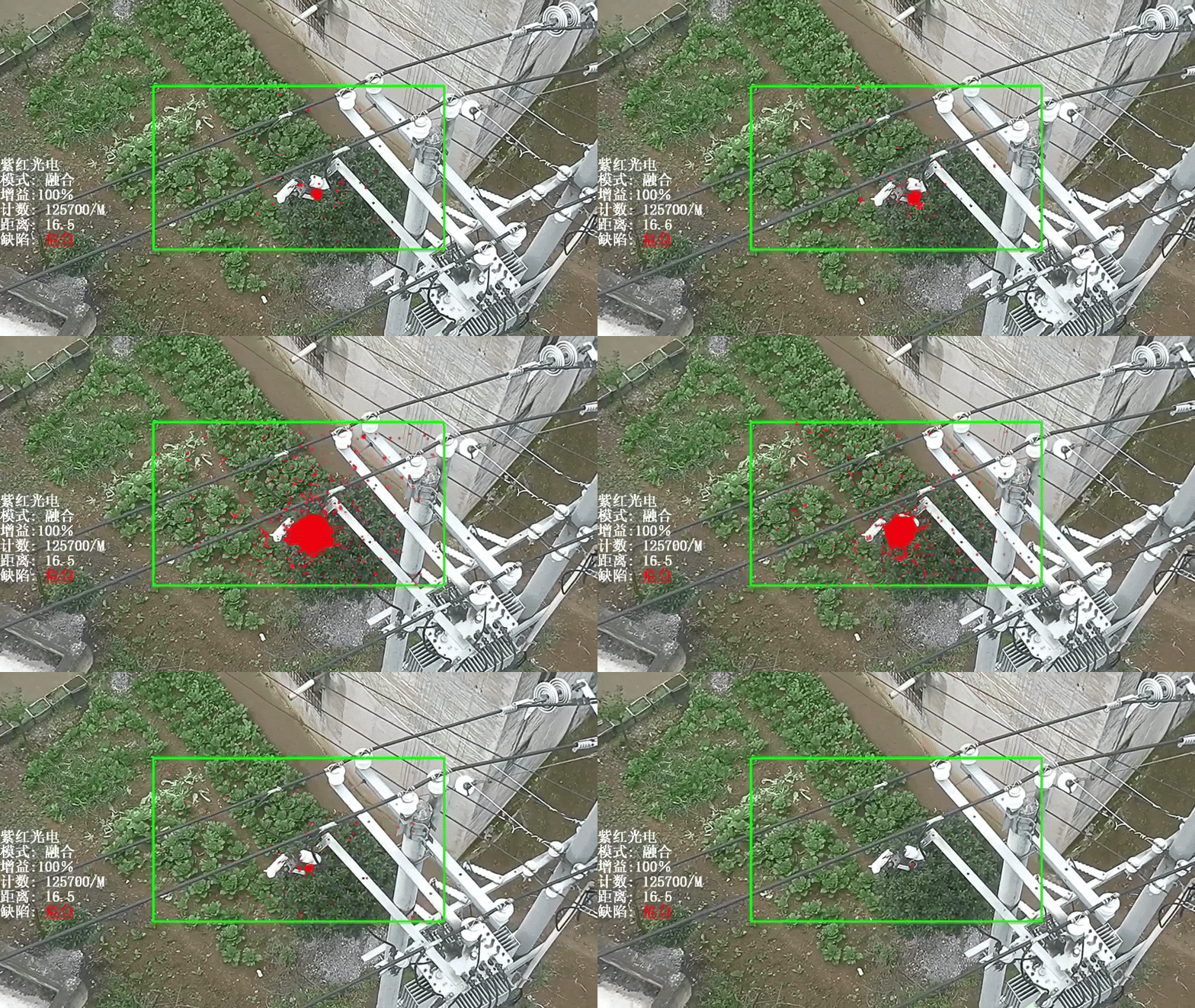
Each channel is looking for something different. Together, they can provide a much more complete picture than any one sensor alone.
There is still an important limitation: detecting corona is not the same as diagnosing the defect.
The camera tells an inspector that electrical discharge is occurring and helps locate it. Engineers still need to interpret the finding in the context of the equipment, operating voltage, environmental conditions and discharge intensity before deciding what maintenance is required.
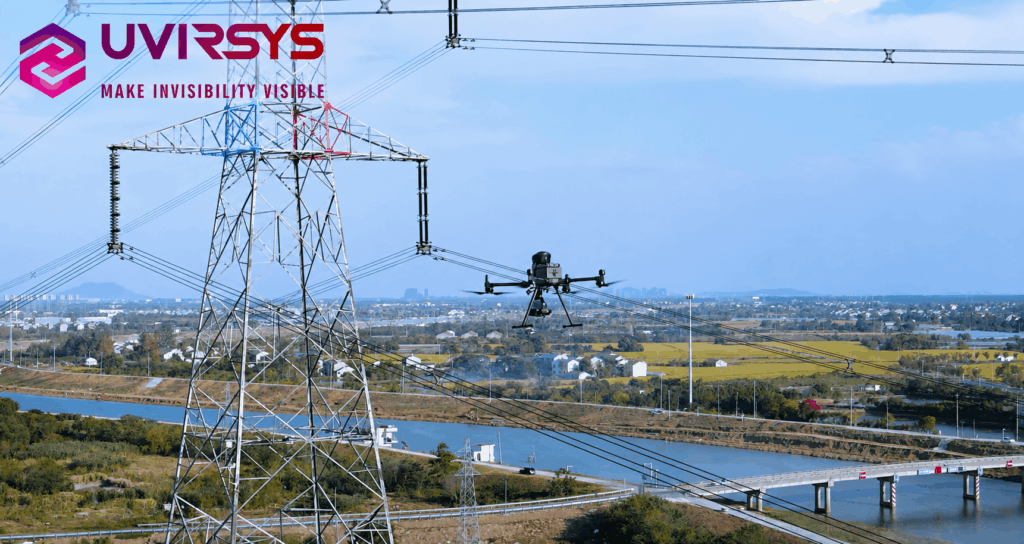
Ultraviolet cameras can be used from the ground, but high-voltage infrastructure creates an obvious problem: many of the components that need to be inspected are high above the inspector and difficult to view from the right angle.
Distance matters as well, since corona emissions can be weak.
A drone changes the inspection geometry. Instead of observing an insulator from tens of meters below, an unmanned aircraft can carry the sensor closer to the equipment while maintaining an appropriate safety distance. It can also approach the same component from different viewing angles.
This is particularly useful for transmission towers, overhead lines and substations, where the structures themselves can obscure parts of the equipment from ground level.
The approach has also been demonstrated outside commercial camera applications. NASA has tested UAVs equipped with ultraviolet sensors for autonomous inspection of high-voltage transmission structures. During the tests, airborne sensors measured UV emissions, while GPS data helped locate the source.
The goal is straightforward: turn a difficult manual inspection into a repeatable aerial data-collection process.
The value of putting a UV camera on a drone becomes clearer when distance and viewing angle are measured rather than discussed in theory.
A 2019 study published in Optics and Precision Engineering tested a UAV-based method for detecting and locating corona discharge on power-line insulators. The researchers observed the same transmission structure from two different angles and used the measurements to determine the position of the defective insulator.
Their experiments also showed how much inspection geometry matters. As the distance between the detector and UV source increased, the measured UV signal decreased, although the relative measurement error remained within 11.5% across the tested distances. The most accurate results in their UV LED tests were obtained at viewing angles of 0° and 15°.
This helps explain one of the practical advantages of UAV inspection: the aircraft can move the sensor into a position where both distance and angle are more favorable instead of relying on a fixed observation point on the ground.
Current inspection hardware is increasingly designed around this approach. UVIRSYS offers UAV-mounted corona cameras such as the ZH480-UAV and multispectral ZH580-UAV, while third-party integrations now pair the ZH480 with DJI’s Matrice 400 platform.
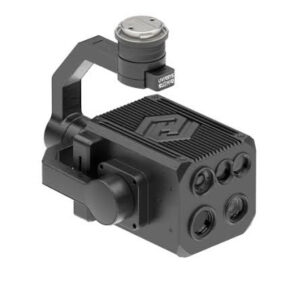
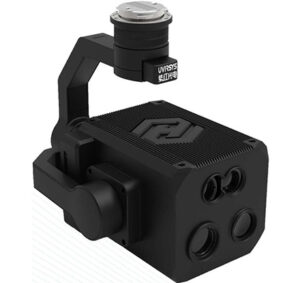
UAV platform | UV camera | Key specifications | Best suited for |
240–280 nm UV + 4K RGB; 1 pC at 15 m; 300 g camera; up to 49 min flight time | Lightweight, rapid field inspections | ||
240–280 nm UV + visible + laser; 520 g camera; 6 kg UAV payload; up to 59 min flight time | Longer, more complex infrastructure inspections |
Both configurations use solar-blind UV detection to identify corona in daylight. The main difference is scale: the Matrice 4T setup prioritizes portability, while the Matrice 400 offers greater payload capacity and flexibility for more demanding inspection missions.
*The ZH480 Mini + Matrice 4T is offered as a third-party integration. Compatibility should be confirmed for the specific installation.
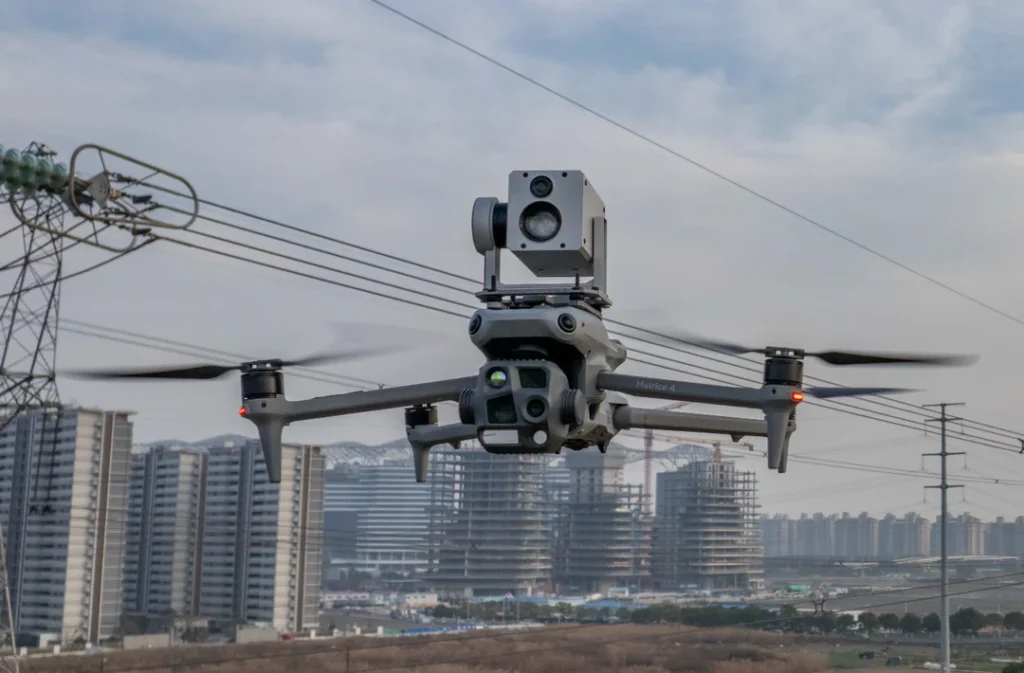
For centuries, corona discharge was something people could observe without understanding. St. Elmo’s fire glowing above a ship mast was dramatic enough to become part of maritime folklore.
Modern power infrastructure presents the opposite problem. Corona can be important precisely when it is difficult to see.
Solar-blind UV imaging gives engineers a way to detect that electrical activity during normal daytime operations. Mounting those sensors on drones extends their reach to equipment that is difficult to inspect safely and effectively from the ground.
Combined UV, infrared and visible imaging takes the concept further by giving maintenance teams several views of the same asset in a single inspection.
The physics behind corona discharge is old. The ability to find, locate and document it from the air is considerably newer — and it is becoming another useful tool for understanding the condition of increasingly complex electrical infrastructure.
Corona discharge occurs when a strong electric field ionizes the air around a conductor, creating a localized electrical discharge.
It can result from high voltage, damaged conductors, sharp edges, contaminated insulators and other conditions that concentrate the electric field.
No. Partial discharge is a broader category of localized electrical discharges; corona is one type that occurs through ionization of the surrounding gas, usually air.
Common methods include UV imaging, acoustic detection and electrical measurements. UVIRSYS cameras such as the ZH480-UAV and multispectral ZH580-UAV are designed for UV-based corona detection, including drone inspections.
A UV corona camera detects ultraviolet radiation emitted by electrical discharges, allowing corona activity to be identified even during daylight.
Drones bring UV cameras closer to high-voltage equipment and provide better viewing angles, making difficult-to-access components easier to inspect.
Yes. Persistent corona can contribute to energy losses, interference and insulation degradation, potentially shortening equipment life.