Reliable communication is essential for autonomous drone operations. As mission areas grow larger and more complex, a single DJI Dock may not always provide sufficient coverage across the entire flight area.
The DJI O4 Ground Station addresses this challenge by extending communication beyond the Dock itself. It combines a 12-antenna transmission system, automatic multi-band frequency selection, integrated GNSS, and two operating modes. Depending on the deployment, it can work either as a network-connected gateway or as a traditional relay station.
In this article, we’ll look at how the O4 Ground Station works, what Gateway Mode changes, how Signal Map supports mission planning, and where the system fits into larger autonomous drone operations.
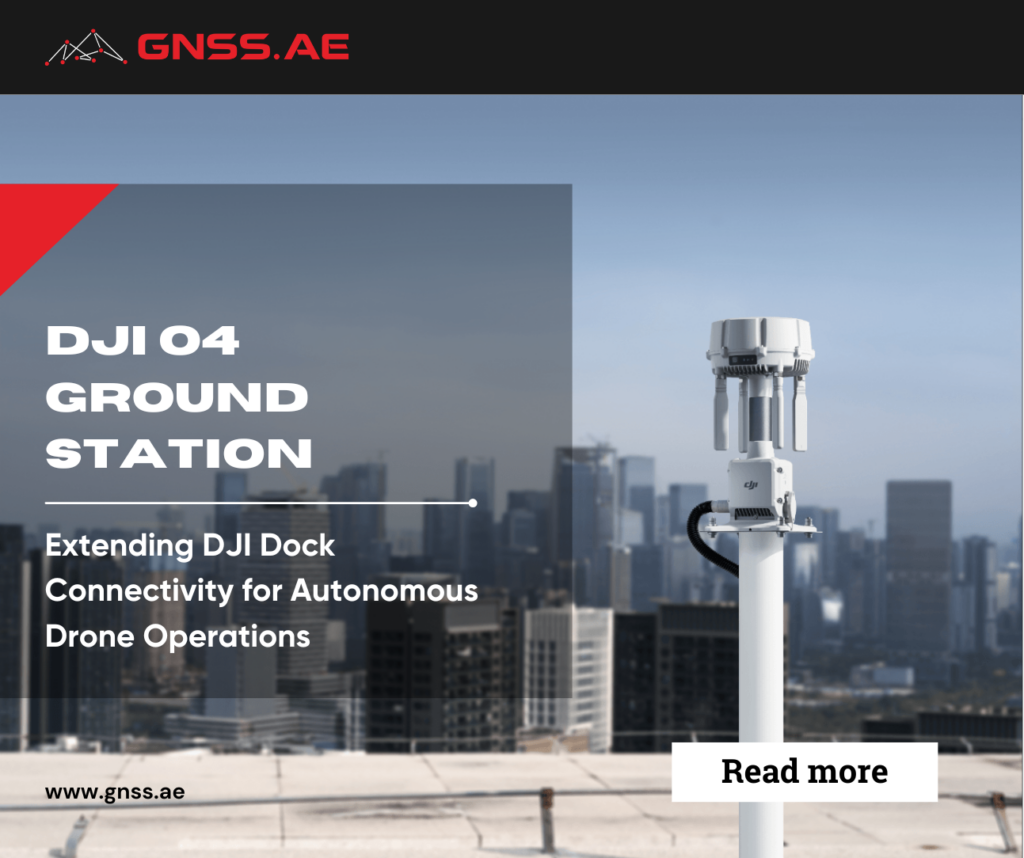
The DJI O4 Ground Station is a dedicated communication device that extends and improves connectivity for DJI Dock deployments. While the earlier D-RTK 3 could function as a relay station, the O4 Ground Station introduces Gateway Mode, giving operators much more flexibility when deciding where communication equipment should be installed.
Inside, the unit combines high-performance RF communication hardware, a 12-antenna array, and an integrated GNSS module to support reliable positioning and long-range data transmission.
“The ground station is not just an extension antenna. It gives us new capabilities for how we deploy and operate DJI Dock systems.”
Ahmed Sami, Solution Engineer and Technical Support at DJI Enterprise KSA
Specification | DJI O4 Ground Station |
Weight | Approx. 3 kg |
Dimensions | 350 × 170 × 170 mm |
Antenna system | 12 high-gain omnidirectional antennas |
Supported frequencies | Sub-2G, 2.4 GHz, 5.2 GHz, 5.8 GHz |
GNSS support | 5 satellite systems, 19 frequencies |
Protection rating | IP67 |
Impact resistance | IK07 |
Operating temperature | -20°C to +55°C (standard operation) |
Low-temperature operation | Down to -40°C with increased power supply |
Maximum operating altitude | Up to 6,000 m |
Typical power supply | Up to 70 W |
Standby power consumption | Approx. 7 W |
The O4 Ground Station supports two operating modes, each designed for different deployment scenarios.
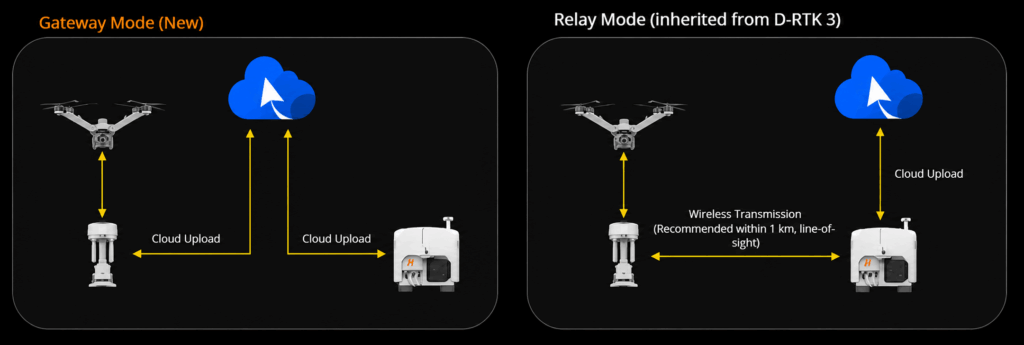
Gateway Mode is the most significant addition introduced with the O4 Ground Station. In this configuration, the station connects to FlightHub 2 through an Ethernet connection or DJI Cellular Dongle 2. Compatible aircraft operating with DJI Dock 3 then use the station as their communication gateway.
Its biggest advantage is deployment flexibility.
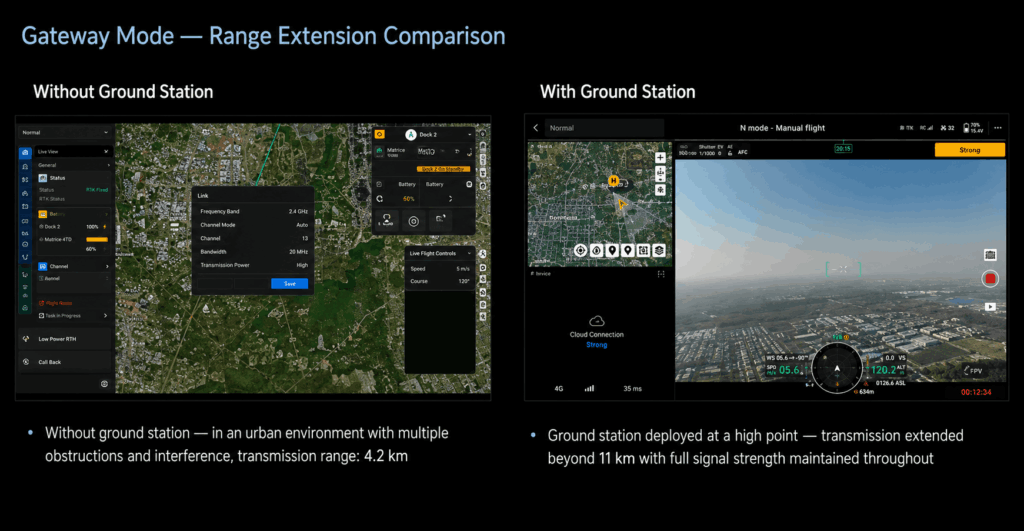
Unlike previous relay-based setups, the ground station no longer needs to be installed beside the Dock. According to DJI, Gateway Mode places no deployment-distance restriction between the O4 Ground Station and DJI Dock 3. Instead, the practical limitation depends on the network connection, with Ethernet cable runs supported up to 100 meters.
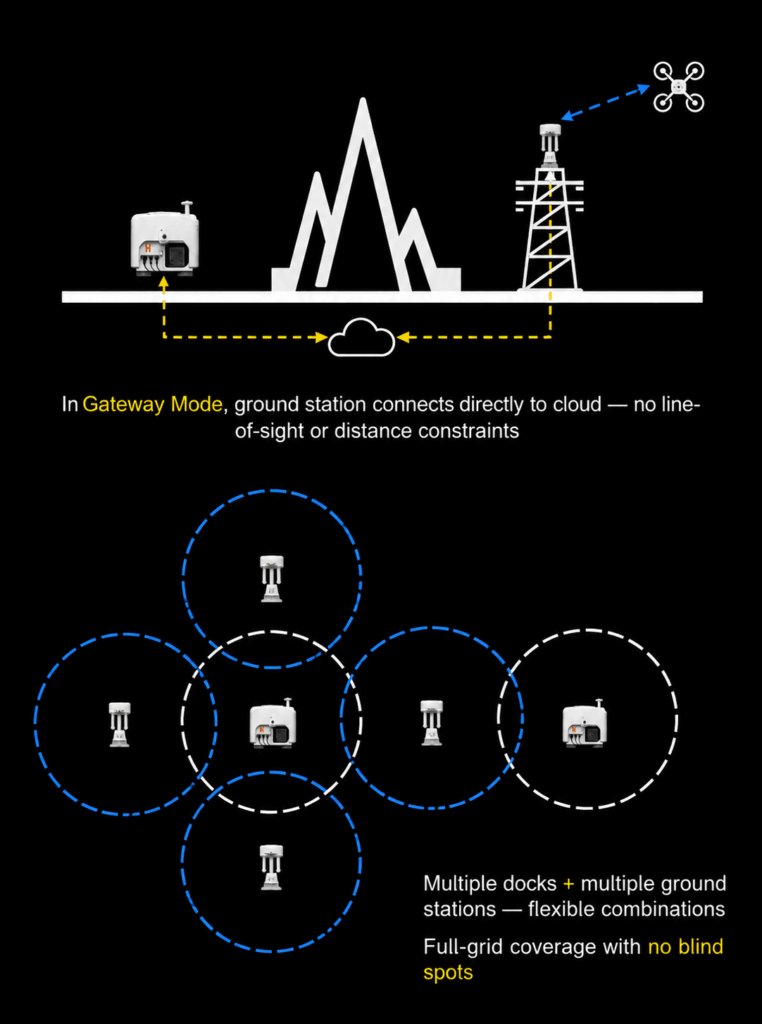
This allows operators to install the ground station wherever radio coverage is strongest—such as on a communications tower, rooftop, or elevated structure—while positioning the Dock where it best supports flight operations.
For example, a Dock could remain inside an industrial facility while the O4 Ground Station is mounted on a nearby tower. Because communication between them is carried over the network, the two installations do not require a direct radio link.
While Gateway Mode is the headline feature of the DJI O4 Ground Station, the device also supports Relay Mode—an updated version of the relay functionality previously available with the DJI D-RTK 3.
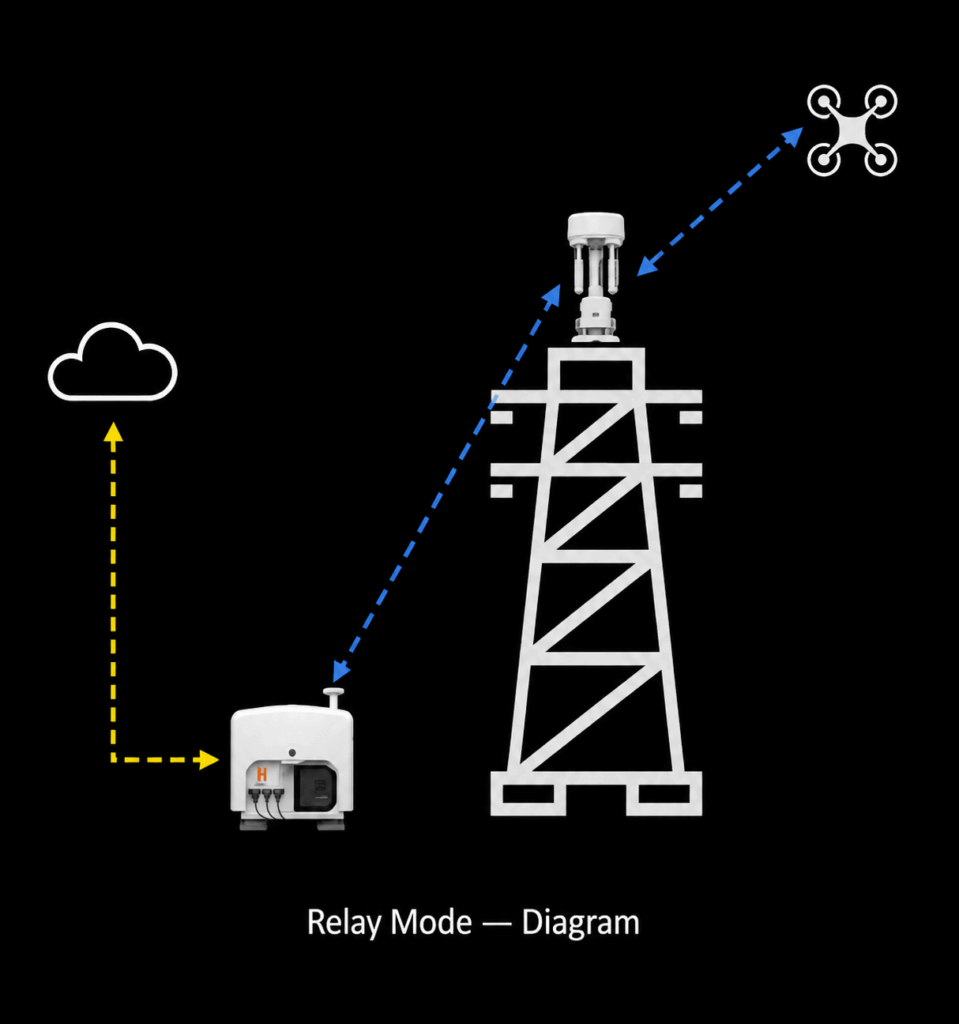
In Relay Mode, the O4 Ground Station acts as a communication bridge between the DJI Dock and the aircraft. Unlike Gateway Mode, it operates without an internet connection or cloud services.
The communication path is straightforward:
DJI Dock → O4 Ground Station → Drone
Relay Mode is designed for situations where buildings, terrain, or other obstacles weaken the direct link between the Dock and the aircraft.
For example, a Dock installed behind a mountain or a large industrial facility may have limited radio visibility. Placing the O4 Ground Station on higher ground or another unobstructed location allows it to relay the signal and maintain a more reliable connection with the drone.
Although both modes extend communication range, they solve different operational challenges.
Gateway Mode | Relay Mode | |
Network connection | Required | Not required |
Connection architecture | Ground station → network → FlightHub 2 | Ground station as direct communication relay |
Deployment relative to Dock | Flexible | Recommended within 1 km |
Main advantage | Flexible placement and wide-area coverage | Extends communication where direct line of sight is blocked |
Typical environment | Large autonomous operating areas | Remote or obstructed areas |
One of the most practical additions to the DJI O4 Ground Station is Signal Map.
Instead of relying on signal estimates, the system records actual communication quality throughout the operating area. It divides the mission area into hexagonal cells and assigns each one a color based on measured signal strength:
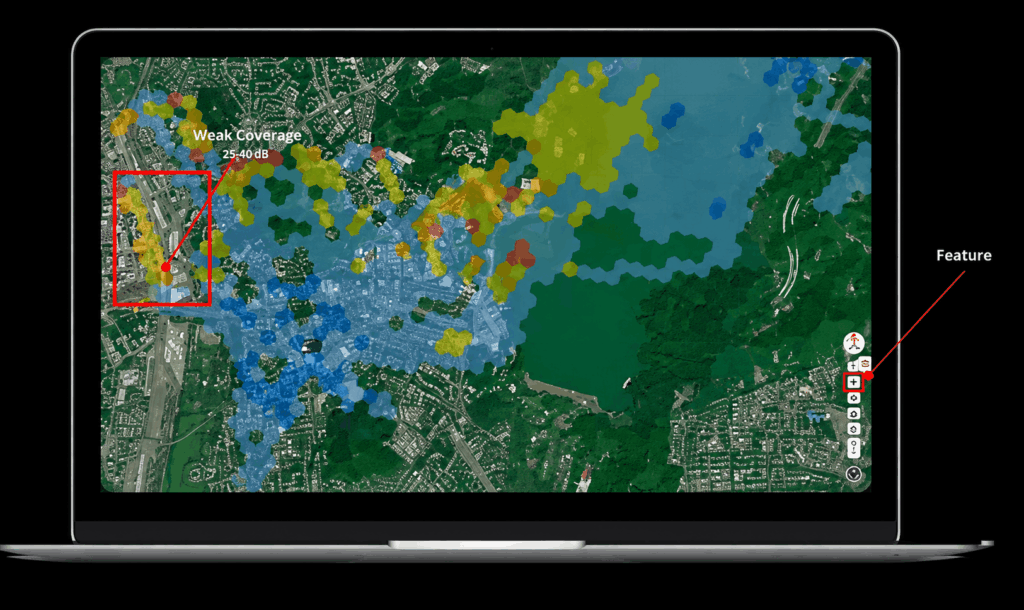
This gives operators a clear picture of where communication quality may become an issue, making it easier to plan routes and avoid weak coverage areas.
Signal Map is especially valuable in environments where radio conditions vary significantly, including:
Signal Mapping does not require a separate surveying process. The map is gradually created and updated during flights. During the first operation, only limited information may be available. As the drone continues flying through different areas, additional cells are added and stored in DJI FlightHub 2.
Operators can view Signal Mapping data directly inside the virtual cockpit and use it during manual flights to avoid weak coverage zones.
It is also important to note that Signal Map data is related to a specific dock. If multiple docks are operating in the same area, each dock has its own communication map. A strong signal area for one dock does not necessarily mean the same performance for another.
A 12-antenna array helps the O4 Ground Station maintain a stable connection across a wide range of operating environments. Four antennas are mounted externally, while eight are integrated into the enclosure. Using both horizontal and vertical polarization, the system provides more consistent omnidirectional coverage around the station.
Rather than relying on a fixed frequency, the O4 Ground Station automatically switches to the band best suited to current operating conditions. Supported frequency bands include:
Available bands depend on the aircraft, operating mode, country, and local regulations. In supported regions, the Matrice 400 can use the Sub-2 GHz band, which offers longer communication distances than the higher-frequency options.
Under IC compliance and in interference-free, unobstructed conditions, DJI specifies a maximum transmission distance of up to 40 km between the Matrice 400 and the O4 Ground Station. For other compatible aircraft, the published maximum reaches up to 30 km.
Built for permanent or semi-permanent outdoor deployment, the O4 Ground Station carries an IP67 ingress-protection rating and IK07 impact resistance. DJI specifies an operating temperature range of -40°C to 55°C, provided the appropriate power supply is used, and supports installation at altitudes of up to 6,000 m.
Power requirements vary depending on operating mode and ambient conditions. The station supports PoE through its Ethernet ports, with different PoE power classes recommended for specific temperature ranges. When no aircraft is connected, a low-power mode reduces the unit’s own consumption to approximately 7 W.
A built-in backup battery keeps the station operating if PoE power is unexpectedly interrupted. Under DJI’s specified test conditions, it can continue running for approximately 45 minutes in Gateway Mode or 30 minutes in Relay Mode, helping maintain connectivity during temporary power outages.
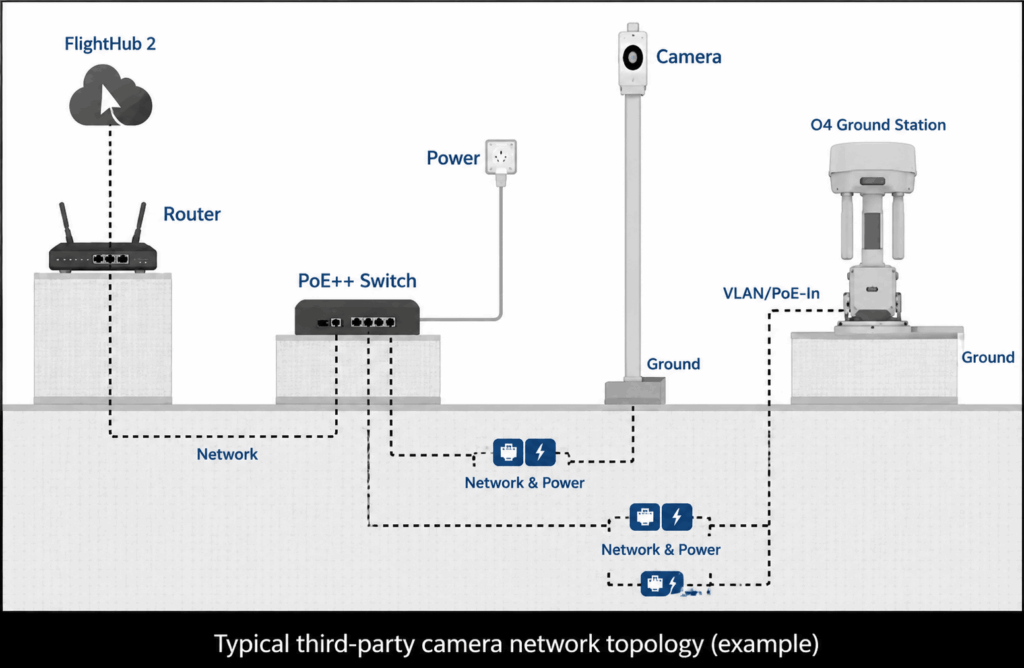
Beyond extending radio coverage, the O4 Ground Station can also act as a hub for equipment installed around the Dock. Its LAN interface supports compatible third-party devices, while Gateway Mode provides network connectivity for cloud platforms and external software.
This allows operators to build additional functionality around autonomous drone operations. Depending on the deployment, the O4 Ground Station supports:
For example, an IP camera can continuously monitor the area around a Dock while the drone carries out inspection or surveillance missions. At the same time, external detection systems can provide additional situational awareness by tracking nearby aircraft and supplying operators with another layer of operational information.
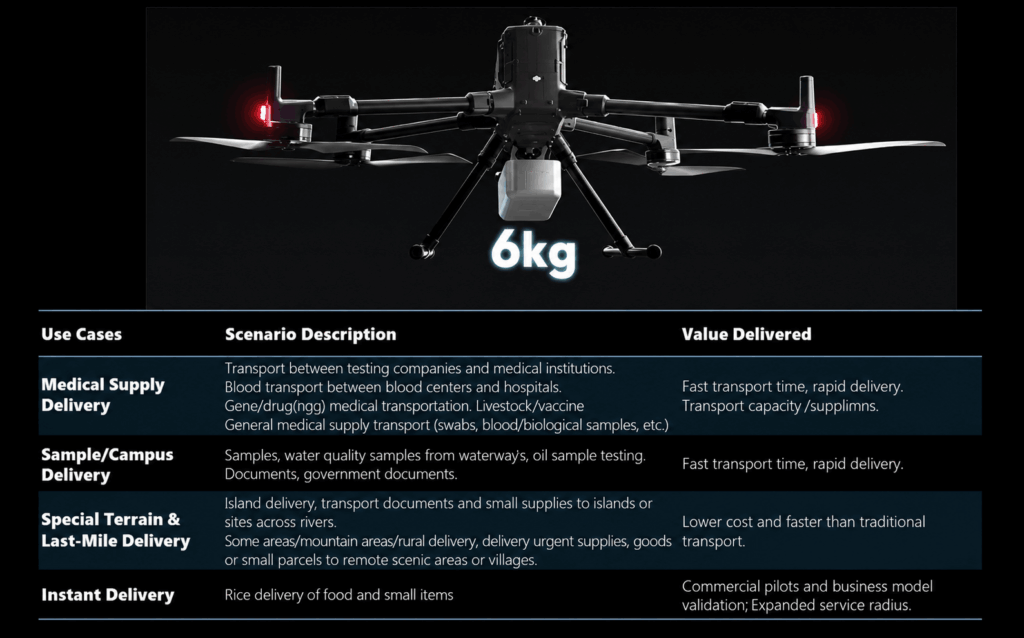
An upcoming M400 Delivery Mode is designed to support distributed delivery operations with the DJI Matrice 400. The feature will allow the aircraft to move between multiple predefined locations along a route instead of completing the entire mission from a single takeoff and landing point.
A key part of the concept is multi-point hopping. The Matrice 400 can move between several designated points, landing at intermediate locations when required. These points can be used for cargo delivery, battery replacement, or other operational stops before the aircraft continues to the next stage of the route
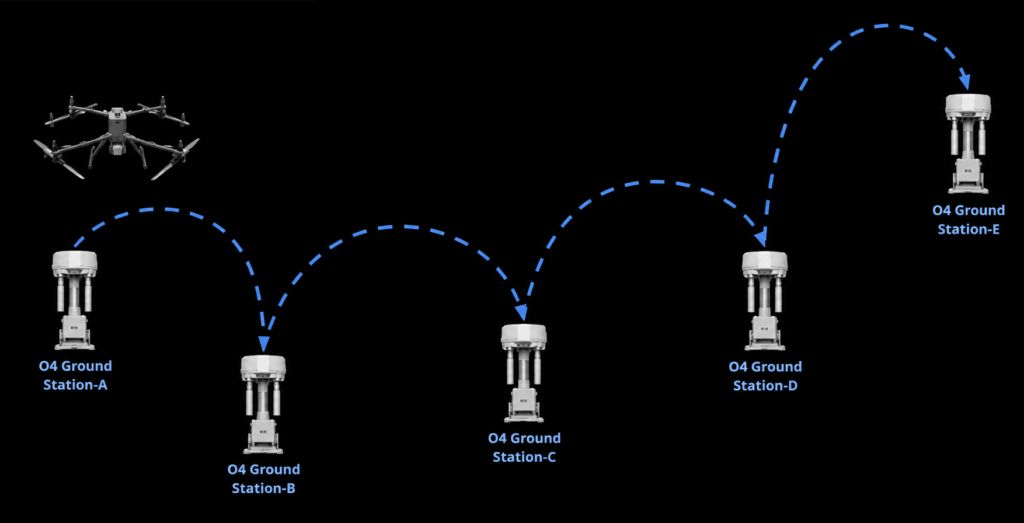
A typical route could include:
Battery swapping is particularly important for longer routes. After a battery is replaced, the aircraft can reconnect to the system and continue the planned mission. This makes it possible to divide a long delivery operation into several flight segments rather than relying on a single battery cycle.
The delivery configuration supports a cargo box with a capacity of up to 6 kg and a volume of approximately 14 liters. The maximum flight speed in this configuration is limited to 17 m/s.
The O4 Ground Station provides the communication infrastructure between the distributed operating points. Combined with FlightHub 2 and the Matrice 400, the upcoming feature is intended to support multi-stage delivery routes with multiple takeoff, landing, battery-swap and delivery locations.
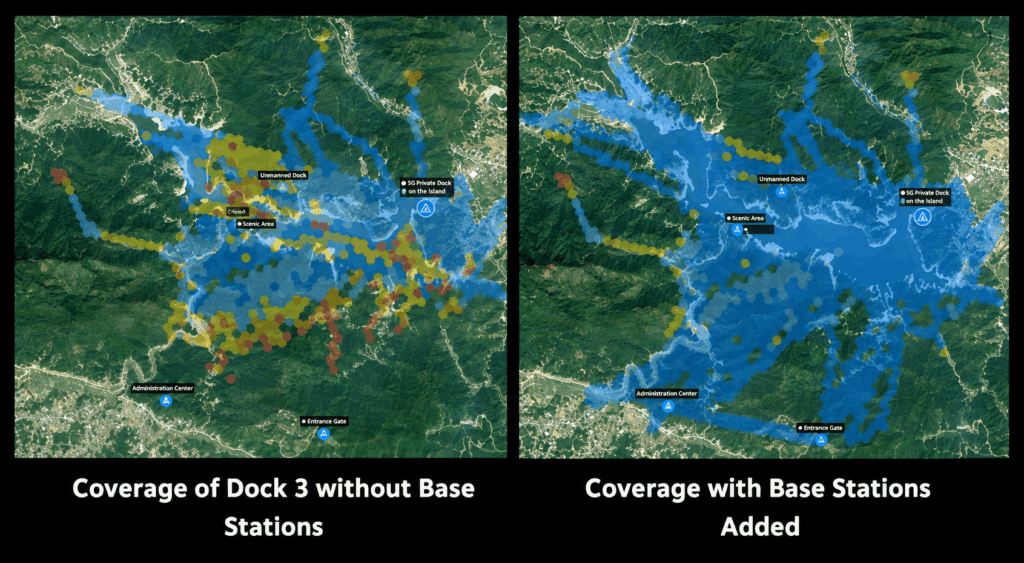
A practical example presented during the webinar focused on surveillance of a large reservoir.
The site covered approximately 25 km², with a shoreline stretching for nearly 58 km. Multiple inflow and outflow channels complicated aerial coverage, while several sections lacked reliable power and communications infrastructure.
To overcome these challenges, the deployment combined a DJI Dock with the O4 Ground Station to extend the effective operating area. Additional network equipment was installed where communication coverage was limited, and solar panels with battery systems powered stations in locations without access to the electrical grid.
The resulting coverage map showed a clear improvement in areas that previously experienced weak signal conditions. As a result, the drone was able to patrol sections of the shoreline that would have been difficult to reach reliably using the Dock alone.
According to the case study, a single patrol mission took approximately 20 minutes, covered around 80% of the wider surveillance area, and reduced operating costs by roughly 70%.
The system also proved its value during an actual surveillance incident involving suspected illegal fishing. While conducting a routine patrol, the drone captured imagery of the individuals, vehicles, and fishing equipment involved, including details that could help identify those responsible. According to DJI, the recorded footage was later used by the relevant authorities as supporting evidence.
Rather than replacing the D-RTK 3 Relay Station, the O4 Ground Station builds on the same concept with more capable hardware and a significantly more flexible operating architecture.
The most noticeable upgrade is the 12-antenna design, replacing the four-antenna configuration used by the D-RTK 3 Relay Station. It also introduces Gateway Mode, automatic multi-band frequency selection, low-power operation, IP camera connectivity, and broader integration with third-party systems.
At the same time, Relay Mode remains available, allowing organizations that rely on traditional relay-based deployments to continue using a familiar operating model while benefiting from the new hardware platform.
Feature | DJI O4 Ground Station | D-RTK 3 Relay Station |
Antennas | 12 | 4 |
Gateway Mode | Yes | No |
Relay Mode | Yes | Yes |
Automatic multi-band selection | Yes | No |
Sub-2 GHz support | Supported with applicable Matrice 400 configurations/regions | No |
Low-power mode | 7 W | — |
IP camera integration | Supported | No |
Remote ID / ADS-B ecosystem | Supported | No |
GNSS | 5 systems / 19 frequencies | Similar GNSS positioning role |
Main deployment advantage | Flexible network-connected infrastructure | Direct relay extension |
The biggest change introduced by the O4 Ground Station is not its transmission range or the number of antennas. It changes how communication infrastructure can be planned for autonomous drone operations.
With Gateway Mode, communication equipment can be installed where it delivers the strongest radio coverage rather than beside the Dock. Signal Map helps operators understand coverage across the mission area, while Relay Mode provides a practical option for deployments without reliable network connectivity. Support for IP cameras, ADS-B receivers, Remote ID receivers, and third-party systems also makes it easier to build a more integrated operational environment.
These capabilities become increasingly valuable as autonomous drone programs expand beyond occasional flights into routine operations across industrial facilities, utility networks, reservoirs, transport corridors, and other large sites.
Ultimately, the challenge is no longer just extending how far a drone can fly from its Dock. It is building a communication infrastructure that keeps the aircraft connected, supports reliable mission execution, and scales as operations grow.
The O4 Ground Station is designed to support that shift, giving operators more flexibility in how autonomous drone networks are deployed and managed.