Getting materials to the right place is a basic part of construction logistics. On an open site with good road access, trucks, forklifts and cranes already do that job efficiently. The equation changes when crews are working on rooftops, across rivers, along transmission lines or several kilometers into difficult terrain.
Heavy-lift drones are becoming another option for these jobs. Globally available platforms such as the DJI FlyCart 100 have entered the 100 kg payload class, while newer regional systems are pushing single-aircraft capacity to 200 kg and coordinated lifting considerably further..
Their role is still relatively specialized. But as payload capacity increases and flight management becomes more sophisticated, the range of construction operations that can be handled from the air is growing.
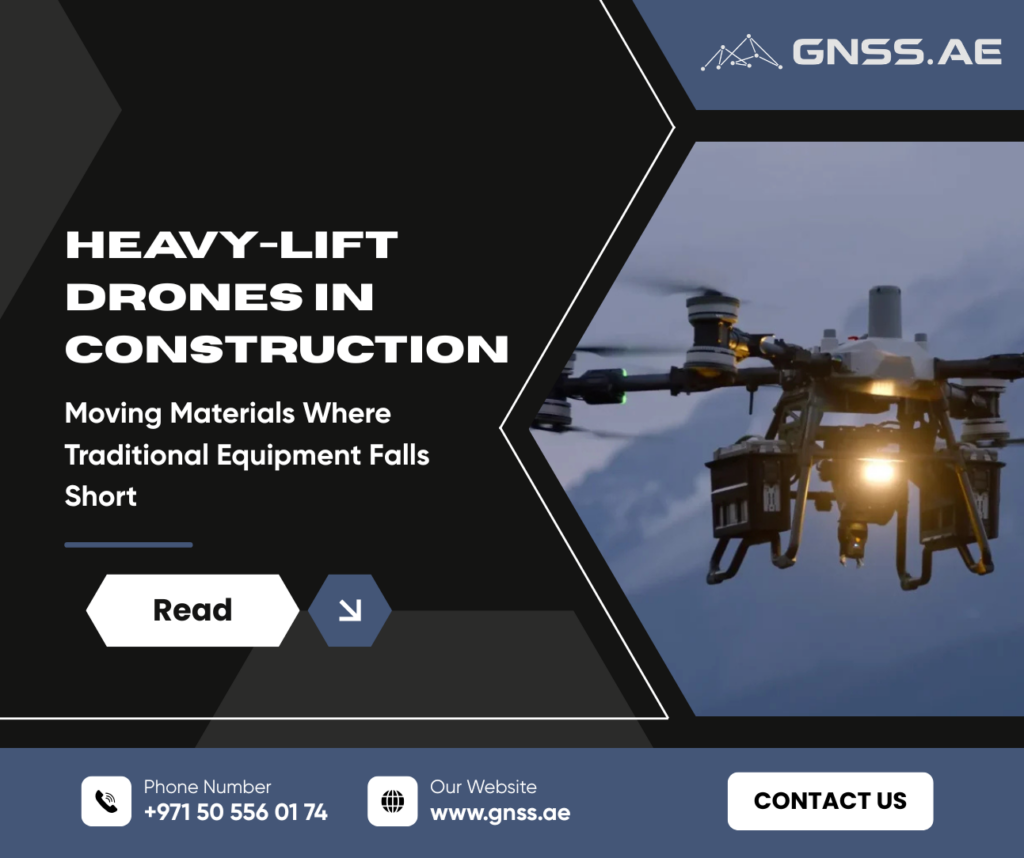
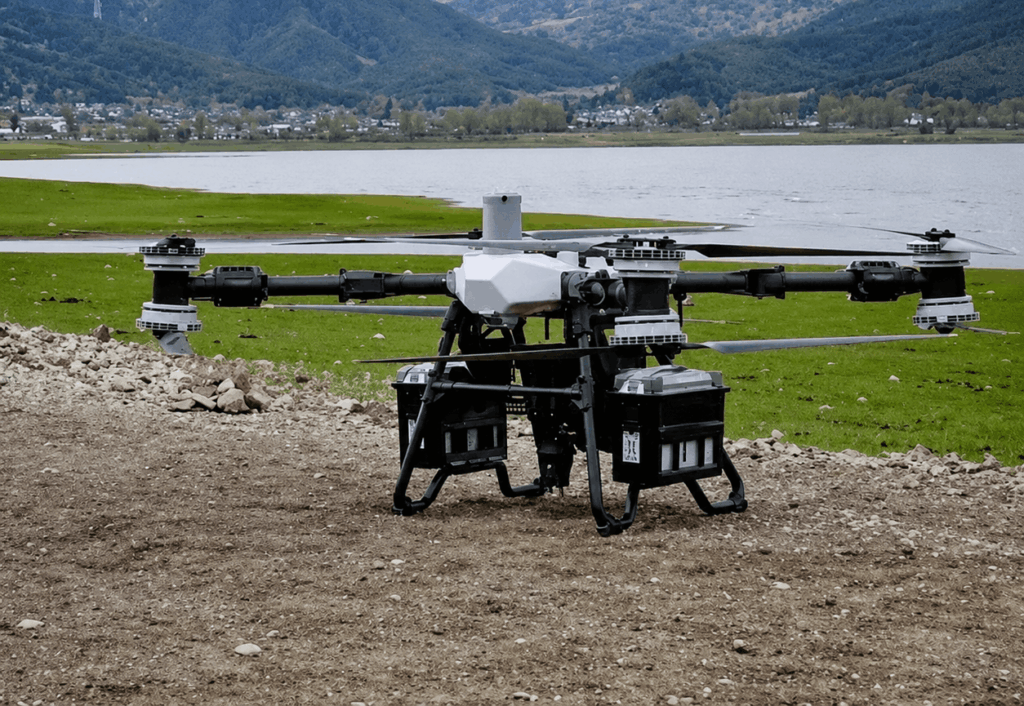
The DJI FlyCart 100 (FC100) gives a useful picture of where heavy-lift drone technology stands today. Released globally in late 2025, it combines a substantial payload with a powered winch, long-range flight capability and systems designed for operation in demanding environments.
Specification | |
Maximum payload | 100 kg with one battery; 85 kg with two batteries, measured at sea level |
Payload and distance examples | Up to 65 kg over 12 km with two batteries; up to 80 kg over 6 km with one battery under DJI test conditions |
Maximum route speed | 15 m/s on planned routes; up to 20 m/s in S mode |
Maximum altitude | 6,000 m above sea level with two batteries and no payload; payload decreases with takeoff altitude |
Positioning | RTK-assisted hovering accuracy of ±10 cm horizontally and vertically under strong GNSS conditions |
Safety | Integrated parachute; battery redundancy when operating with two batteries |
Payload, distance, speed and altitude figures represent separate maximum values and should not be interpreted as simultaneously achievable operating performance. Actual limits depend on battery configuration, takeoff altitude, weather, required energy reserve and local regulations.
Carrying construction materials from A to B is the most obvious application, but it is only one way to use this kind of aircraft.
DJI already lists construction, utilities, emergency response, firefighting, transport over water and general logistics among the main applications for its delivery platform.
On a construction site, the payload could be power tools, batteries, cable hardware, fittings, replacement parts or packaged materials. Utility crews can use the same lifting capacity for tools and equipment along power infrastructure. Emergency teams can move supplies into areas where road access has been disrupted.
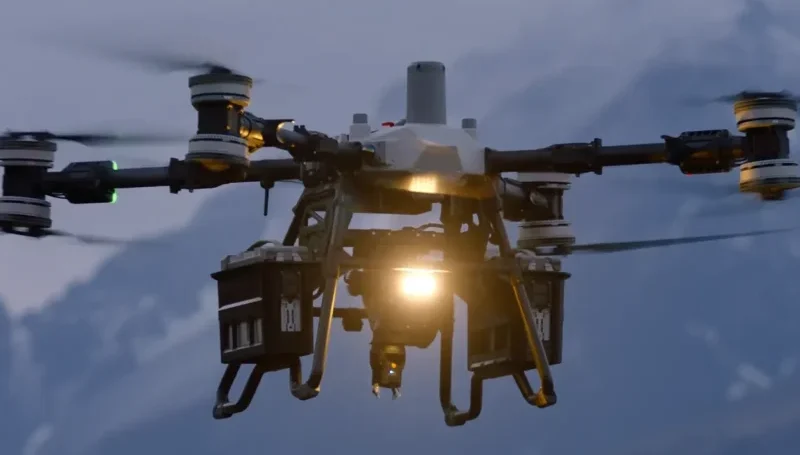
The aircraft itself also carries spotlights for safer operation in low-light conditions. More broadly, the ability to hold or position a payload in the air opens the door to specialized attachments developed around particular industries rather than limiting the platform to boxes and cargo.
The clearest applications are jobs where the material is manageable but getting it to the work area is difficult.
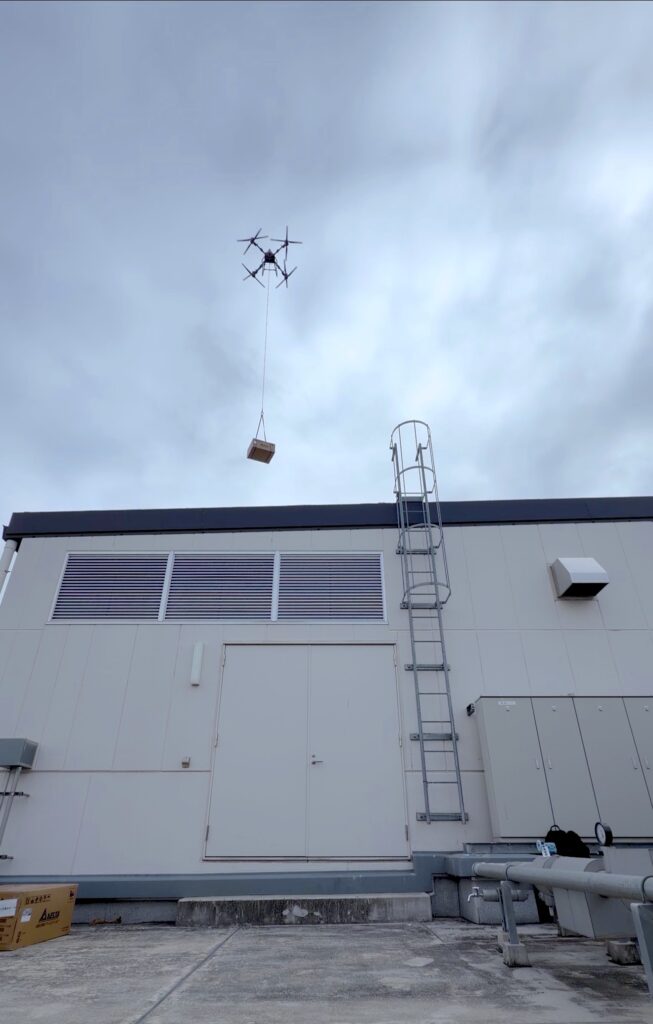
In March 2026, Japanese drone operator SKYSHIFT used a FlyCart 100 to transport construction materials directly to the roof of a factory in Osaka.
The site had no available elevator, while the building layout, nearby power lines and other restrictions prevented a crane boom from reaching the roof. Conventional delivery would have required significantly more manual handling and labor.
The FC100 provided a direct ground-to-roof route instead.
This is a relatively simple example, but it illustrates an important use case for urban construction and renovation. A drone does not need to replace the site’s crane. It can handle specific lifts where crane access is unavailable or impractical.
The same idea becomes more valuable as horizontal distance and terrain increase.
Transmission lines, railways, roads, telecom infrastructure and renewable-energy projects can stretch across kilometers of undeveloped land. Crews may be separated from staging areas by forests, steep slopes, rivers or incomplete roads.
Ground logistics have to follow the terrain. A drone can often fly directly over it.
Tools, batteries, electrical components and replacement equipment can therefore move between a central staging point and active work areas without every destination requiring vehicle access.
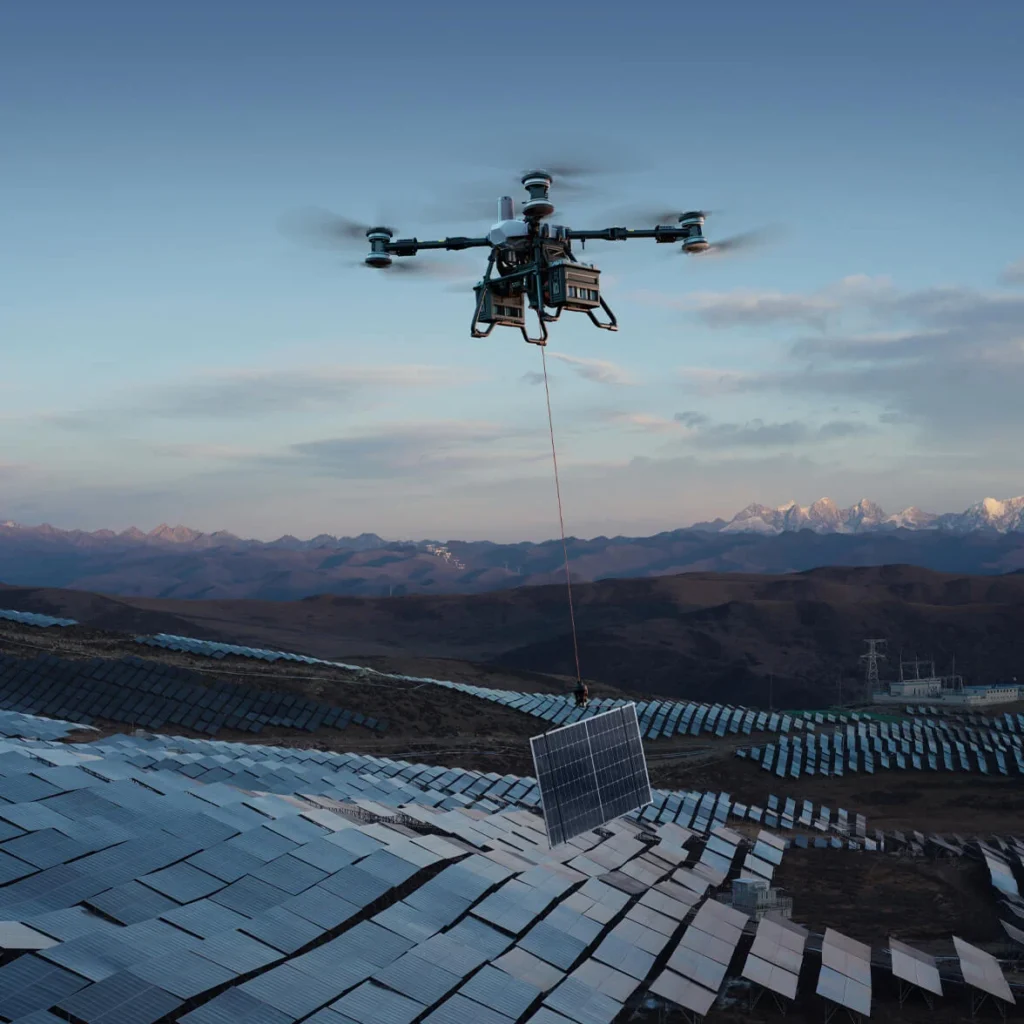
Winch delivery extends that reach further. A suitable landing area is not always necessary: the aircraft can hover above the destination and lower the load to workers below.
Some of the most interesting applications go beyond conventional cargo delivery.
At the Big Bar Ferry in British Columbia, Canadian Wire Rope Works and Upslope Millwright & Rigging needed to install a lightweight high-strength pulling line across approximately 1,100 feet of the Fraser River as part of maintenance work.
The traditional approach involved a manned trolley system and manual placement of support equipment. Instead, In Flight Robotics deployed a FlyCart 100 for logistical support and the line pull itself.
The drone first transported batteries, rigging components and landing-zone equipment across the river. It then performed the main pull with an average line load of around 35 kg.
The actual line pull took about seven minutes. The complete operation involved nine flights over roughly three hours.
This is a useful example because the drone was participating in the infrastructure work itself, rather than simply delivering a box to a crew.
There is also a less dramatic application that could matter on everyday projects.
If a crew working on a tower, roof or remote section of a site needs another battery, tool or replacement component, retrieving it may require someone to leave the work area and make the journey to a staging point.
A drone allows the material to move while the worker stays where the productive work is happening.
The same route can operate in reverse. Tools, removed components and other loads can be flown back instead of being carried manually across the site.
A single drone carrying a component to a rooftop solves a specific transport problem. The more interesting development is what happens when heavy-lift UAVs begin working as part of a coordinated logistics system.
DJI DeliveryHub already provides some of the infrastructure for this with the FC100 and FC30. The cloud platform brings route planning, task allocation, operational monitoring and team-resource management into one system. Routes can also be generated using digital elevation model data, which is particularly useful for infrastructure projects spread across uneven terrain.
DJI’s FC200, introduced in China in April 2026, takes coordinated lifting further. DJI rates the aircraft for a maximum individual payload of 200 kg. With the multi-drone coordination kit, one controller can command a formation of two to four aircraft, while four FC200s can carry a combined load of up to 600 kg. Availability and approved operating configurations may differ by market.
For construction, this creates possibilities beyond routine material delivery. Individual drones could move tools and components between work areas, while coordinated formations could handle heavier or oversized loads that exceed the capacity of a single aircraft.
Construction has always had two related problems: building something and getting people, tools and materials to the place where that work is happening.
Heavy-lift drones are beginning to change the second one.
With payloads now reaching around 100 kg, powered winches, increasingly sophisticated obstacle sensing and centralized operations software, these aircraft can do considerably more than deliver small packages.
The strongest applications are likely to remain highly practical: carrying materials to an inaccessible roof, supplying a remote crew, moving equipment across difficult terrain or pulling a line over an obstacle.
For construction companies, the useful question may therefore be less about whether drones can replace traditional equipment and more about which parts of the site no longer need to be reached from the ground.
Heavy-lift drones can transport tools, equipment and materials between staging areas and work zones. They are particularly useful for rooftops, remote sites and locations with difficult ground access.
Capacity varies by aircraft and configuration. The DJI FlyCart 100 is rated for up to 100 kg with one battery or 85 kg with two batteries. DJI’s China-launched FC200 is rated for up to 200 kg as a single aircraft.
Yes. Heavy-lift drones can transport construction materials, tools, cables and equipment as long as the load remains within the aircraft’s operating limits.
Industrial drones can include LiDAR, radar, obstacle sensing, redundant power systems and emergency parachutes. Safe operation still requires trained operators, proper planning and compliance with aviation and site-safety rules.
They can shorten delivery routes, reduce manual material handling and reach locations that are difficult for vehicles or workers to access.
Yes. The DJI FC200 supports coordinated formations of two to four aircraft, with a maximum combined payload of 600 kg in a four-drone configuration. Regional availability and operating approvals may vary.