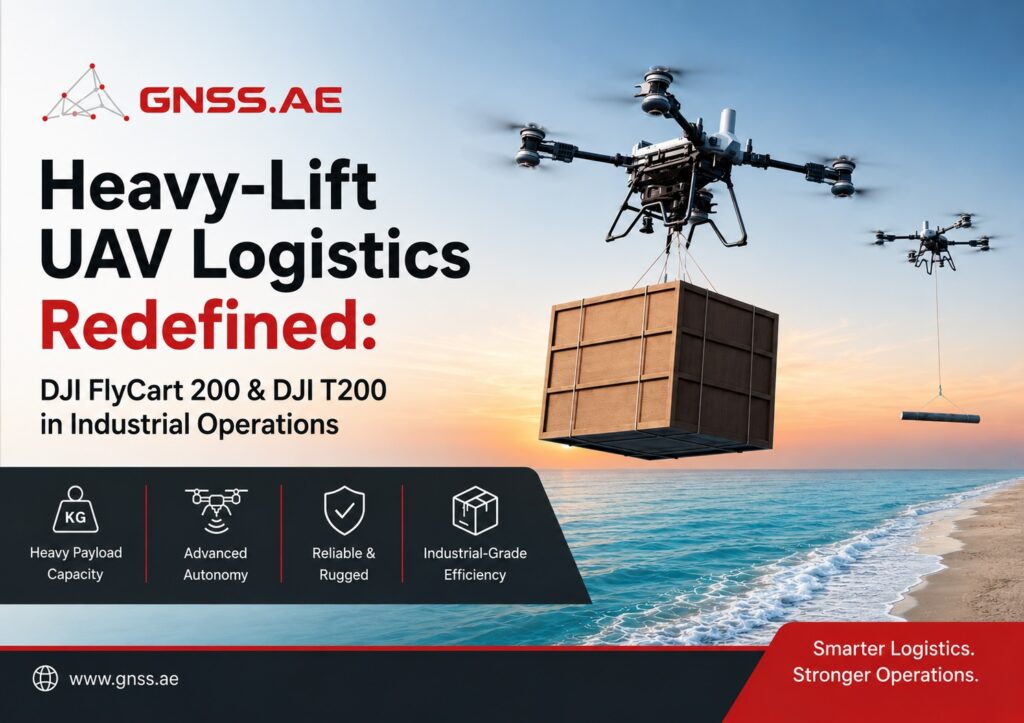
In the past decade, industrial drones have evolved from aerial data collection tools into critical operational assets capable of executing physical tasks. The next phase of this evolution is already underway: autonomous aerial logistics and heavy payload delivery.
With the introduction of DJI FlyCart 200 (FC200) and DJI T200, the market is moving toward drone-enabled supply chains, where materials, equipment, and resources are transported directly to hard-to-reach locations — without reliance on traditional ground logistics.
For regions such as the Gulf (GCC) — characterized by remote oil fields, offshore assets, desert infrastructure, and rapidly expanding urban environments — this shift is not theoretical. It is operationally relevant today.
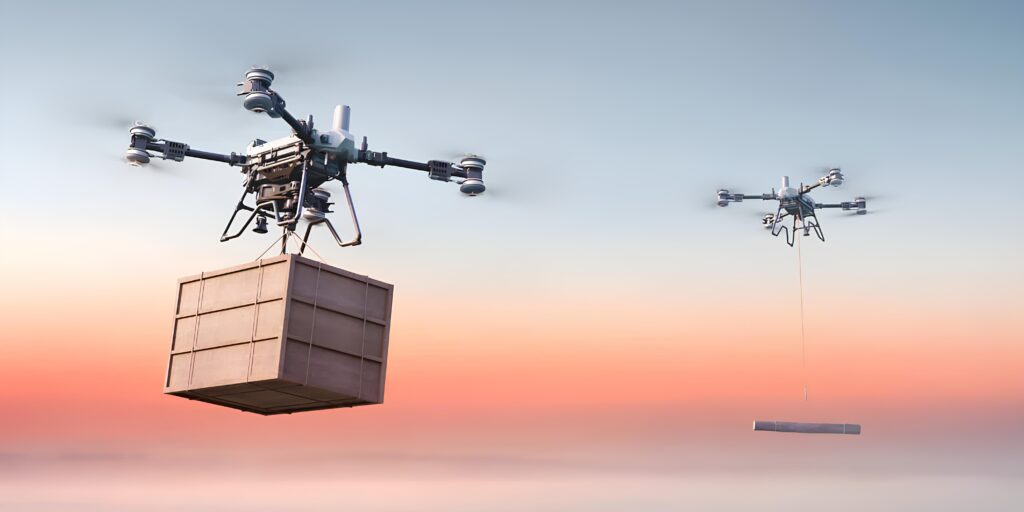
The FlyCart 200 is designed as a flagship aerial cargo system for industrial logistics:
The T200 shares the same payload class (200 kg) but is optimized for:
Key distinction:
The FC200 introduces several critical engineering upgrades:
The key innovation is the synchronized fleet system supporting up to four FC200 units operating together.
The platform supports coordinated multi-drone operations, where two to four UAVs can be synchronized to carry a single payload. In this configuration, the system transitions from a standalone aircraft to a distributed aerial lifting mechanism, with a combined payload capacity reaching up to 600 kg.
The system operates as a unified structure:
Instead of selecting a larger aircraft, operators can scale lifting capacity depending on the mission:
This modular approach introduces a level of flexibility that is difficult to achieve with traditional aviation or ground transport. It also reduces deployment complexity — the same platform can be used across multiple scenarios without changing the core system.
All this results into a high mission turnover with minimal downtime.
In the Gulf region, oil and gas infrastructure is often spread across vast and remote areas — ranging from desert wellheads to offshore platforms. Supplying these sites with tools, spare parts, and maintenance equipment remains one of the most persistent operational challenges. Traditional logistics rely heavily on ground transport or helicopters. Both approaches introduce limitations: ground transport is slow and constrained by terrain, while helicopters are expensive, weather-dependent, and require complex coordination.
The introduction of heavy-lift UAVs such as the DJI FlyCart 200 changes the structure of these operations. Instead of relying on scheduled transport or emergency dispatches, operators can deploy drones on-demand to deliver payloads directly to the required location. This is particularly valuable for time-sensitive maintenance scenarios where delays can result in production losses.
In practical terms, this means that critical components—such as sensors, valves, or repair tools — can be transported directly from a central hub to a remote asset within a single flight. The ability to bypass roads, terrain obstacles, and logistical bottlenecks significantly reduces response times. Over time, this leads to measurable improvements in uptime, reduced operational costs, and lower exposure of personnel to hazardous environments.
For operators in Abu Dhabi and across the GCC, where infrastructure scale is large and environmental conditions are demanding, such a capability is not just an efficiency gain — it becomes a strategic advantage.
Solar energy is a rapidly growing sector in the Gulf, driven by large-scale projects across the UAE and Saudi Arabia. However, one of the defining operational challenges in this region is dust accumulation. Fine sand particles settle on solar panels continuously, reducing their efficiency and requiring frequent cleaning and maintenance.
While specialized robotic systems are used for cleaning, logistics remains a critical bottleneck. Maintenance teams need constant access to spare parts, cleaning modules, water systems, and diagnostic tools — often across vast solar fields that can span several square kilometers.
This is where aerial logistics platforms like the FlyCart 200 provide a meaningful advantage. Instead of relying on ground vehicles that must navigate long distances across solar arrays, drones can transport equipment directly to specific maintenance zones. This reduces the time required to service individual sections of the facility and enables more dynamic, responsive maintenance workflows.
In practice, this translates into higher operational efficiency for solar farms. Panels can be cleaned and repaired faster, minimizing energy production losses.

Construction projects operate under constant pressure to deliver faster while managing increasingly complex environments. High-rise towers, large infrastructure developments, and giga-projects require a continuous flow of materials, tools, and equipment across both horizontal and vertical spaces. In practice, this creates logistical bottlenecks. Cranes become overloaded, ground transport is often inefficient, and moving even small but critical components between zones can introduce delays that affect the entire workflow.
The use of heavy-lift drones such as the DJI FlyCart 200 introduces a new layer of flexibility into these operations. Instead of relying solely on cranes or elevators, materials can be delivered directly to upper floors or specific work zones on demand. This is particularly valuable in situations where immediate access to tools or components is required to avoid downtime.
From an operational perspective, this changes how construction sites function. Logistics become more decentralized and responsive, reducing dependency on fixed infrastructure like cranes. As a result, project timelines can be compressed, and workflows become more efficient. At the same time, reducing the need for manual transport of materials in complex environments contributes to improved safety conditions on site.
In emergency and government scenarios, the key constraint is not efficiency but time. Whether responding to fires, industrial incidents, or natural hazards, the ability to deliver equipment and supplies quickly can directly impact outcomes. In many cases, access to affected areas is limited due to damaged infrastructure, restricted zones, or hazardous conditions.
Heavy-lift drones provide a practical solution by enabling rapid deployment of critical payloads without relying on ground access. The DJI FlyCart 200 can be used to transport medical supplies, firefighting equipment, or emergency tools directly to the point of need. This is especially relevant in scenarios where traditional vehicles cannot reach the site or where time-sensitive delivery is required.
Beyond individual missions, this capability also improves coordination between agencies. Civil defense, emergency services, and government operators can integrate drone logistics into their response frameworks, allowing for more structured and predictable deployment of resources. Over time, this leads to faster response cycles, reduced operational friction, and a higher level of preparedness for complex emergency scenarios.
Although agriculture in the Gulf differs from traditional large-scale farming regions, it is becoming increasingly important due to food security initiatives and investments in controlled-environment agriculture. Operations are often spread across remote or semi-arid areas, where transporting materials such as fertilizers, tools, and equipment can be inefficient and labor-intensive.
The DJI T200 addresses this challenge by enabling aerial transport across fields and agricultural zones. Instead of relying on ground vehicles that must navigate uneven terrain, drones can move supplies directly to where they are needed. This is particularly useful for distributed operations, where multiple locations require coordinated support.
In practical terms, this reduces dependency on manual labor and improves the consistency of operations. Tasks that previously required significant time and coordination can be executed more quickly and with greater precision. As agriculture in the region becomes more technology-driven, such systems also integrate naturally into broader smart farming ecosystems, supporting data-driven decision-making and scalable operations.

The introduction of heavy-lift drones represents a broader shift in how logistics is approached. Traditionally, material transport has been manual, linear, and dependent on fixed infrastructure. With the integration of aerial platforms, logistics becomes more flexible, dynamic, and increasingly autonomous.
When combined with supporting technologies such as drone-in-a-box systems, fleet management platforms, and AI-based routing, these drones form the foundation of a new operational model. Instead of reacting to logistical needs as they arise, organizations can begin to anticipate and automate them.
This transition enables continuous operations, where supply chains function in parallel with core activities rather than acting as a constraint. It also reduces the need for human intervention in routine transport tasks, allowing personnel to focus on higher-value activities.
For industries in the Gulf — where scale, distance, and environmental conditions define operations — this shift toward autonomous aerial supply chains is not just an innovation. It represents a fundamental change in how infrastructure and logistics are managed.
Lorem ipsum dolor sit amet, consectetur adipiscing elit. Ut elit tellus, luctus nec ullamcorper mattis, pulvinar dapibus leo.
The value of DJI FlyCart 200 and T200 is truly transformational.
They enable:
In environments where distance, heat, and scale define operations, aerial logistics is becoming not just efficient — but essential.
The FC200 operates in a completely different category:
It is designed for industrial logistics, not small parcel delivery.
Advantages over helicopters:
Limitations:
Yes, particularly for:
However, deployment depends on:
At the moment, it is still unclear whether the DJI FlyCart 200 will be available for the international market. We are closely monitoring updates, and we will inform you as soon as any official information becomes available.