Methane leaks are a concern for far more than just the oil and gas industry. They represent a safety risk, contribute significantly to greenhouse gas emissions, and can lead to substantial product losses if left undetected.
Two of the most widely used approaches today are Tunable Diode Laser Absorption Spectroscopy (TDLAS) and Optical Gas Imaging (OGI). While both are designed to detect methane, they work in very different ways and solve different inspection challenges. Understanding these differences helps operators select the most effective solution—or combination of solutions—for a specific application.
Consider a pipeline extending for kilometers across difficult terrain or equipment inside a refinery where accessing every valve, flange, and fitting is time-consuming, costly, or potentially hazardous. In these situations, inspectors need to determine whether methane is present without approaching every potential leak source.
Unlike point sensors that sample the surrounding air, a TDLAS instrument projects a laser beam toward a target surface, such as the ground, a pipeline, or process equipment. The reflected beam returns to the detector, passing twice through the air along the measurement path. If methane is present anywhere along that path, its molecules absorb part of the laser energy at a specific wavelength.
The instrument measures this absorption and calculates the integrated methane concentration between the detector and the target. Rather than measuring gas at a single location, TDLAS reports the total methane along the optical path, typically expressed in ppm·m (parts per million multiplied by distance).
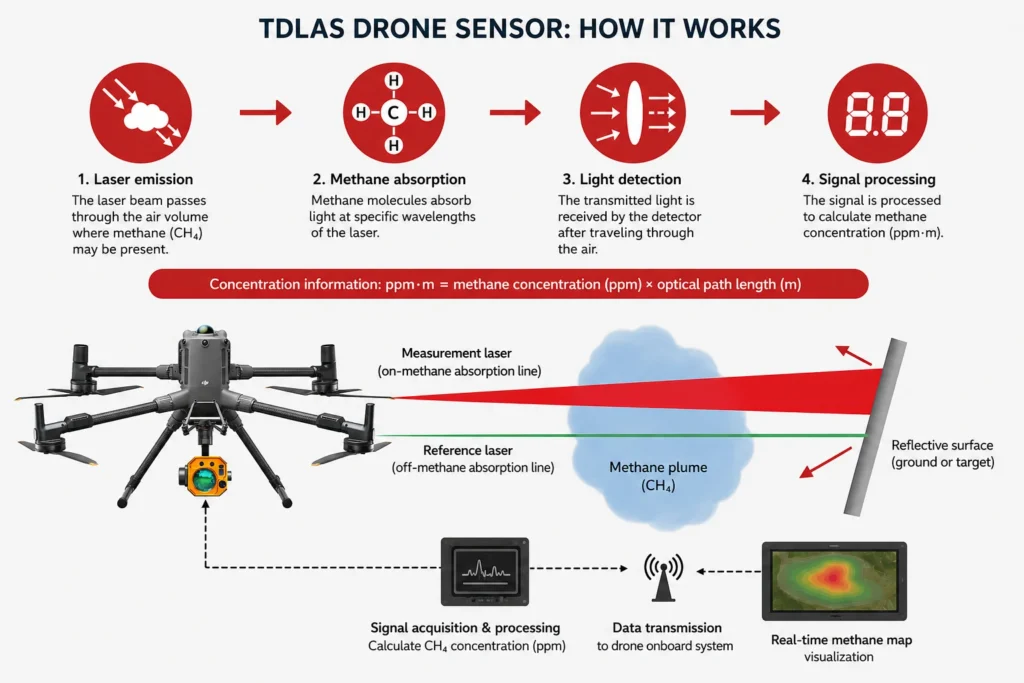
Because the sensor is tuned to methane’s unique absorption wavelength, it is highly selective. Other common atmospheric gases have little influence on the measurement, making false positives significantly less likely than with many traditional gas sensing technologies.
Long transmission pipelines, compressor stations, LNG terminals, storage facilities, and petrochemical plants often contain thousands of potential leak points. Checking every component individually with contact-based instruments can take days.
A TDLAS sensor allows inspectors to screen these assets much more quickly, highlighting only the locations where methane has actually been detected.
Many inspections take place in environments that involve elevated structures, confined spaces, busy industrial sites, or difficult terrain. Remote laser measurements reduce the need for personnel to enter these areas during the initial inspection.
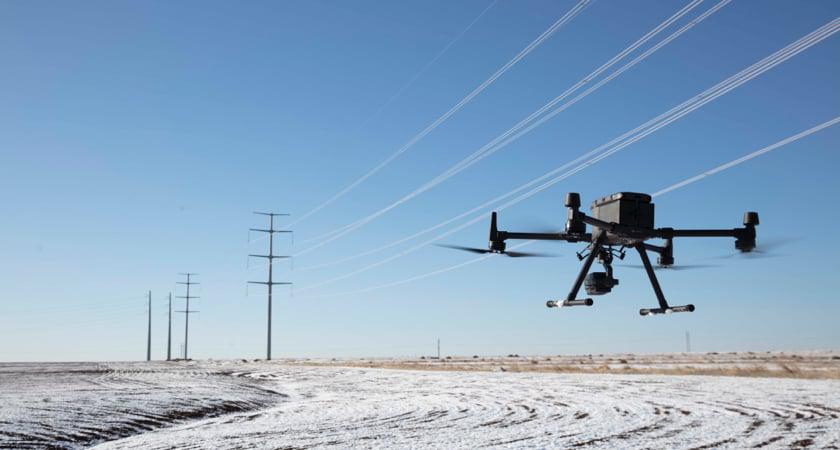
When combined with UAVs, inspections can also be carried out above pipelines, around flare stacks, over storage tanks, or across inaccessible terrain without exposing workers to unnecessary risks.
Modern TDLAS instruments can detect low methane concentrations, allowing operators to identify small leaks before they develop into larger emissions or operational issues.
Unlike some conventional gas sensors, TDLAS is designed specifically for methane detection, so the measurements remain highly selective even in complex industrial environments where multiple gases may be present.
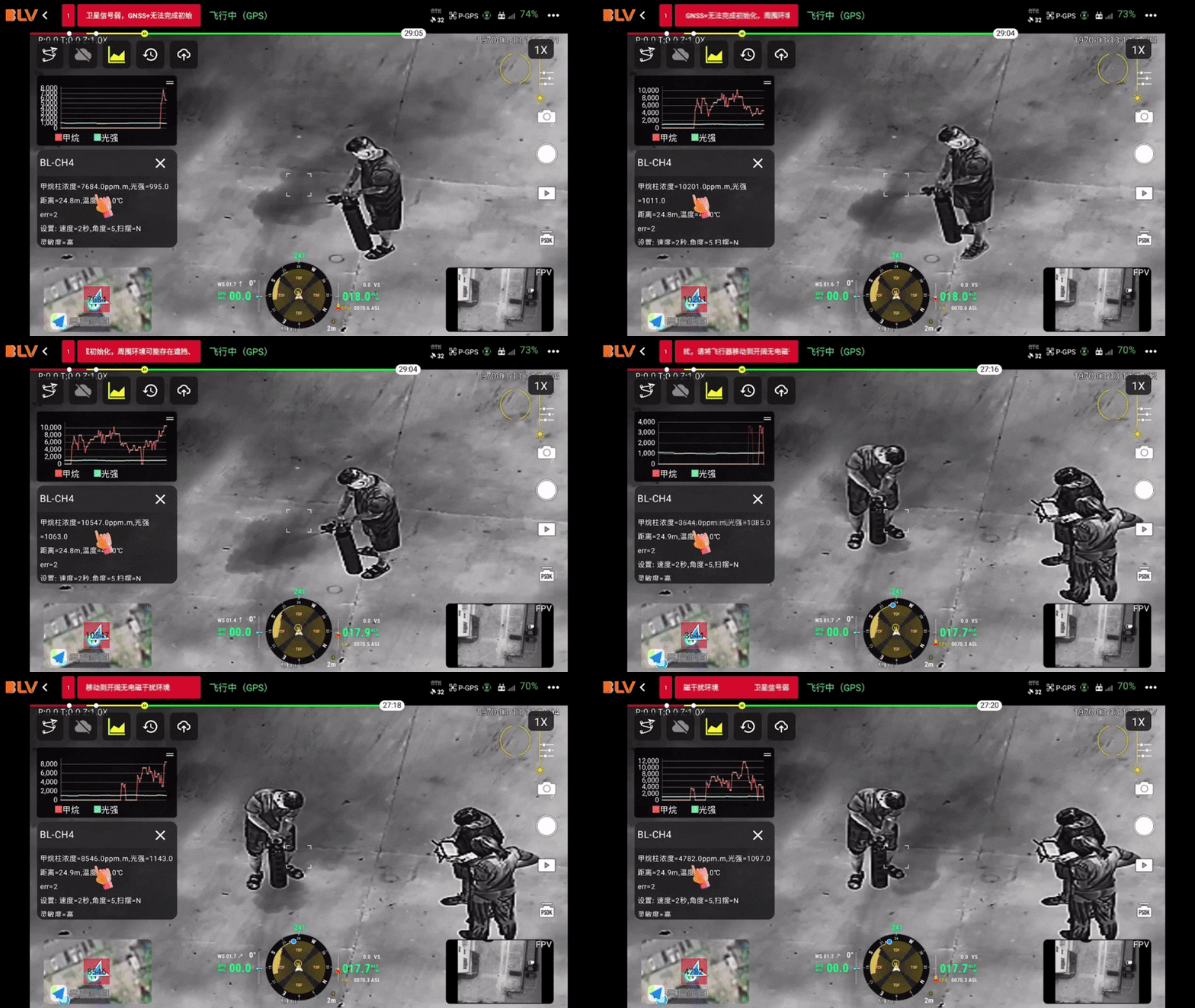
Measurements are available almost instantly. As a drone follows its flight path, inspectors can monitor methane readings in real time and immediately identify areas with elevated concentrations.
The effectiveness of TDLAS has been demonstrated not only in laboratory experiments but also in field studies conducted by universities, gas utilities, and industrial operators.
One notable example comes from Poland, where researchers evaluated a UAV equipped with a laser methane detector over an active buried natural gas pipeline with a confirmed leak. Unlike many earlier studies based on controlled methane releases, the inspection was carried out under real operating conditions.
The multirotor UAV carried a compact laser methane detector and flew along the pipeline corridor, continuously measuring methane concentrations while recording their geographic locations. Rather than attempting to identify the leak visually, the researchers looked for localized methane concentrations exceeding the background level.
The UAV successfully detected elevated methane concentrations above the known leak location, despite the pipeline being buried about one meter below the surface. Although the resulting methane plume was weaker than those produced in controlled experiments, it remained distinguishable from the natural background.
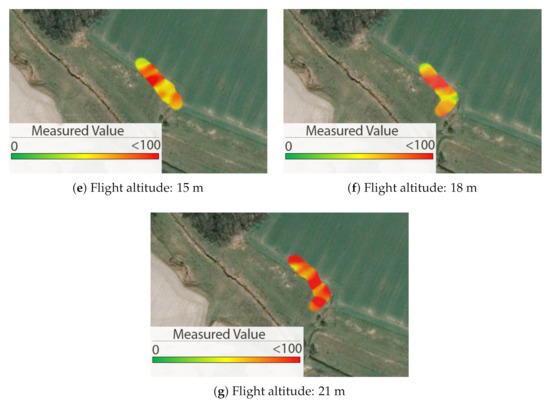
The study also demonstrated the importance of flight altitude. Lower altitudes produced stronger methane signals but increased the likelihood of disturbing the gas plume with rotor wash. At higher altitudes, methane became more diluted along the optical path, reducing sensitivity to small leaks.
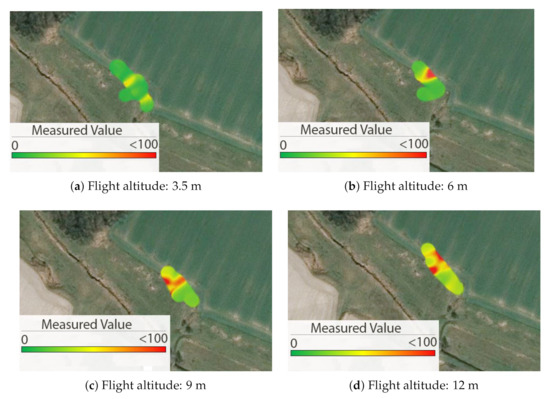
The researchers concluded that flight altitudes of approximately 4–15 meters provided the best balance between detection performance and operational safety, with the strongest signals generally observed near the lower end of that range.
Rather than replacing conventional leak inspections, UAV-mounted TDLAS can be used as an efficient screening tool. Operators can first survey long pipeline sections from the air, then deploy ground crews only to locations where elevated methane concentrations have been detected. This approach reduces inspection time while allowing field resources to be focused where they are most needed.
If TDLAS answers the question “Is methane present?”, Optical Gas Imaging (OGI) helps answer a different one: “Where is it coming from?”
Methane is colorless and odorless, which makes leaks difficult to identify with the naked eye. OGI cameras solve this problem by using a cooled mid-wave infrared (MWIR) detector that operates in the spectral range where methane absorbs infrared radiation.
Instead of measuring gas concentration, an OGI camera creates a live thermal image in which methane appears as a moving plume against the background. Operators can watch the gas disperse in real time, making it much easier to locate the source of an emission.
The technology is particularly valuable when operators need visual confirmation before planning maintenance work or shutting down equipment. Inspectors can actually see how the gas behaves, how large the plume is, and whether wind conditions are carrying it toward neighboring equipment.
OGI is widely used across industrial facilities where rapid leak localization is essential, including:
These environments typically contain large numbers of closely spaced assets. A methane detector may confirm that gas is present within an area, but locating the exact leaking component can still take considerable time.
OGI simplifies that process. An inspector can scan an entire section of equipment and immediately see whether the emission originates from a valve, flange, compressor seal, or another component. Identifying the source visually reduces troubleshooting time and allows maintenance crews to focus directly on the affected equipment.
Although the two technologies are often compared, they are designed to solve different inspection problems.
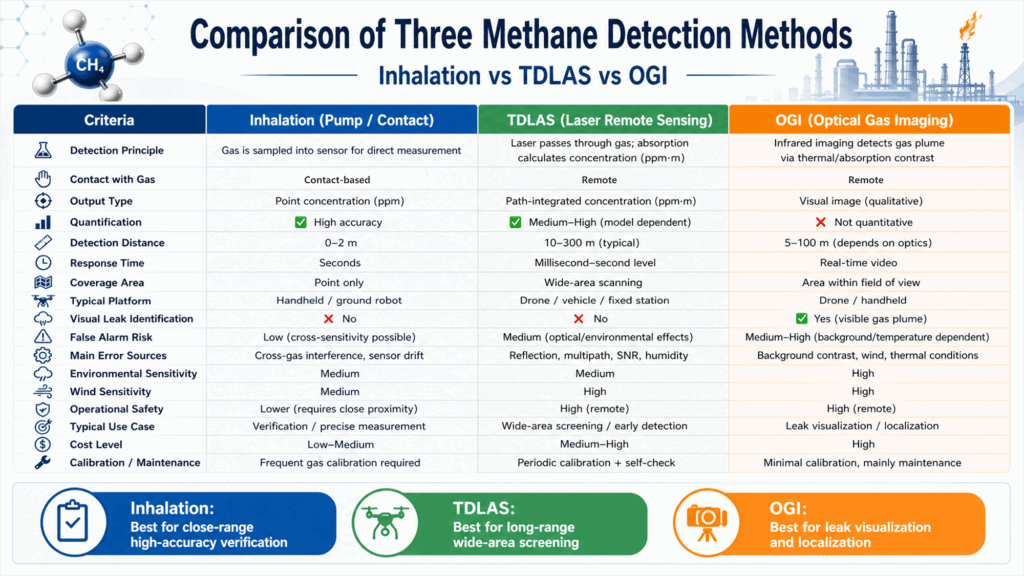
Viewed this way, the technologies are not competitors—they are sequential steps in the same inspection workflow. One finds anomalies, the other explains them.
Until recently, inspection teams typically had to choose between two approaches: measuring methane concentrations with a laser sensor or visually locating leaks with an OGI camera. In many cases, that meant carrying separate payloads or repeating the same inspection with different equipment.
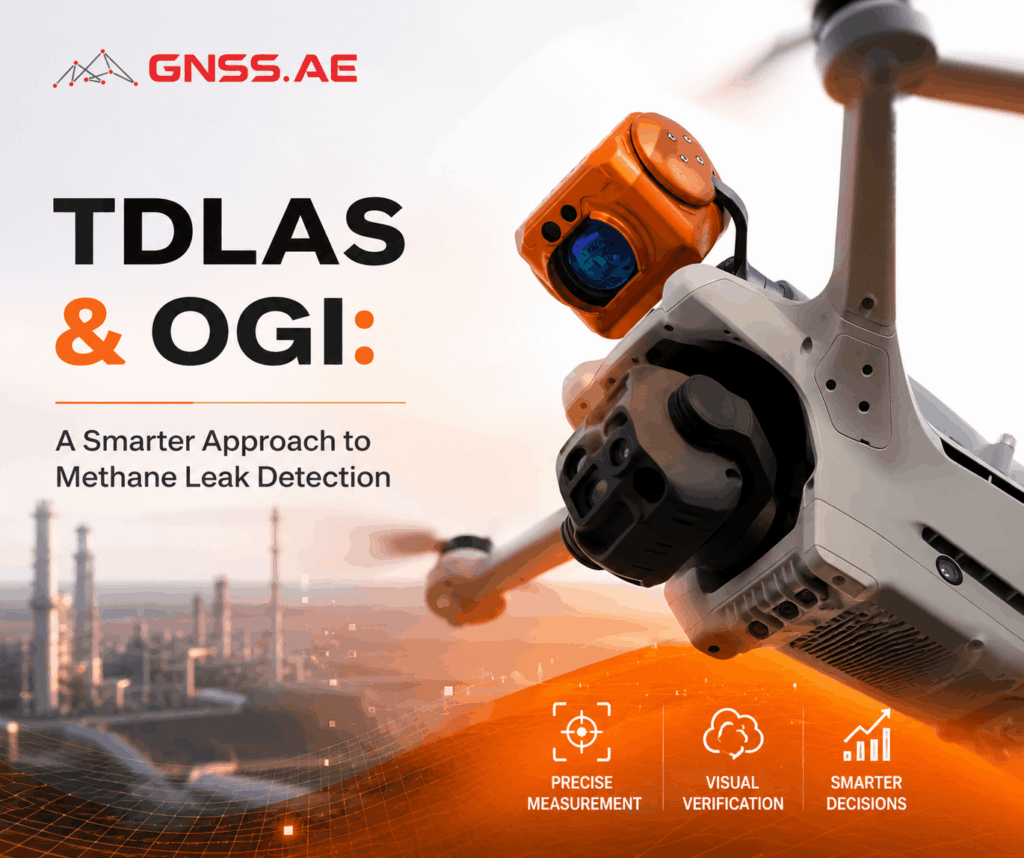
New inspection systems like GasVision-TD1 are combining laser-based methane measurement with Optical Gas Imaging in a single integrated payload, allowing operators to detect, verify, and document methane emissions during the same flight.
Rather than switching between different sensors or conducting multiple inspection flights, operators can use one system that performs both tasks simultaneously.
The integrated TDLAS sensor performs rapid remote screening with a sensitivity of 5 ppm·m at distances of up to 70 meters, allowing inspectors to survey large areas while keeping personnel away from potentially hazardous locations.
When elevated methane levels are detected, the integrated MWIR Optical Gas Imaging camera immediately provides visual confirmation. Inspectors can see the methane plume in real time, identify the leaking component, and assess how the gas disperses.
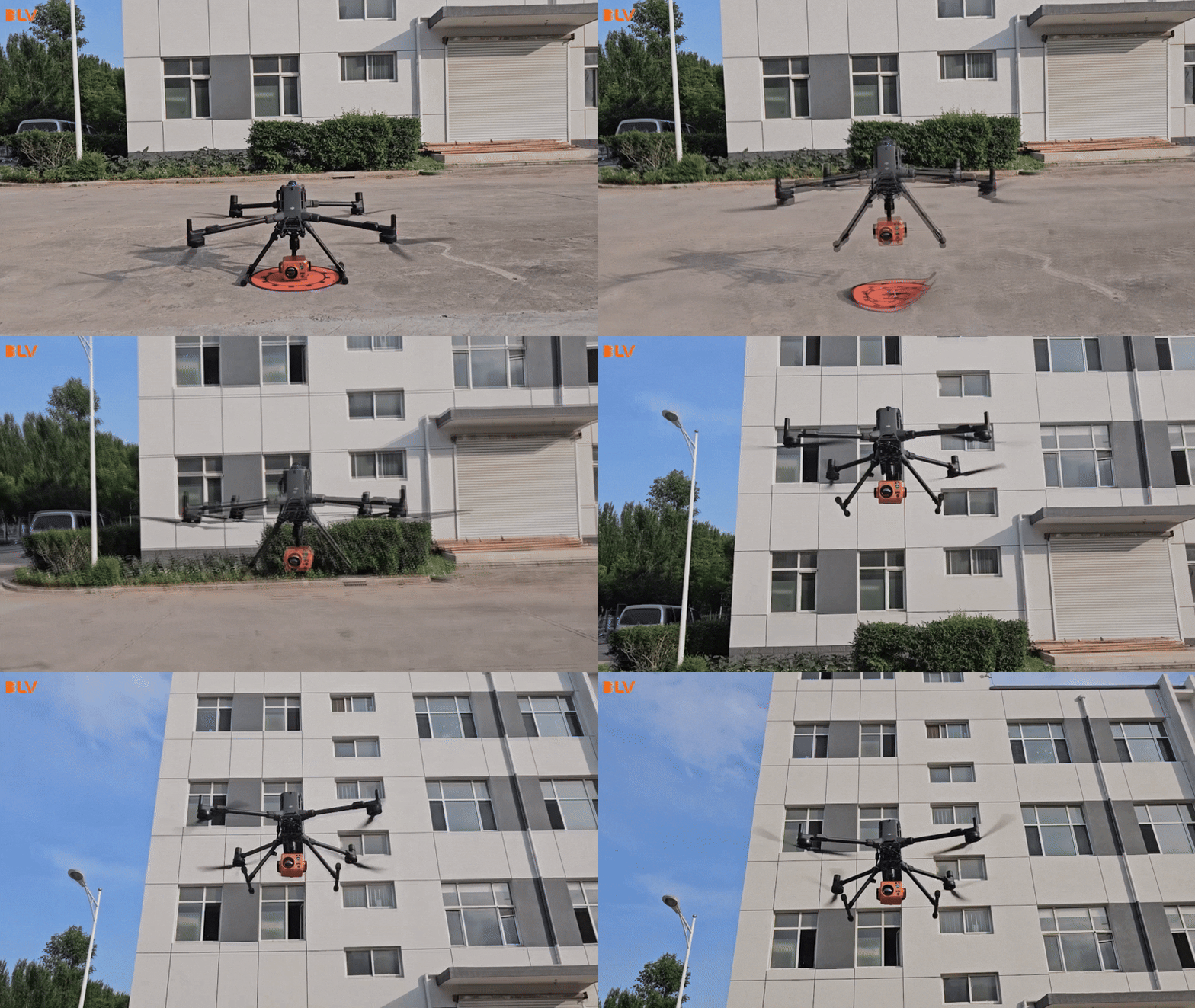
The result is a more streamlined inspection workflow:
GasVision-TD1 also supports inspection workflows aligned with internationally recognized frameworks such as the EU Methane Regulation (EU 2024/1787) and OGMP 2.0, helping organizations collect and document methane inspection data in line with modern emissions management practices.
Methane monitoring is steadily moving beyond simple leak detection. Today’s operators need inspection systems that support the entire workflow—from rapid screening and leak localization to documentation and maintenance planning.
TDLAS remains one of the fastest methods for remotely identifying methane across large industrial assets, while OGI provides the visual context needed to pinpoint emission sources and understand their behavior.
By combining both technologies in a single payload, GasVision-TD1 eliminates the need to compromise between detection speed and visual verification. Inspection teams can complete more work in a single flight, reduce operational complexity, and return with the information needed to support maintenance decisions and regulatory reporting.
As drone-based inspections continue to replace traditional survey methods, integrated systems like GasVision-TD1 are setting a new standard for methane monitoring—bringing remote detection, real-time visualization, and inspection-ready documentation together in one workflow.