Traditional inspection models were built around fixed cycles: fly, capture, review, repeat.
Nowadays, modern UAV systems can gather massive amounts of visual and thermal data in just one mission. The quality is better, the coverage is broader, and inspections are happening more frequently across various infrastructure sectors. However, the ability to interpret this data has not scaled at the same rate.
This has led to a noticeable gap: while data collection has become super-efficient, analyzing that data is still a slow and resource-heavy process. This imbalance is one of the main reasons AI tools are being introduced into inspection pipelines.
AI in drone inspection systems is not one “layer” of “automation” but a number of closely defined functions integrated across capture, pre-processing and analysis stages. In current enterprise workflows, it is used primarily for classification, prioritization, and change detection rather than full autonomous decision-making.
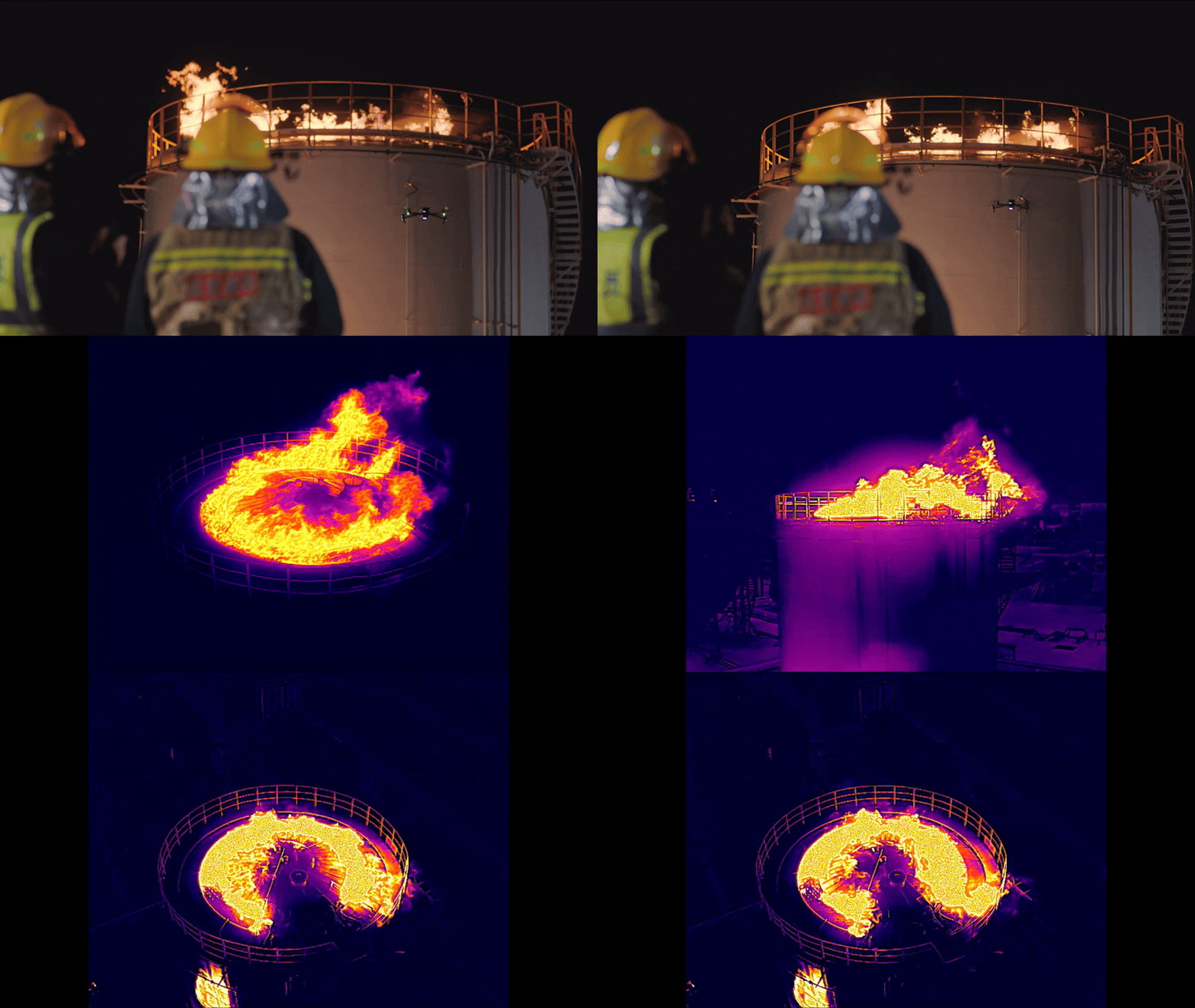
Current applications of AI are most developed around visual and thermal image-based defect detection. In platforms such as DJI Matrice 4TD / Matrice 4T and DJI Mavic 3 Thermal Advanced, as well as payload-based systems like DJI Zenmuse H20T and DJI Zenmuse H30T, onboard or near-real-time inference is used to highlight:
In the context of solar farm operations, enterprise payloads are pre-processed to flag any anomalous panels before a manual review takes place.
A more detailed overview of drone-based inspection workflows and data analysis in solar energy projects — including thermal imaging applications — was covered in one of our previous articles: Drones Applications in Solar Power Industry
Inspection flights, particularly corridor or large-area surveys, produce large amounts of repetitive visual data. AI is increasingly used as a filtering layer to reduce this load. For example, in workflows where DJI Mavic 3 Enterprise or DJI Terra map data is being processed for:
This is especially important in infrastructure corridors, where a single mission can generate hundreds or even thousands of nearly identical frames, and manual screening becomes the primary bottleneck.
Another, much more complex use of AI involves comparing observations and reports between inspection cycles. Here, the system does not analyze the single flight in isolation but compares the current to the previous.
This can be part of workflows using a combination of DJI Matrice 400 + Zenmuse L3, DJI Terra, repeated flights and survey missions, where AI-driven analysis reveals:
In this context, AI is not detecting absolute defects, but the changes over time, changing visual checks into continuous condition reports.
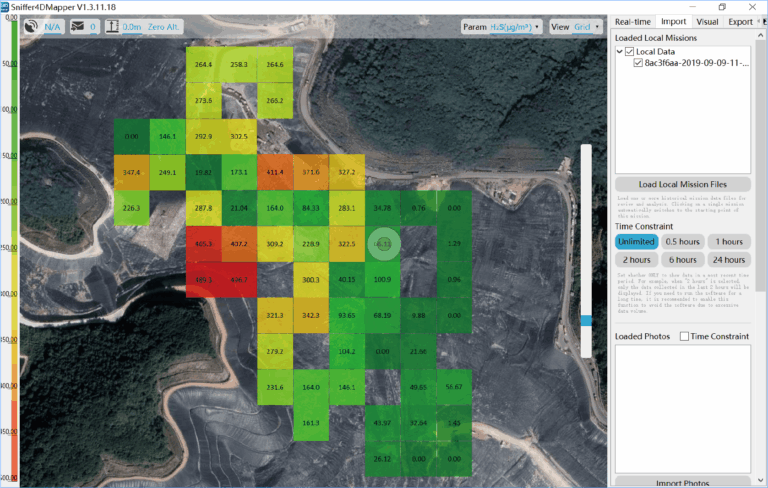
In environmental and industrial safety applications, AI is also used to interpret non-visual sensor data.
Systems such as Sniffer4D gas detection platforms apply analytical models to:
Here, AI functions as a spatial interpretation layer rather than an image-based classifier.
A more detailed comparison of sensor configurations and their practical use cases is covered in a previous article on Sniffer4D Nano 2+ platforms, where differences between multi-gas and methane-focused deployments are analyzed in the context of real inspection scenarios.
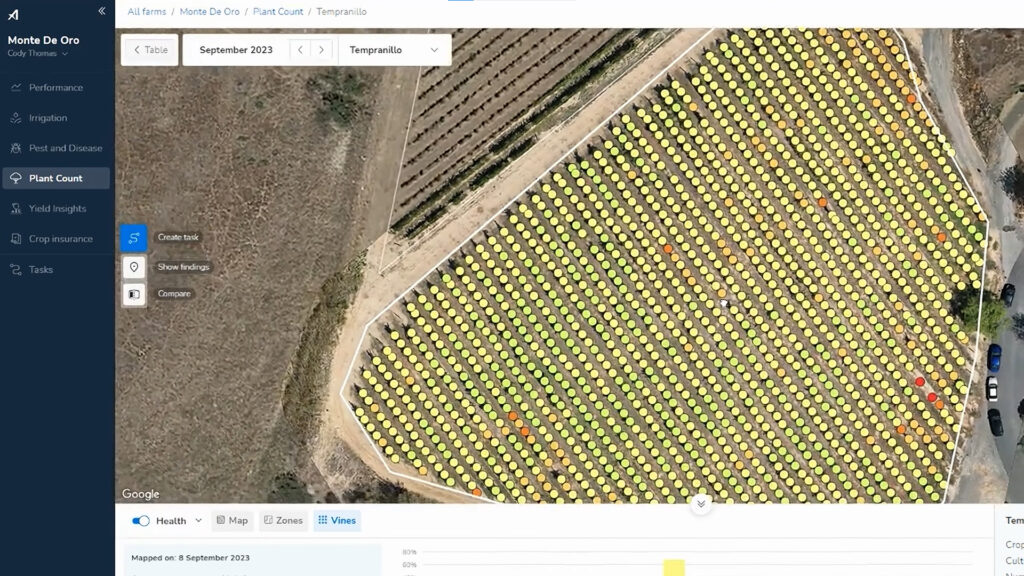
In agricultural and environmental monitoring, AI-assisted workflows rely on multispectral data interpretation. AI systems can be used to:
Beyond these integrated drone systems, dedicated multispectral payloads like the Yusense cameras take these two steps further. These systems capture multiple narrow spectral bands (typically including red edge and near-infrared) with synchronized imaging and real-time reflectance calculation.
A more detailed overview of Yusense multispectral cameras and their role in expanding UAV-based spectral imaging capabilities was covered in a previous article: Yusense Multispectral Cameras: Expanding Capabilities in UAV-Based Spectral Imaging
However, even with higher spectral resolution, the outputs remain analytical layers rather than final conclusions. Vegetation indices and classifications still require agronomic or environmental interpretation, particularly in heterogeneous or mixed-condition fields.
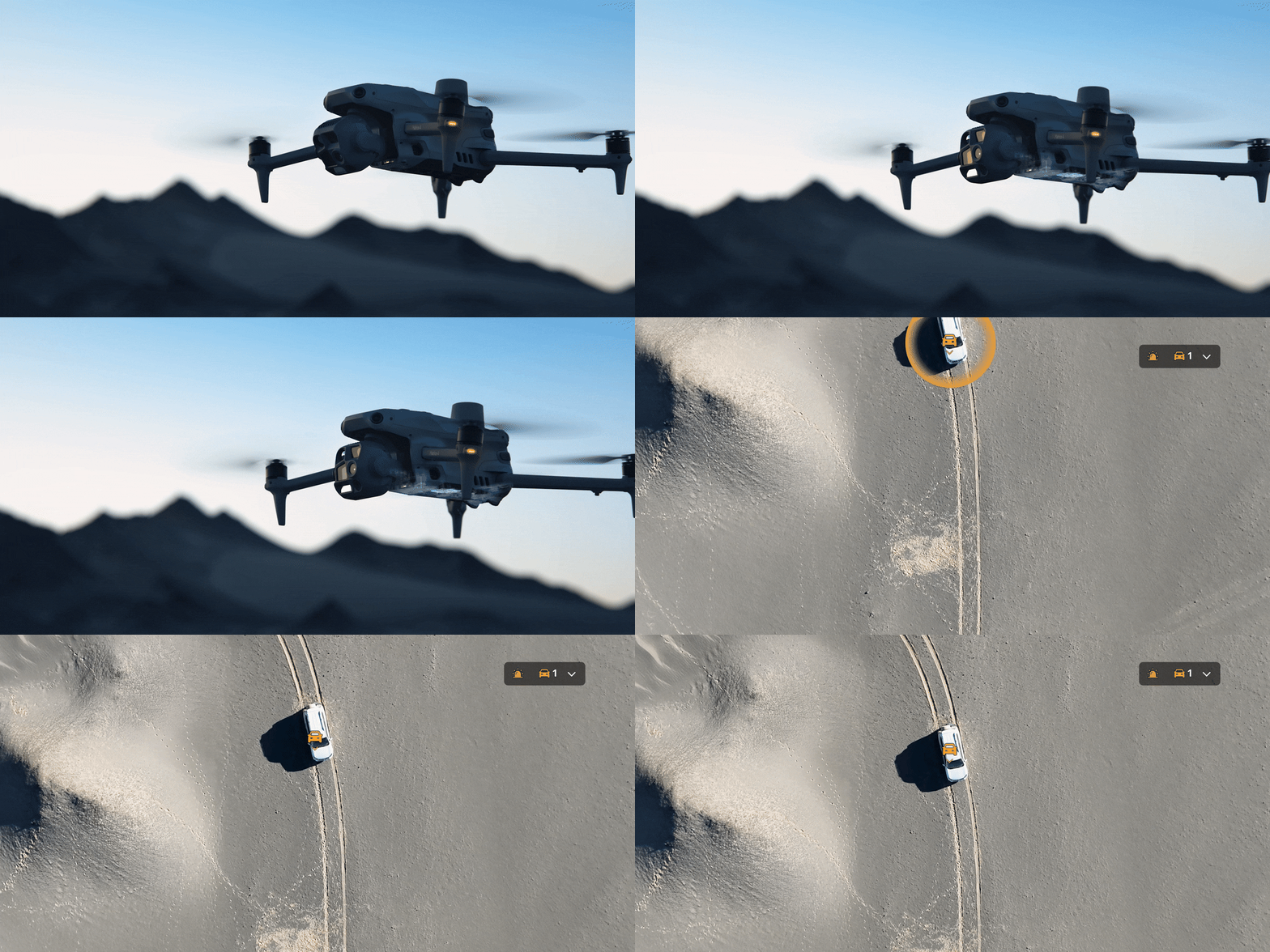
In security operations, drones are increasingly integrated with AI-based analytics to support perimeter monitoring, threat detection, and real-time situational awareness.
In platforms such as DJI-based enterprise security systems and autonomous docking solutions like DJI Dock ecosystems, AI models can identify and classify objects of interest during patrol missions, including humans, vehicles, and unauthorized intrusions within restricted zones. These systems are commonly deployed across industrial facilities, airports, ports, and critical infrastructure sites.
AI is also used to reduce operator workload by filtering large volumes of surveillance footage, automatically flagging unusual activity, and prioritizing alerts for human review. In some configurations, drones can be triggered by predefined security events and perform autonomous patrol routes, providing live video streams for command centers to assess and validate potential incidents.
At the processing stage, AI is embedded in reconstruction and classification pipelines. In DJI Terra AI-driven functions are used to:
This layer is critical for reducing manual segmentation work, which traditionally represents one of the most time-consuming steps in geospatial processing.
System / Product | Primary AI Function | Role in Workflow |
Onboard object & thermal anomaly detection | Real-time inspection support | |
Thermal + visual anomaly detection, zoom-assisted inspection | Multi-sensor inspection (utilities, infrastructure) | |
Enhanced thermal sensitivity, long-range detection, AI-assisted targeting | Advanced inspection in complex or large-scale environments | |
Assisted visual detection & flight optimization | Data capture filtering | |
Thermal anomaly pre-classification | Pre-review defect identification | |
LiDAR/RGB classification, change detection | Post-processing & temporal analysis | |
DJI Dock 3 ecosystem | Event-driven automation logic | Autonomous inspection triggering |
Sniffer4D systems (Sniffer4D Nano2+ Methane / Sniffer4D Nano2+ | Gas dispersion modeling & anomaly detection | Environmental analytics |
Vegetation classification & stress analysi | Agricultural decision support | |
Point cloud classification & reconstruction automation | Geospatial processing layer |
Across all systems, AI does not replace inspection logic. Instead, it operates in three constrained roles:
AI improves throughput and prioritization, but the interpretation of operational relevance still depends on domain expertise.
AI performs best not simply in “repetitive” environments, but in cases where the input data has low variability and a predictable structure of features. In these conditions, models behave closer to a filtering mechanism than a system that needs to interpret complex context.
In practical terms, this usually means:
Poles, conductors, and insulators follow a consistent topology along the corridor so the model can expect to see features before visually recognizing them. AI performs reliably in:
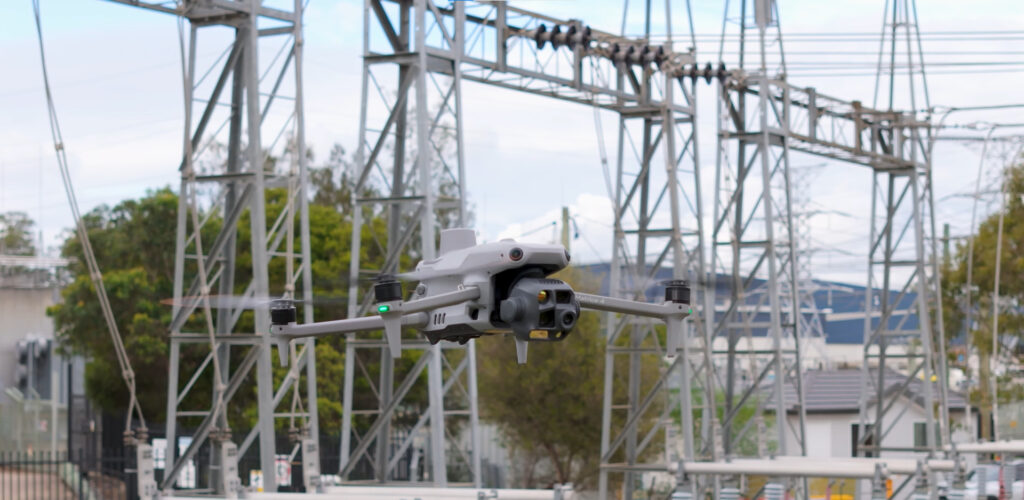
Good results are harder to achieve in cluttered or complex background (eg heavy vegetation, urban environment overlaps) when there is a proliferation of candidate objects.
A more detailed overview of drone-based inspection workflows for powerline infrastructure — including operational constraints and safety considerations — is covered in our previous article: Powerline Inspection with DJI Mavic 3 Thermal: Everything You Need to Know for Safe Utility Inspections.
Blades have relatively uniform surfaces and a limited range of defect types (edge erosion, cracks, contamination).
When image resolution and capture angles are controlled, AI can detect surface anomalies with good consistency. However, performance is sensitive to lighting conditions, reflections, and viewing angle — small changes here can affect detection quality.
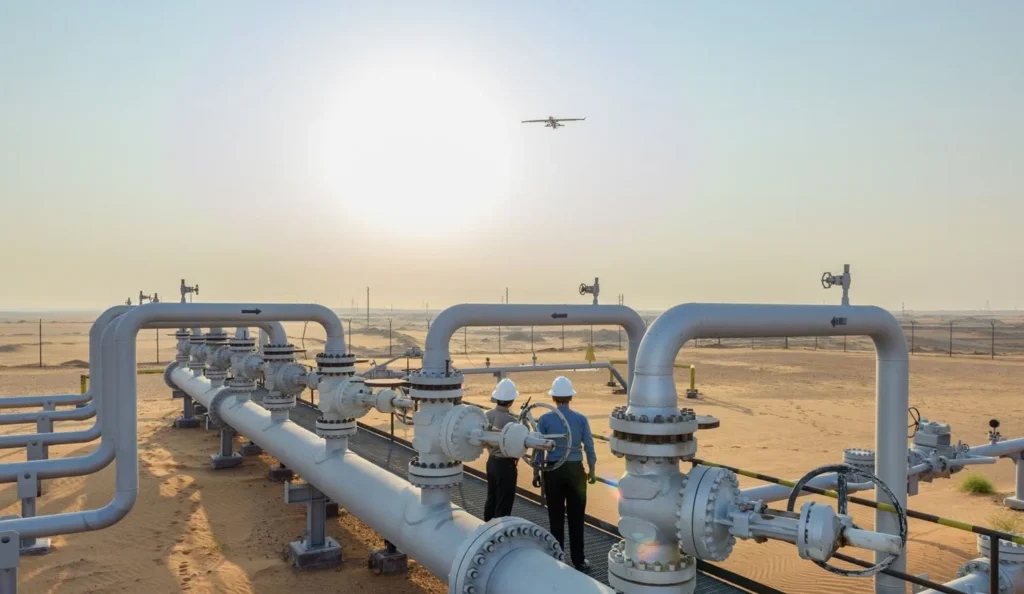
AI is not equally effective across the entire site, but works well in segments with repeating structures:
In these areas, models can compare similar objects against each other, which reduces reliance on absolute detection and improves consistency.
Scenario | AI effectiveness | Technical reason |
Powerlines | Medium–High | Consistent topology, but variable background and occlusions |
Urban infrastructure | Medium | High scene variability, weak feature consistency |
Complex industrial sites | Medium–Low | Mixed materials and non-repeating structures |
The key point here is not just “structured vs unstructured” environments.
AI is reliable when three conditions are met:
When these are present, the task becomes deviation detection. When they are not, it turns into interpretation — and that is where model performance becomes much less predictable.
Despite rapid progress, AI systems still struggle with context.
AI can identify anomalies, but it does not reliably explain them. A thermal hotspot may indicate a fault, but it could also be caused by reflection, environmental conditions, or temporary load variations.
In real-world inspections, data is rarely clean. Common challenges include:
These factors often lead to false positives or missed detections.
Perhaps the most important limitation is decision-making. Even when AI correctly identifies anomalies, it does not determine:
For example, AI can segment point clouds and detect geometric differences, but cannot determine structural risk, compliance with standards (e.g. clearance zones, deformation thresholds), or operational criticality. These decisions require engineering context, regulatory understanding, and operational experience.
Modern inspection workflows are increasingly structured as layered systems rather than linear pipelines. A typical model looks like this:
In this structure, AI reduces workload but does not remove responsibility.
The practical benefit is not full automation, but compression of review time. Instead of reviewing every frame, operators focus only on AI-flagged segments.
AI is fundamentally changing drone inspections, but not by replacing human operators. Its real impact is in restructuring workflows:
At the same time, human expertise remains central to interpretation, validation, and decision-making. The future of drone inspections is therefore not fully autonomous. It is AI-augmented engineering workflows, where speed increases, but accountability remains human.