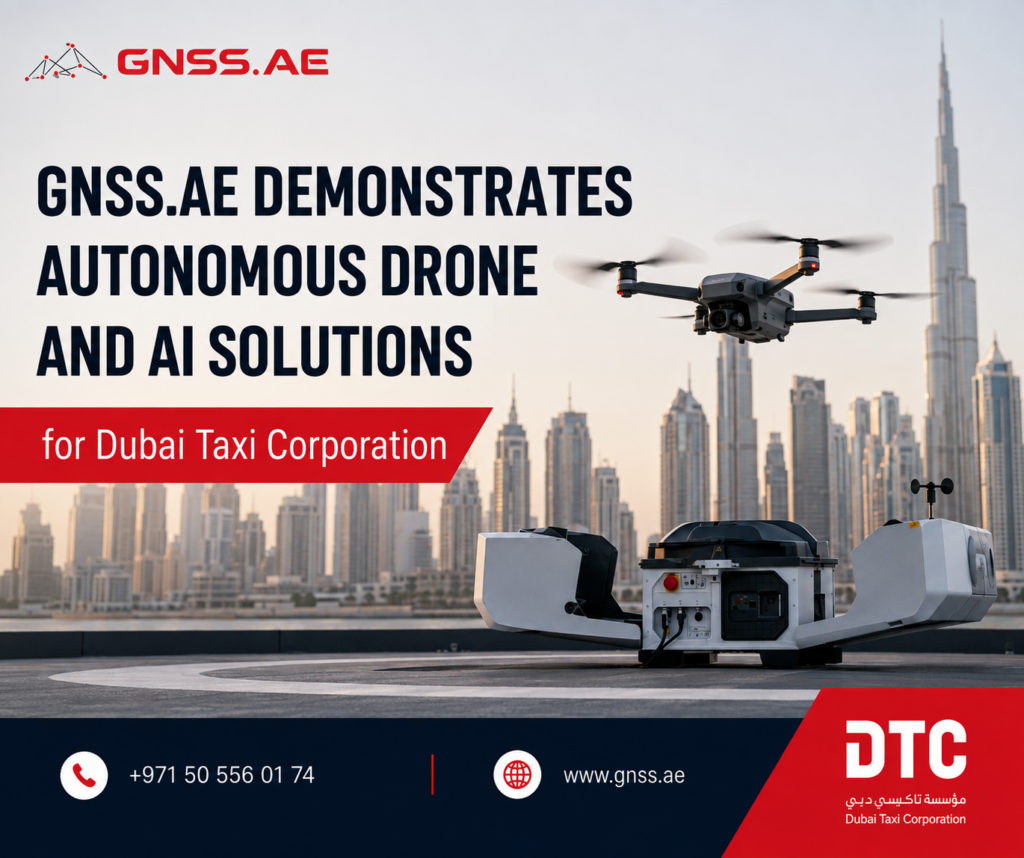
GNSS.AE recently conducted an online demonstration for Dubai Taxi Corporation (DTC), part of Dubai’s Roads and Transport Authority (RTA), presenting autonomous drone and AI-powered solutions for security and operational monitoring.
The discussion covered requirements across several areas, including QHSE, Operations, Security, and IT. Key use cases included perimeter and parking monitoring, inspections, intrusion detection, and identifying potential violations.
To address these requirements, GNSS.AE presented a technology stack built around DJI Dock 3, automated drone operations, and the AI capabilities available through DJI FlightHub 2.

DJI Dock 3 provides the infrastructure for scheduled and remotely operated drone missions without requiring a pilot to be continuously present on site.
For security and monitoring teams, drones can be deployed on predefined routes to inspect perimeters, parking areas, facilities, and other zones at regular intervals. After each mission, the drone returns to the dock to recharge and remain ready for the next flight.
This makes regular aerial inspections more practical across large sites, where repeated manual checks can take significant time and resources.

FlightHub 2 provides a centralized layer for managing drone operations. Teams can plan missions, monitor flights remotely, access live information, and manage collected data from a single platform.
Its AI capabilities can also support automated monitoring. Rather than relying entirely on operators to review footage manually, AI-assisted workflows can help flag specific objects or events that may require attention, such as potential perimeter intrusions, vehicles, or activity within defined areas.
With regular automated flights, the workflow becomes more consistent: the drone collects the data, FlightHub 2 brings it into the operational environment, and AI helps teams identify relevant events more quickly.
For DTC, the proposed solutions are designed to support more frequent inspections, broader coverage of operational areas, and faster access to information when an incident occurs.
Autonomous drones, remote fleet management, and AI analytics can reduce the need for routine manual monitoring while giving security and operations teams a more consistent view of their sites.
The demonstration showed how these technologies can be integrated into a structured workflow for security, inspection, and infrastructure monitoring — rather than being used only for individual drone flights.