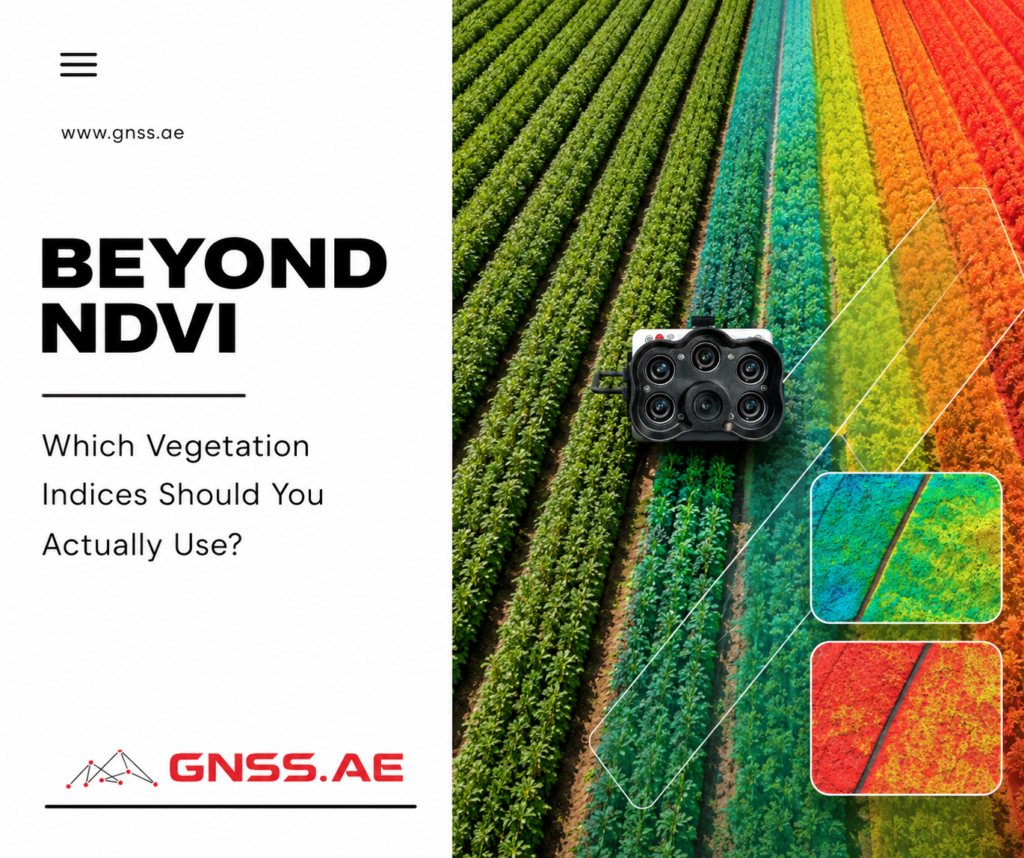
Multispectral software can produce a colorful NDVI map in minutes. The map may be technically correct and still answer the wrong question.
NDVI shows broad differences in green vegetation. It becomes less informative when soil dominates the image or a dense canopy pushes the index toward saturation. No single formula works best throughout the season.
The practical choice depends on three things: what you want to measure, how much vegetation covers the ground and which spectral bands your camera records.
A vegetation index combines reflectance from two or more spectral bands. Healthy leaves absorb much of the visible red light that reaches them and reflect strongly in the near-infrared (NIR). The contrast can reveal differences that are difficult to see in RGB.
The result is an indicator, not a diagnosis. A low value may reflect sparse plants, nutrient limitation, water stress, disease, soil exposure, shadow or poor calibration. The map shows where to investigate; field observations and tests help explain why.
In the formulas below, Blue, Green, Red, Red Edge and NIR refer to surface reflectance in the corresponding bands.
Index | Formula | Best starting use | Main limitation |
NDVI | (NIR − Red) / (NIR + Red) | General crop vigor, cover and repeat monitoring | Soil influence at low cover; saturation in dense canopies |
NDRE | (NIR − Red Edge) / (NIR + Red Edge) | Chlorophyll variation in established, high-biomass crops | Requires a red-edge band and field calibration for nitrogen decisions |
GNDVI | (NIR − Green) / (NIR + Green) | Chlorophyll-related variation where NDVI has lost sensitivity | Can still be affected by canopy structure, soil and illumination |
OSAVI | (NIR − Red) / (NIR + Red + 0.16) | Sparse to moderate vegetation with visible soil | Fixed adjustment may not suit every canopy and soil |
SAVI | (1 + L)(NIR − Red) / (NIR + Red + L) | Early growth or arid fields where soil brightness is important | The adjustment factor L must be chosen consistently |
EVI | 2.5(NIR − Red) / (NIR + 6Red − 7.5Blue + 1) | Dense crops, forests and high-biomass monitoring | Needs a calibrated blue band and careful preprocessing |
NDVI remains a useful first view of a field. It is widely supported and suited to mapping vegetation cover, locating poorly established areas and following broad changes. NASA describes it as a red–NIR measure of greenness, with values from −1 to 1.
NDVI remains the most practical starting point for:
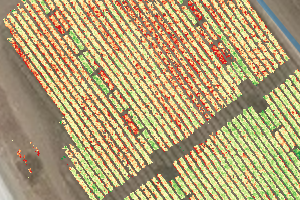
It works well as a broad screening layer. For example, if most of a field has a similar NDVI pattern but one area is consistently lower, that zone can be investigated on the ground for irrigation problems, nutrient issues, pests, disease or uneven emergence.
Use NDVI when the question is “where is green biomass different?” It works well during early-to-mid canopy development, once foliage can be separated from bare ground.
Do not rely on NDVI alone in a mature, closed canopy. As red absorption becomes very strong, additional leaves may produce only a small change in the index.
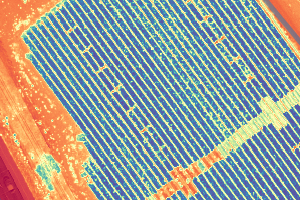
NDRE replaces red with a red-edge band, positioned between red absorption and NIR reflection. It generally retains more sensitivity to chlorophyll variation in moderate-to-high biomass than NDVI.
NDRE is particularly useful for:
For example, a field may show generally high NDVI because the canopy is already well developed. NDRE can provide additional separation between areas that look similarly vigorous in an NDVI map but have different chlorophyll responses.
Use NDRE for mid- and late-season scouting, comparing management zones and locating areas for tissue sampling.
GNDVI uses green reflectance instead of red. It is often used to assess chlorophyll-related differences and vegetation condition, especially when looking at nutrient and canopy variability.
GNDVI can be useful for:
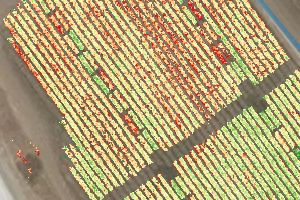
It is especially interesting when NDVI gives a relatively uniform result but you still need to investigate differences within a developed canopy.
Choose GNDVI when the objective concerns pigment variation more than simple cover.
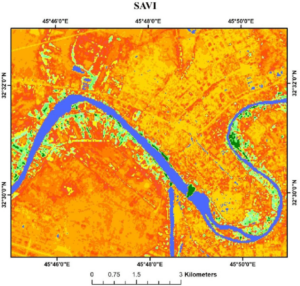
SAVI was developed to reduce the influence of soil brightness on vegetation measurements. That makes it particularly relevant when vegetation is sparse and a significant amount of soil is visible between plants. Its L factor controls the correction. A value of 0.5 is a common compromise; values closer to 1 apply stronger adjustment in sparse vegetation, while SAVI approaches NDVI as L approaches 0.
SAVI is useful for:
Imagine a field shortly after emergence. Two areas may have similar plant condition, but one has more exposed soil. A standard NDVI map can be influenced by that background. SAVI is designed to reduce this effect.
Use SAVI when soil dominates and there is a defensible method for choosing L. For one consistent soil-adjusted index across many fields, OSAVI may be easier.
OSAVI follows the same soil-adjustment principle as SAVI but uses a fixed correction factor of 0.16. Because this factor does not need to be selected for each scene, OSAVI is a practical option for sparse-to-moderate vegetation where visible soil influences the spectral response.
OSAVI is a good choice for:
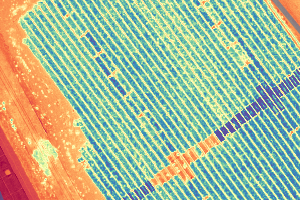
In practice, OSAVI and SAVI often answer similar questions. The distinction is mainly in how the soil correction is handled.
Use OSAVI for emergence surveys, orchards and vineyards with visible inter-row soil, or dryland vegetation where the canopy never closes. Its advantage declines as foliage becomes dense.
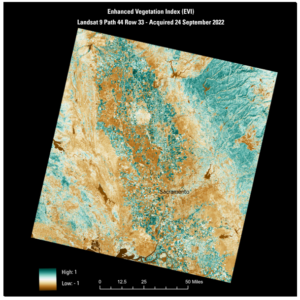
EVI combines NIR, red and blue reflectance to reduce canopy-background and atmospheric influences while retaining sensitivity in high biomass. NASA notes that it loses less sensitivity than NDVI in dense vegetation.
EVI is less forgiving of weak preprocessing. Low blue reflectance means noise, shadows or mismatched bands can strongly affect the result.
Use EVI for mature crops, forests and closed canopies where NDVI flattens changes in structure or biomass. On low-altitude drone surveys, its behavior over dense vegetation usually matters more than its satellite-oriented atmospheric correction.
Index | Main strength | Most useful when | Required bands |
NDVI | General vegetation vigor | Most routine crop and vegetation surveys | Red + NIR |
NDRE | Chlorophyll and dense-canopy sensitivity | Mature or dense crops | Red Edge + NIR |
GNDVI | Chlorophyll-related variability | Active growth and nutrient-related assessment | Green + NIR |
SAVI | Reduces soil influence | Sparse vegetation and early growth | Red + NIR |
OSAVI | Standardized soil correction | Early growth and exposed soil | Red + NIR |
EVI | Dense vegetation sensitivity | High biomass and canopy monitoring | Blue + Red + NIR |
There is no need to calculate all six indices simply because the software makes it possible. A good workflow normally starts with the question being asked.
The choice of vegetation index is directly linked to the spectral bands available on the camera.
The Yusense MS400 combines four multispectral bands with an RGB camera. Its multispectral configuration is 555 nm Green, 660 nm Red, 720 nm Red Edge and 840 nm NIR.
That makes it capable of supporting:
NDVI ✓
NDRE ✓
GNDVI ✓
SAVI ✓
OSAVI ✓
Standard EVI ✕
The reason EVI is excluded is simple: the standard formula requires a Blue band, while the MS400’s listed multispectral configuration starts with Green.
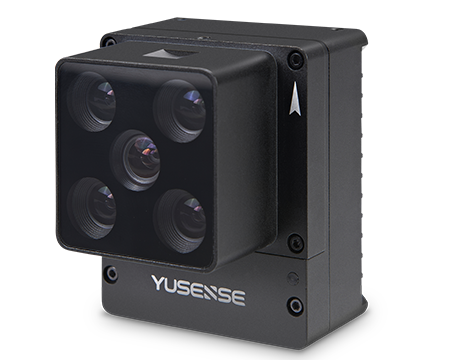
For smaller UAVs and applications where RGB imagery is useful alongside multispectral data, the MS400 is a practical configuration for core vegetation indices.
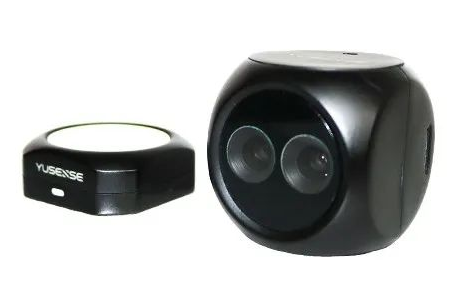
The MS200 adds a Blue channel to the Red, Red Edge and NIR bands. Its standard configuration is 450 nm Blue, 555 nm Green, 660 nm Red, 720 nm Red Edge and 840 nm NIR, with 1.3 MP per multispectral channel and a global shutter.
That band combination covers all six indices. The MS200 is designed as a lightweight payload and is compatible with DJI M30/M30T and other small UAV platforms.
Best fit: compact agricultural surveys, vegetation mapping and projects where a full five-band multispectral configuration is needed without moving to a larger payload
The MS600 Pro uses six multispectral channels: 450 nm Blue, 555 nm Green, 660 nm Red, 720 nm Red Edge, 750 nm Red Edge and 840 nm NIR.
It also provides 12-bit raw data, a global shutter, real-time reflectance calculation and DJI X-Port integration for DJI M400.
Because it includes Blue, Green, Red, Red Edge and NIR, it provides the spectral bands needed for all six indices in this comparison. The additional red-edge channel also gives more flexibility for vegetation analysis beyond the standard NDVI workflow.
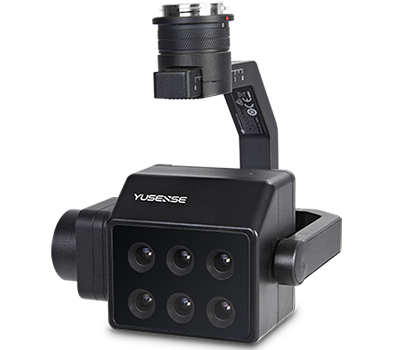
Best fit: precision agriculture, professional vegetation monitoring and repeatable UAV surveys.
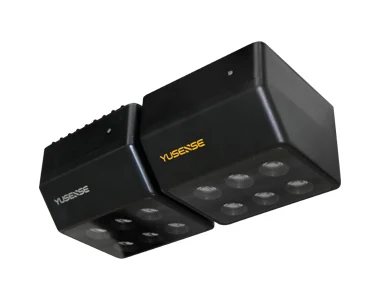
The MS600 V2 + MS600 Dual configuration expands the system to 12 multispectral bands. The V2 covers Blue, Green, Red, two red-edge/NIR-related bands and NIR, while the Dual unit adds further wavelengths from the visible and near-infrared range.
The system supports synchronized 12-band imaging and pixel-level registration, while Yusense positions the MS600 Dual as a way to extract additional information for vegetation physiological parameter inversion.
Best fit: research, advanced vegetation analysis and projects requiring more spectral flexibility.
The RedEdge-P uses five narrow multispectral bands — Blue, Green, Red, Red Edge and NIR — together with a high-resolution panchromatic sensor.
This combination supports NDVI, NDRE, OSAVI and other vegetation indices, while the panchromatic channel enables pan-sharpened outputs with much finer spatial detail.
It is particularly interesting when the spectral information matters but spatial detail matters just as much — for example, when analyzing individual plants rather than only looking at large field-level patterns.
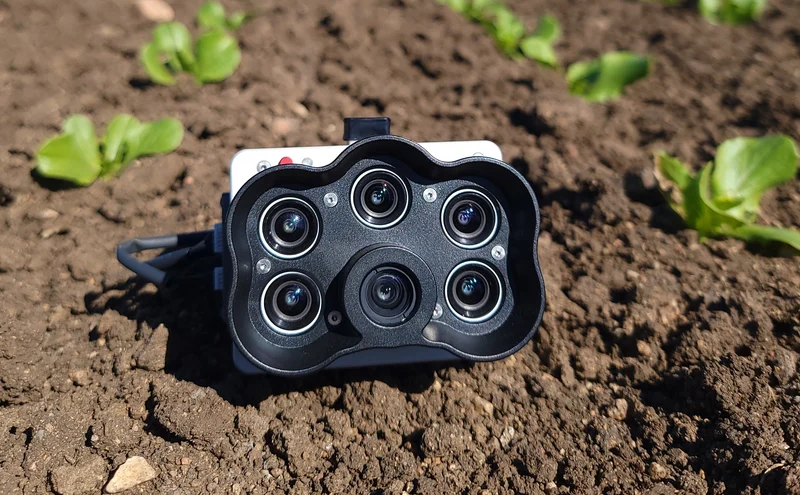
Best fit: high-resolution crop mapping, plant-level analysis and phenotyping.
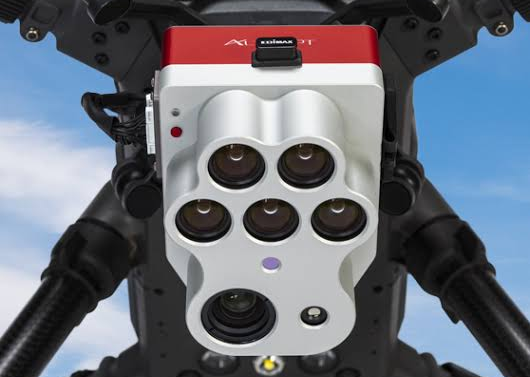
The Altum-PT combines five multispectral bands with a panchromatic sensor and a thermal camera. It features simultaneous multispectral, thermal and panchromatic capture, with outputs including NDVI, NDRE and CIR.
A multispectral map can show that a part of a field is behaving differently. Thermal data can add another dimension by showing differences in surface temperature, which can be relevant to water-stress investigations.
Best fit: precision agriculture where vegetation indices need to be analyzed together with thermal information.
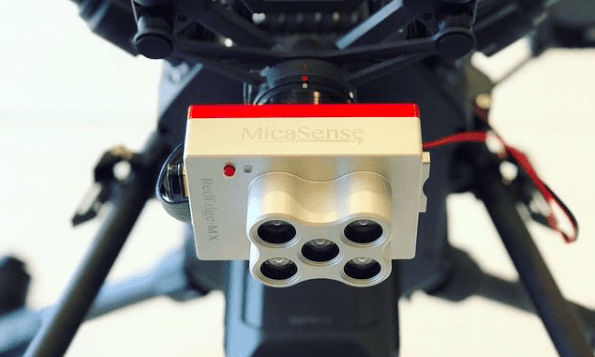
The MicaSense RedEdge-MX captures Blue, Green, Red, Red Edge and NIR bands, making it suitable for the main vegetation indices covered in this article: NDVI, NDRE, GNDVI, SAVI, OSAVI and EVI.
Its five-band configuration makes it a practical choice for crop monitoring, vegetation mapping and workflows where calibrated multispectral data are more important than a large number of spectral channels.
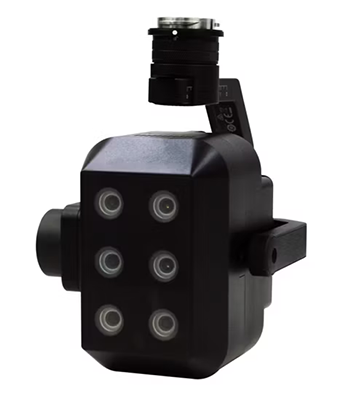
The CHNSpec FS-600 is a six-channel multispectral camera covering the 400–1000 nm range, with customizable band configurations and dual red-edge sensitivity.
This flexibility makes it useful for projects where the required wavelengths depend on the specific application rather than a standard vegetation-index workflow.
One important consideration is that index compatibility depends on the selected band configuration, especially when custom wavelengths are used.
Best fit: agricultural, environmental and research applications requiring a flexible spectral setup.
The cameras differ not only in the vegetation indices they support, but also in payload weight, spatial detail, spectral flexibility and the availability of thermal data.
Camera | Data captured | Index compatibility | Main advantage | Best fit |
Four multispectral bands: Green, Red, Red Edge and NIR; separate RGB camera | NDVI, NDRE, GNDVI, SAVI and OSAVI. Standard EVI is not supported because the multispectral set lacks Blue. | Compact configuration combining core multispectral bands with RGB imagery | Smaller UAVs and routine agricultural or vegetation surveys | |
Five multispectral bands: Blue, Green, Red, Red Edge and NIR | All six indices | Lightweight five-band payload with the complete spectral set required for the indices covered in this article | Compact surveys, vegetation mapping and DJI M30/M30T operations | |
Six multispectral bands, including Blue, Green, Red, two Red Edge channels and NIR | All six indices | Two red-edge wavelengths, real-time reflectance calculation and DJI X-Port integration | Precision agriculture and repeatable professional surveys with DJI M400 | |
Twelve synchronized multispectral bands across the visible and near-infrared range | All six indices, with additional bands available for custom analysis | Greater spectral flexibility and pixel-level registration for advanced models | Research, physiological parameter estimation and detailed vegetation classification | |
Five multispectral bands plus a high-resolution panchromatic sensor | All six indices | Pan-sharpened multispectral imagery with greater spatial detail | Individual-plant mapping, crop trials and phenotyping | |
Five multispectral bands, panchromatic imagery and thermal data | All six indices, supplemented by temperature measurements | Combines spectral, spatial and thermal information in one survey | Crop-health and water-stress investigations requiring thermal context | |
Six customizable bands within the 400–1000 nm range | Depends on the selected configuration; all six require Blue, Green, Red, Red Edge and NIR | Bands can be selected for a specific crop, environment or research model | Projects requiring a configurable spectral setup |
The right index depends on the crop, growth stage, canopy density and soil conditions.
NDVI works well for general vegetation monitoring, while NDRE is often more useful in dense, mature crops. SAVI and OSAVI are better suited to sparse vegetation and exposed soil, while EVI can be useful in high-biomass areas when Blue, Red and NIR bands are available.
The same principle applies to sensor selection: choose the camera based on the analysis you need, not simply on the number of spectral bands or megapixels.
There is no universal best index. NDVI is a useful baseline, SAVI and OSAVI work well when soil is visible, NDRE and GNDVI highlight chlorophyll variation, and EVI is useful in dense vegetation.
NDVI uses Red and NIR bands to indicate vegetation cover and general vigor. NDRE replaces Red with Red Edge and usually remains more sensitive to chlorophyll variation in mature, dense crops.
Both reduce soil-background influence. SAVI uses an adjustable correction factor, while OSAVI fixes it at 0.16. OSAVI is simpler to apply; SAVI offers more control when the adjustment factor can be calibrated.
NDRE and EVI are generally more useful than NDVI in dense canopies. NDRE responds to chlorophyll variation, while EVI retains greater sensitivity to canopy structure and high biomass.
Red and NIR are sufficient for NDVI, SAVI and OSAVI. Adding Green, Red Edge and Blue enables GNDVI, NDRE and standard EVI. A five-band Blue–Green–Red–Red Edge–NIR camera supports all six indices covered here.