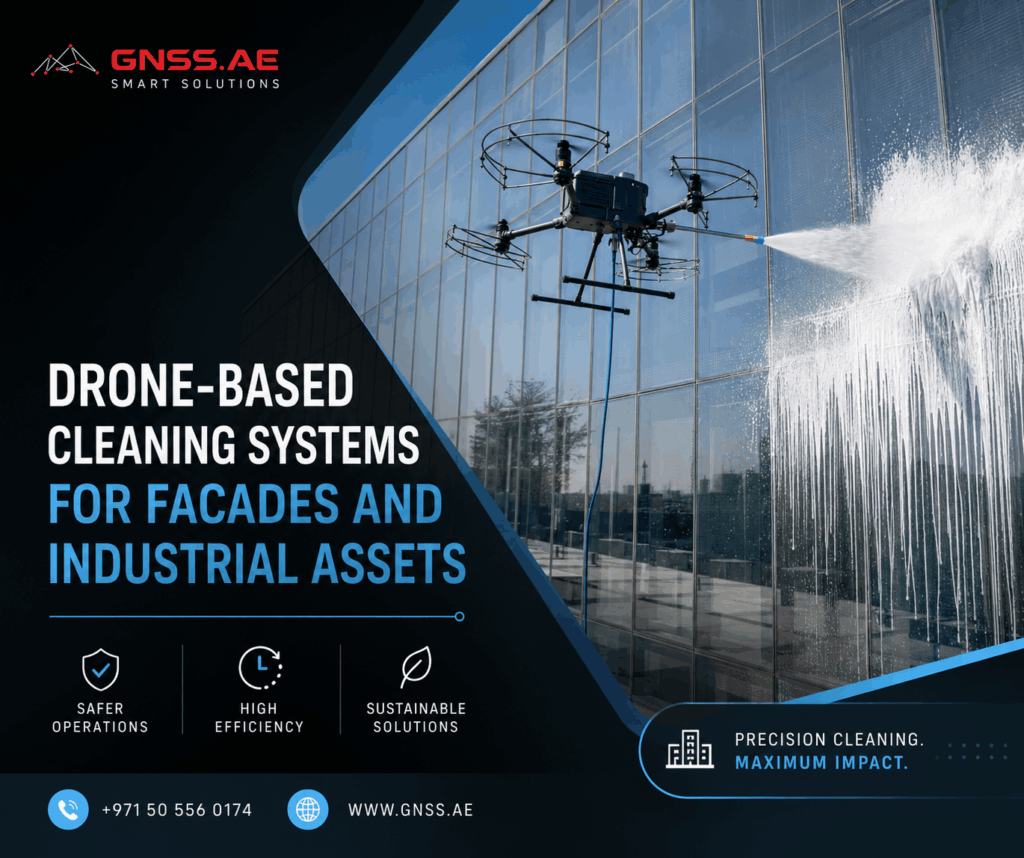
Cleaning high-rise facades, industrial facilities, and large solar farms has traditionally required scaffolding, suspended platforms, boom lifts, or rope access teams. These methods are effective but involve lengthy setup, high labor costs, and safety risks associated with working at height.
Drone-based cleaning systems offer an alternative. Instead of sending workers to the surface, the drone delivers the cleaning equipment directly where it’s needed. Today, these systems are being used to clean glass facades, photovoltaic panels, roofs, storage tanks, and other hard-to-reach structures, with adoption steadily growing beyond pilot projects.
This article explains how drone cleaning systems work, what sets them apart from conventional UAVs, and where they deliver the greatest operational value.
A professional cleaning drone is not simply a standard UAV with a spray nozzle attached. The system combines several components that must work together:
The biggest difference compared with conventional drone operations is that cleaning drones must work in direct proximity to surfaces. Inspection drones usually maintain a safe distance from buildings, bridges, or industrial assets. Cleaning systems must move much closer to deliver consistent water pressure and coverage.
A water jet creates a reaction force that pushes the aircraft in the opposite direction. At high pressures used for professional cleaning applications, this force can affect stability and flight accuracy.
The drone’s flight controller must continuously compensate for these disturbances while maintaining the correct position relative to the surface. This becomes especially important when the aircraft changes direction or moves across areas with different surface geometry.
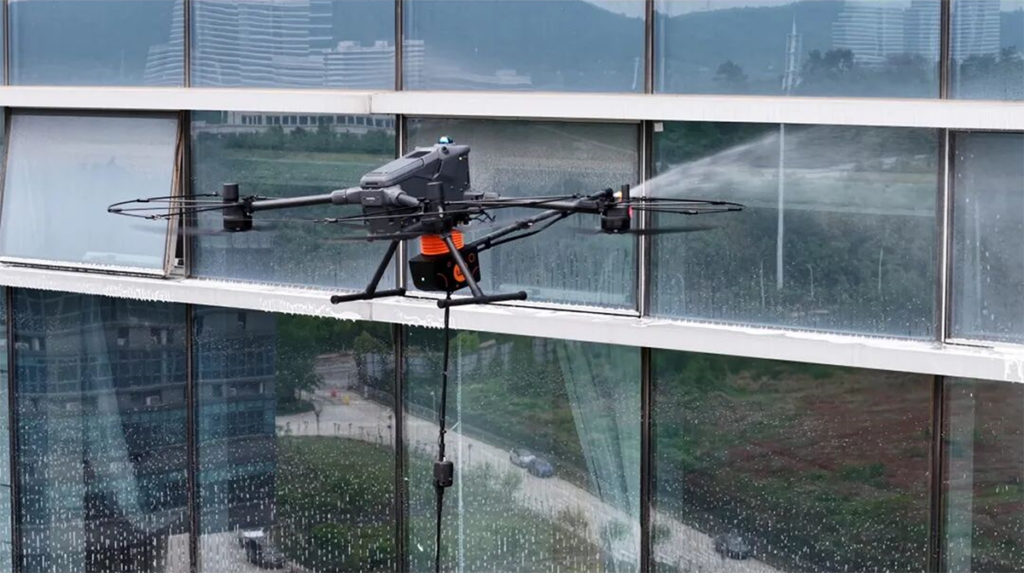
Professional cleaning drones usually do not carry large water tanks onboard. Instead, water is supplied from a ground station through a hose.
This design significantly reduces the aircraft’s payload requirements. Water is heavy — one liter weighs approximately one kilogram — making large onboard tanks impractical for aerial platforms.
With a ground-based supply system, the drone only carries the equipment needed at the working point: the spray assembly, connection mechanism, and hose attachment.
However, the hose itself introduces another challenge. As the aircraft moves, the hose creates changing tension and drag forces. The drone must compensate for these additional loads while maintaining stable flight. This is why professional cleaning drones require specialized control algorithms and carefully designed tether management systems.
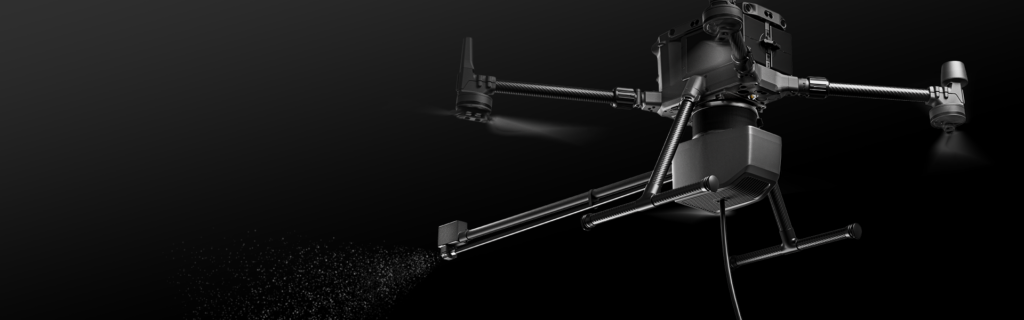
The drone must keep the cleaning nozzle at a consistent distance from the surface. If it moves too far away, water pressure decreases and cleaning becomes less effective. If it gets too close, there is a risk of collision or uneven coverage.
Different manufacturers use different approaches to solve this problem.
Wisson developed the Pliabot® aerial robotic system, which introduces a flexible contact mechanism designed for close interaction with vertical surfaces. Instead of relying only on precise hovering, the system allows controlled contact with the facade, helping maintain a stable working position.
Other systems, including Joyance cleaning drones, focus on precise flight control combined with high-pressure cleaning equipment. These platforms maintain a controlled distance from the surface while the spray system performs the cleaning operation.
In both cases, the goal is the same: create a stable platform that can operate safely and consistently in an environment where ordinary drones are not designed to work.
The design of cleaning drones makes them suitable for a wide range of maintenance tasks where access, safety, or operational downtime are major concerns.
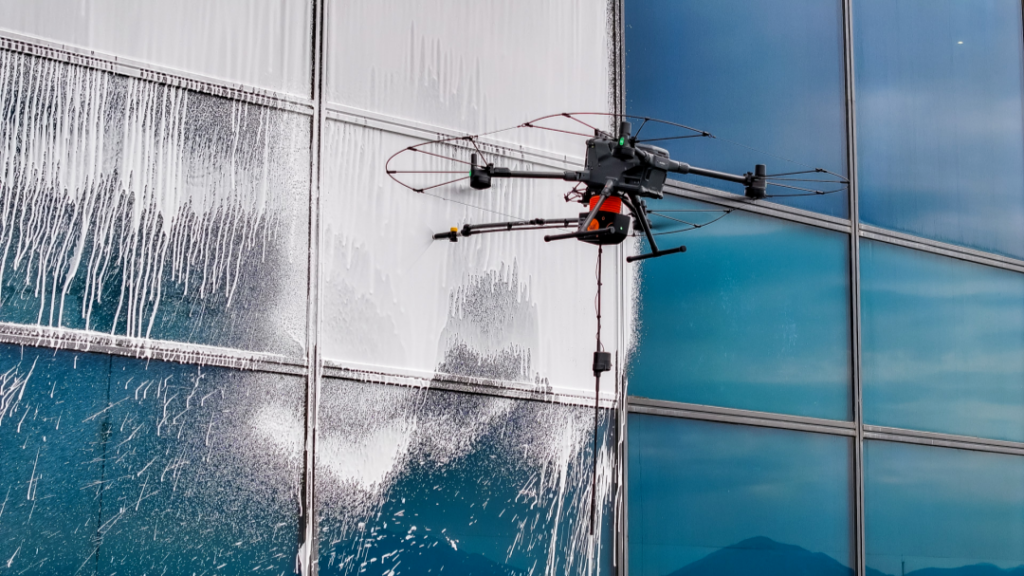
Modern commercial buildings often use large glass curtain walls that require regular maintenance to remove dust, pollution, mineral deposits, and water stains. While traditional access methods are well established, they become increasingly complex as building height and surface area grow.
Drone-based systems can reduce the need for suspended platforms and rope access operations. The aircraft can move vertically along the facade while the cleaning equipment remains connected to a ground station.
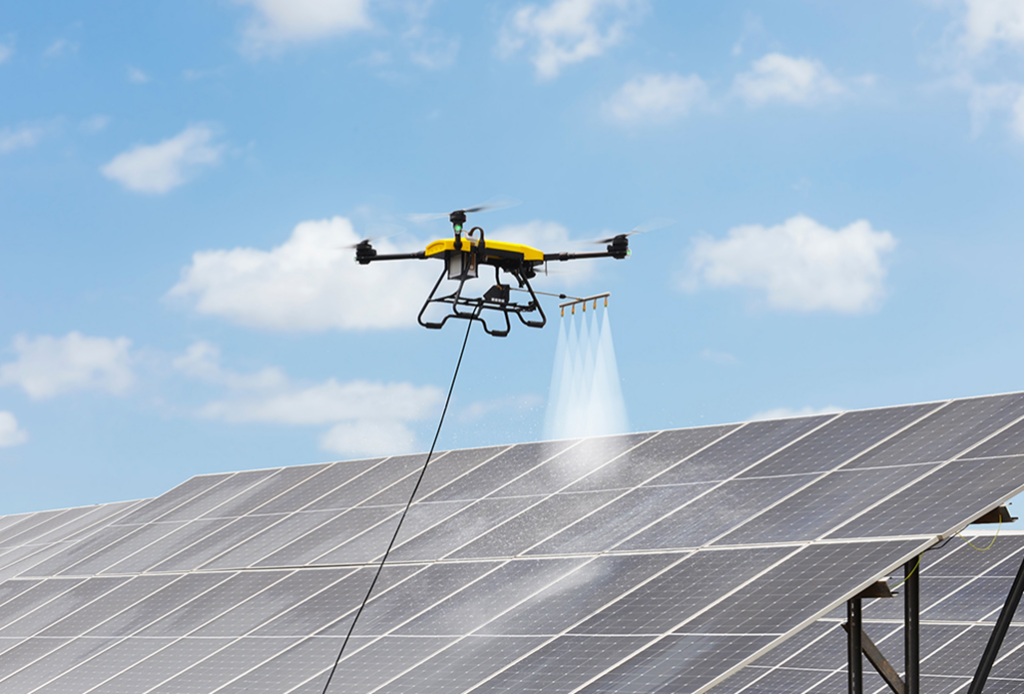
Dust accumulation is a persistent issue, especially in dry and desert regions. Fine particles can create a layer on the panel surface that reduces incoming solar radiation and gradually affects energy production.
Large solar farms may contain thousands or millions of panels distributed over extensive areas. Manual cleaning requires significant labor, while heavy vehicles can create access problems or damage the terrain around the installation.
Cleaning drones provide an alternative by allowing operators to cover large areas without placing workers directly on the panels. The aircraft can follow predefined routes while applying water or cleaning solutions from above.
Industrial facilities often contain structures that are difficult to inspect and maintain using conventional equipment.
Examples include:
In these environments, cleaning is often performed as part of regular maintenance programs. However, installing scaffolding around industrial assets can be expensive and may interfere with normal operations.
A drone-based cleaning system allows maintenance teams to reach elevated surfaces while reducing the amount of temporary infrastructure required.
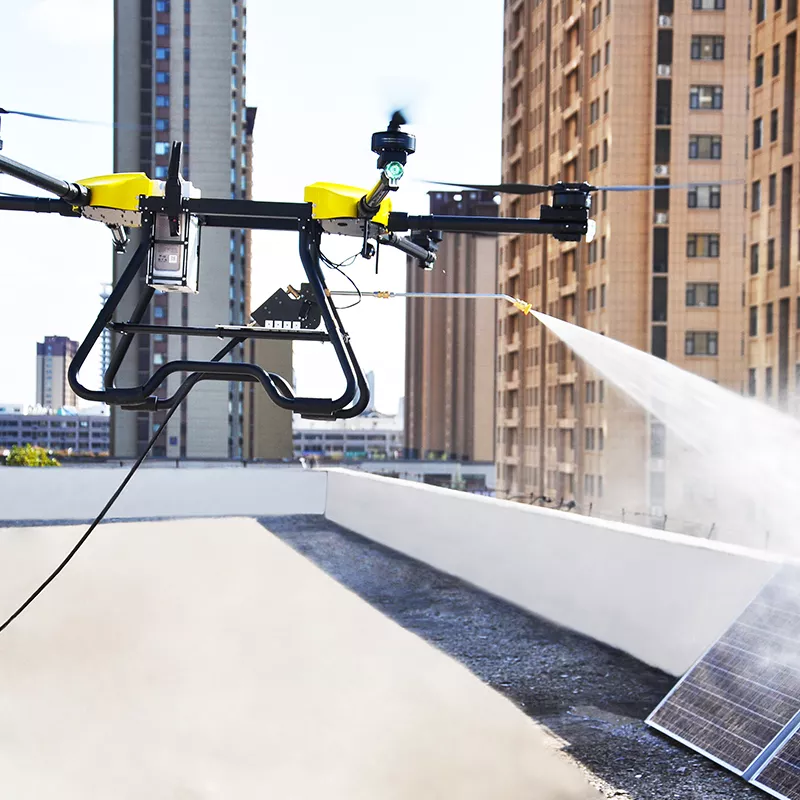
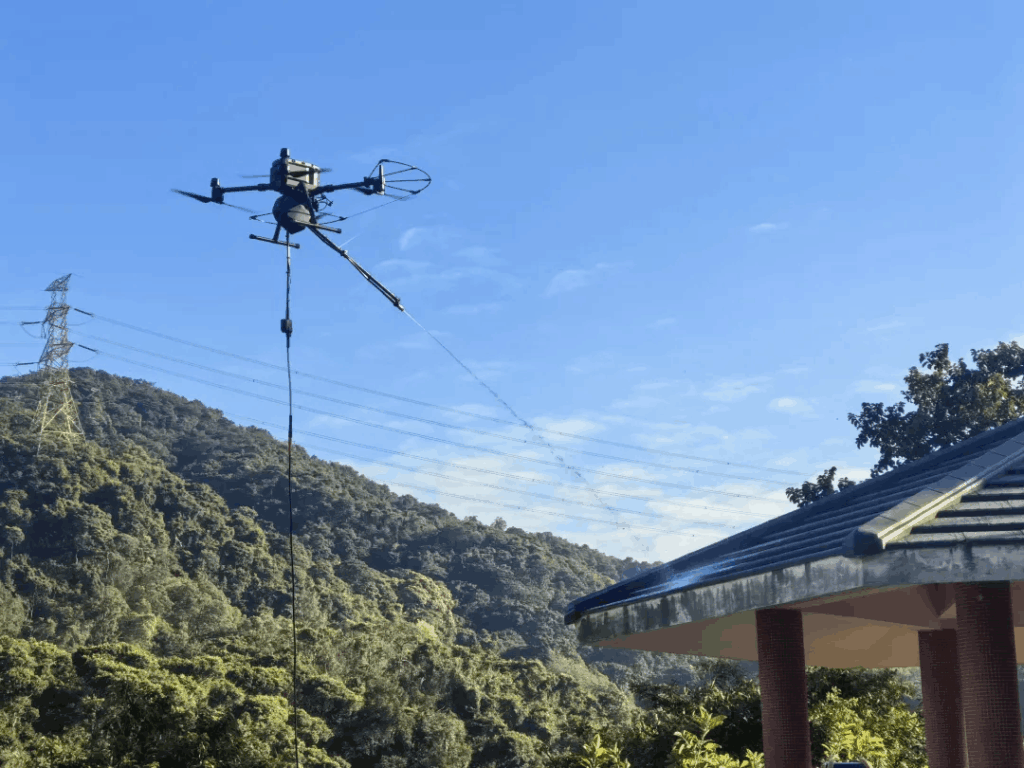
Commercial roofs accumulate dirt, organic material, and debris that can affect drainage and long-term maintenance.
Roof cleaning is usually less demanding than facade cleaning because the drone does not need to operate next to a vertical wall. However, aerial systems can still provide advantages by reducing manual movement across large roof areas and improving access to difficult sections.
One of the most detailed examples of commercial drone cleaning deployment comes from Wisson Robotics.
The company used its AP3-P3 Pliabot® Aerial Tethered Cleaning System for a glass facade cleaning project at the Pearl River International Entrepreneurship Center.
The project covered nearly 20,000 m² of glass facade. According to Wisson’s published case study, the cleaning operation was completed in eight days, with approximately 7.5 working hours per day.
The team consisted of only three people:
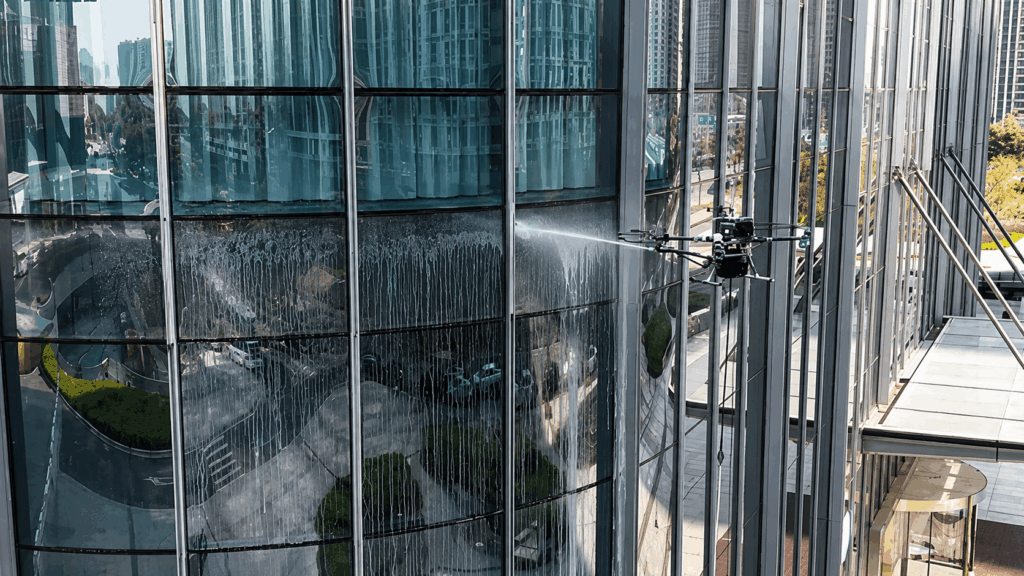
The system used a tethered configuration, meaning the drone received water and power support through ground equipment rather than carrying the entire cleaning system onboard.
The project demonstrated several advantages of aerial cleaning for large buildings:
The case is important because it shows that cleaning drones are moving beyond demonstrations and can already support real maintenance workflows.
While Wisson focuses heavily on tethered facade cleaning solutions, Joyance develops a broader range of cleaning drone configurations designed for different applications.
The company’s cleaning drone lineup includes systems for:
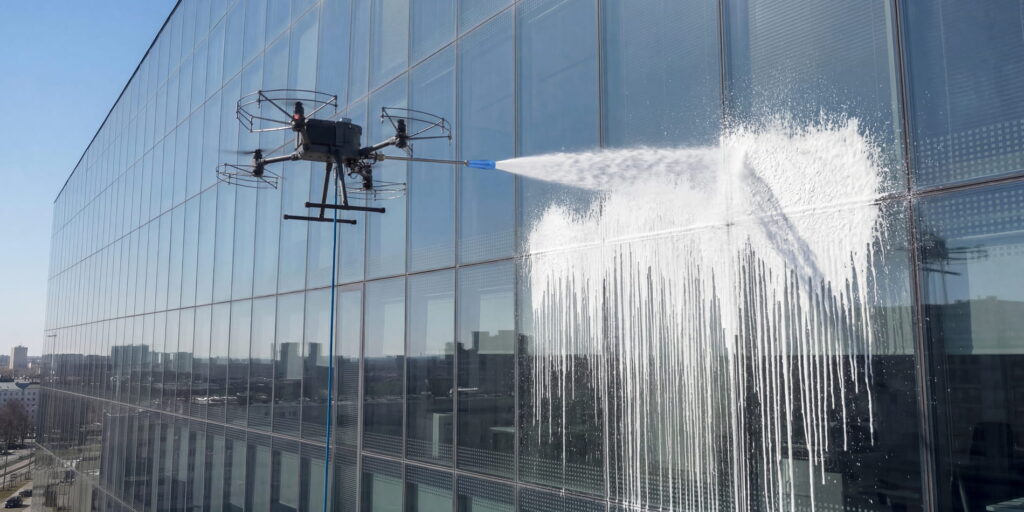
The JOYANCE JTC10 Cleaning Drone is a compact solution for facade, window, roof, and solar panel cleaning. It uses a high-pressure cleaning system reaching up to 4,100 PSI and is designed for operations at heights of up to 60 meters.
The JOYANCE JTC20 Cleaning Drone extends the working range to 100 meters and is designed for larger buildings and more demanding cleaning tasks. It supports high-pressure water cleaning with adjustable spray positioning for different surface conditions.
For high-rise and industrial applications, the JOYANCE JTC30 Cleaning Drone provides a larger operating range, reaching up to 150 meters with a high-pressure cleaning system. It is designed for hard-to-reach structures where greater altitude capability and cleaning performance are required.
This range highlights an important point: cleaning drones are not built as one-size-fits-all solutions. Different surfaces and operating environments require different combinations of flight capability, cleaning power, and deployment flexibility.
Drone-based cleaning systems provide several practical advantages, but they should be considered as specialized maintenance tools rather than universal replacements for all cleaning methods.
Advantages | Limitations |
Reduced work at heightCleaning operations are performed by an unmanned system, reducing the need for workers to operate on suspended platforms or ropes. | Weather sensitivityWind, turbulence, and hose forces can affect flight stability, especially during close-range facade cleaning. |
Lower deployment requirementsCompared with scaffolding or lifting equipment, drones require less physical infrastructure and can be deployed in areas with limited access. | Surface limitationsDifferent materials require different cleaning parameters. Glass, solar panels, painted surfaces, and industrial equipment may require different pressure levels and cleaning solutions. |
Reduced operational disruptionCompact drone operations can minimize the need for road closures, restricted access areas, or large equipment around the site. | Regulatory requirementsCommercial operators must comply with local UAV regulations, particularly when working near buildings, public areas, or industrial facilities. |
Access to difficult locationsDrones can reach tall buildings, industrial structures, and remote installations without extensive preparation or access equipment. | Operator expertiseCleaning drones require specialized knowledge of both UAV operation and cleaning procedures to achieve consistent results. |
Drone-based cleaning systems are becoming a practical solution for maintaining surfaces where traditional access methods are inefficient, expensive, or risky.
The technology combines several disciplines: multirotor flight control, high-pressure cleaning, tether management, and robotic positioning. This combination allows drones to perform tasks that go far beyond aerial inspection.
Real-world projects, such as Wisson’s 20,000 m² facade cleaning operation, demonstrate that these systems are already capable of supporting commercial maintenance workflows.
As drone platforms become more automated and better integrated into facility management processes, aerial cleaning is likely to become another specialized tool used alongside traditional maintenance methods.