On many industrial sites, the environment is harder on the drone than the flight itself. A drone inspecting conveyors at a cement plant may spend hours in fine dust. A mapping mission at a port may expose the aircraft to moisture and salt spray. At a refinery or power station, rain, sand, and airborne particles can all become part of a normal workday.
That is why IP ratings have become one of the most important specifications in industrial drones by 2026. Models such as the DJI Matrice 4TD, DJI Dock 3, and the new Matrice 400 are now expected to operate in conditions that would quickly damage a consumer drone.
Yet the meaning of ratings such as IP54, IP55, or IP67 is often misunderstood. Many operators assume that an IP55 drone is “waterproof”, or that the same level of protection applies to the aircraft, battery, payload, and controller. In practice, the reality is more complicated.
To use an industrial drone correctly, it is not enough to know the number. It is necessary to understand how the rating is tested, what exactly it protects, and where its limits begin.

IP stands for Ingress Protection. The rating is defined by the IEC 60529 standard and describes how well an enclosure protects internal components from:
An IP rating always consists of two numbers:
For example:
Rating | Protection Against Solids | Protection Against Water |
IP54 | Limited dust ingress allowed | Splashing water from any direction |
IP55 | Dust-protected | Low-pressure water jets |
IP56 | Dust-protected | More powerful water jets |
IP67 | Fully dust-tight | Temporary immersion in water |
The first digit is usually the most important for drone operations in construction, mining, and desert environments.
First Digit | Meaning |
5 | Dust-protected. Some dust may enter, but not enough to affect operation |
6 | Completely dust-tight |
The second digit becomes more important for operations in rain, offshore facilities, and industrial washdown environments.
Second Digit | Meaning |
4 | Resistant to splashing water |
5 | Resistant to water jets |
6 | Resistant to stronger water jets |
7 | Can survive temporary immersion |
This distinction is important because IP55 does not mean that a drone is waterproof.
An IP55-rated platform is designed to tolerate rain and moisture better than a standard drone, but it is not designed for:

One of the most important details often missed in specifications is that an IP rating is based on a laboratory test—not on years of field use.
For a dust test, the device is placed in a sealed chamber containing fine particles. Air circulates the dust around the enclosure for a fixed period of time. After the test, the device is inspected to determine whether enough dust entered to interfere with operation.
For water testing, the equipment is exposed to increasingly severe conditions:
Water Rating | Test Method | Typical Equivalent |
IPX3 | Spraying water at an angle | Light rain |
IPX4 | Splashing water from all directions | Wind-blown rain |
IPX5 | Water jets from a nozzle | Heavy rain or hose-level spray |
IPX6 | Powerful water jets | Storm conditions or washdown |
IPX7 | Temporary immersion | Falling into shallow water |
IPX8 | Continuous immersion | Long-term underwater use |
An IPX5 test, for instance, involves spraying a water jet at the enclosure from various angles for a set duration and pressure. On the other hand, an IPX7 test is quite different: it requires the device to be fully submerged in water for as long as 30 minutes. Just because a device passes one test doesn’t mean it will pass the other.
For example, an IP67 enclosure might handle being submerged but may not be able to endure a powerful water jet unless it has also been tested separately for IP65 or IP66.
A drone isn’t just a single, sealed unit; it’s made up of several different parts:
Each of these components can have varying levels of protection. One common misconception is thinking that if the aircraft has an IP55 rating, the whole system must also be IP55. In practice, the controller, payload, or charging contacts may have lower protection and become the weak point.
Platform | IP Rating | What It Means in Practice |
IP55 | Suitable for light rain, dust, and industrial environments | |
IP55 | Similar protection level for automated Dock 3 operations | |
IP56 | Better resistance to water and dust than the drone itself | |
IP55 | Designed for harsh industrial inspection and long-range missions | |
IP55 | Proven platform for utility, oil & gas, and infrastructure inspections |
The DJI Matrice 4TD is one of the most relevant examples because it was specifically designed for autonomous inspection workflows with DJI Dock 3.
Unlike the standard Matrice 4T and Matrice 4E, which do not have the same environmental protection, the 4TD can operate in rain, dust, and low temperatures while remaining deployed outdoors for extended periods.
DJI Dock 3 goes one step further. Its IP56 rating is higher than the rating of the drone itself, because the dock must continue functioning continuously in outdoor conditions.
This approach was described in more detail in the earlier GNSS.AE article “DJI Dock 3: An Autonomous Solution for Enterprise Operations”, which examined why DJI designed Dock 3 with an IP56 enclosure and paired it specifically with the IP55-rated Matrice 4D and 4TD for permanent outdoor deployment.
This is particularly important in remote inspection workflows where the drone may remain at a facility for weeks or months without being stored indoors.
The Matrice 400 follows a similar path. While it’s designed to handle larger payloads and longer missions, its IP55 rating makes it a better fit for offshore inspections, utility corridors, and industrial sites compared to earlier heavy-lift platforms that didn’t offer environmental protection.

In drone specifications, IP55 is often described informally as “weatherproof”. That description is useful—but it is also where most misunderstandings begin.
IP55 means the drone can resist dust and water jets. It does not mean:
A drone rated IP55 may work perfectly in light or moderate rain, but still fail if water is driven into the body by strong wind, rotor turbulence, damaged seals, or repeated exposure.
This is especially true in coastal environments. Saltwater is more aggressive than fresh water. Even when no visible water enters the enclosure, salt aerosol can remain on the motors, cooling vents, screws, and contacts. Over time, that causes corrosion, oxidation, and increased electrical resistance.
Field operators working with Matrice 30T and similar drones consistently point out that the aircraft may tolerate rain, but still needs to be dried and cleaned afterward—especially after flights near the sea or in fog.
A useful rule is:
The same IP rating can mean different things depending on where the drone is used.
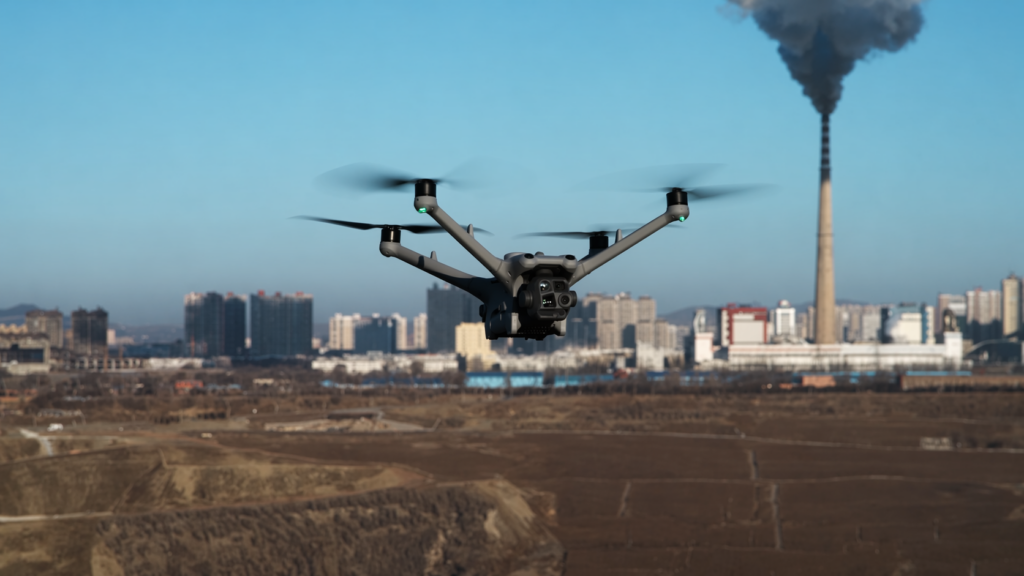
In quarries, mines, cement plants, and construction projects, the main risk is often not water but airborne dust. Fine cement powder and quarry dust can enter motors, bearings, cooling channels, and gimbal mechanisms. For these environments, the first digit of the IP rating is more important than the second.
An IP55 drone is often sufficient. An unrated consumer drone may continue flying, but repeated exposure usually shortens motor life and causes unstable gimbal performance.

Near the sea, the danger comes from moisture combined with salt.
Even a drone rated IP55 shouldn’t be stored while wet after coastal flights. The recommended practice is to wipe it down, check battery contacts carefully, and let it dry thoroughly in a controlled setting before putting it away. Importantly, the standard IP test doesn’t cover salt corrosion, so a drone that meets IP55 standards can still suffer damage after repeated offshore use.

The difference between “light rain” and “storm conditions” matters.
Most industrial IP55 drones can tolerate light or moderate rain. However, wind changes the effective pressure of water striking the drone. A 40 km/h crosswind can push water into areas that were never exposed during a laboratory IPX5 test.
DJI itself generally recommends avoiding operation when rainfall exceeds approximately 100 mm over 24 hours, even for IP-rated aircraft

Sand is often more difficult than dust because it is abrasive.
An IP55 drone may resist sand entering the body, but exposed moving parts—motors, gimbal joints, folding arms, landing gear—can still wear quickly. In desert operations, routine cleaning becomes as important as the IP rating itself.
A strong IP rating is useful only if the drone is operated correctly. In practice, the following habits make more difference than choosing between IP54 and IP55:
Operating Condition | Recommended Practice |
Rain | Keep all port covers closed, inspect seals before flight, dry the aircraft immediately after landing |
Coastal work | Clean the drone after every mission to remove salt residue |
Dust and sand | Blow out moving parts with dry air and inspect motors regularly |
Cold weather with condensation | Let the drone acclimatize before powering on |
Long-term use | Replace damaged seals and worn rubber covers |
Another point often forgotten is that IP protection degrades over time. Rubber gaskets age, seals compress, screws loosen, and repeated opening of battery or SD-card compartments reduces protection.
A three-year-old IP55 drone that has worked in dust, heat, and rain may no longer provide the same protection as when it left the factory. Engineers in other industries regularly note that an IP rating only applies while the enclosure remains in its original condition.
IP ratings are useful because they provide a common technical reference.
They make it easier to compare platforms such as the Matrice 4TD, Matrice 400, Matrice 350 RTK, and DJI Dock 3.
However, they should never be interpreted as proof that a drone can operate safely in any environment.
The laboratory test behind IP55 or IP56 is much simpler than real field conditions.
A drone may pass the official test and still fail because of condensation, salt, dust accumulation, or repeated exposure over time.
The most successful drone operators in 2026 are not necessarily the ones using the highest IP-rated platform. They are the ones who understand what the rating means, where its limits are, and how to adapt maintenance and flight planning to the actual environment.
When interpreted correctly, IP ratings become useful. When interpreted incorrectly, they create a false sense of security.