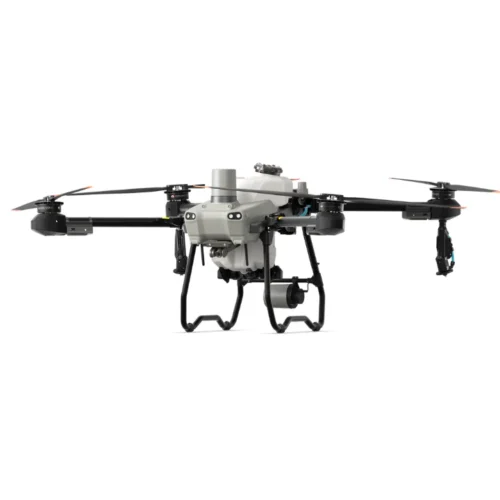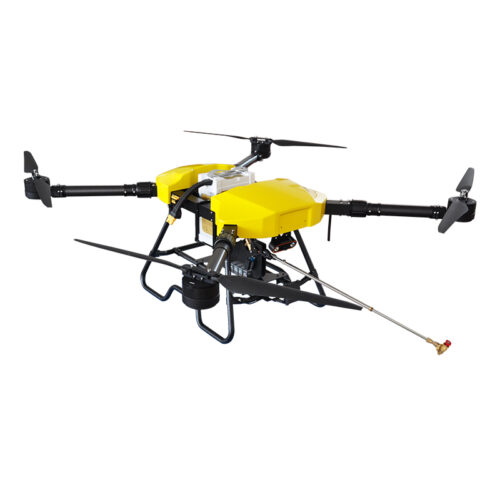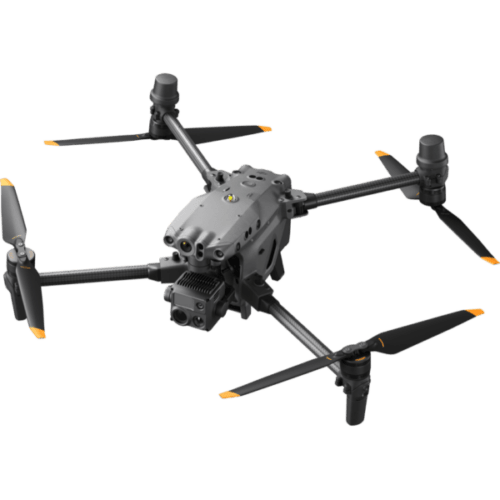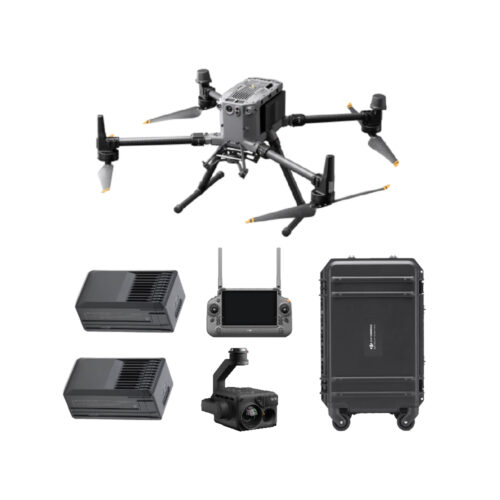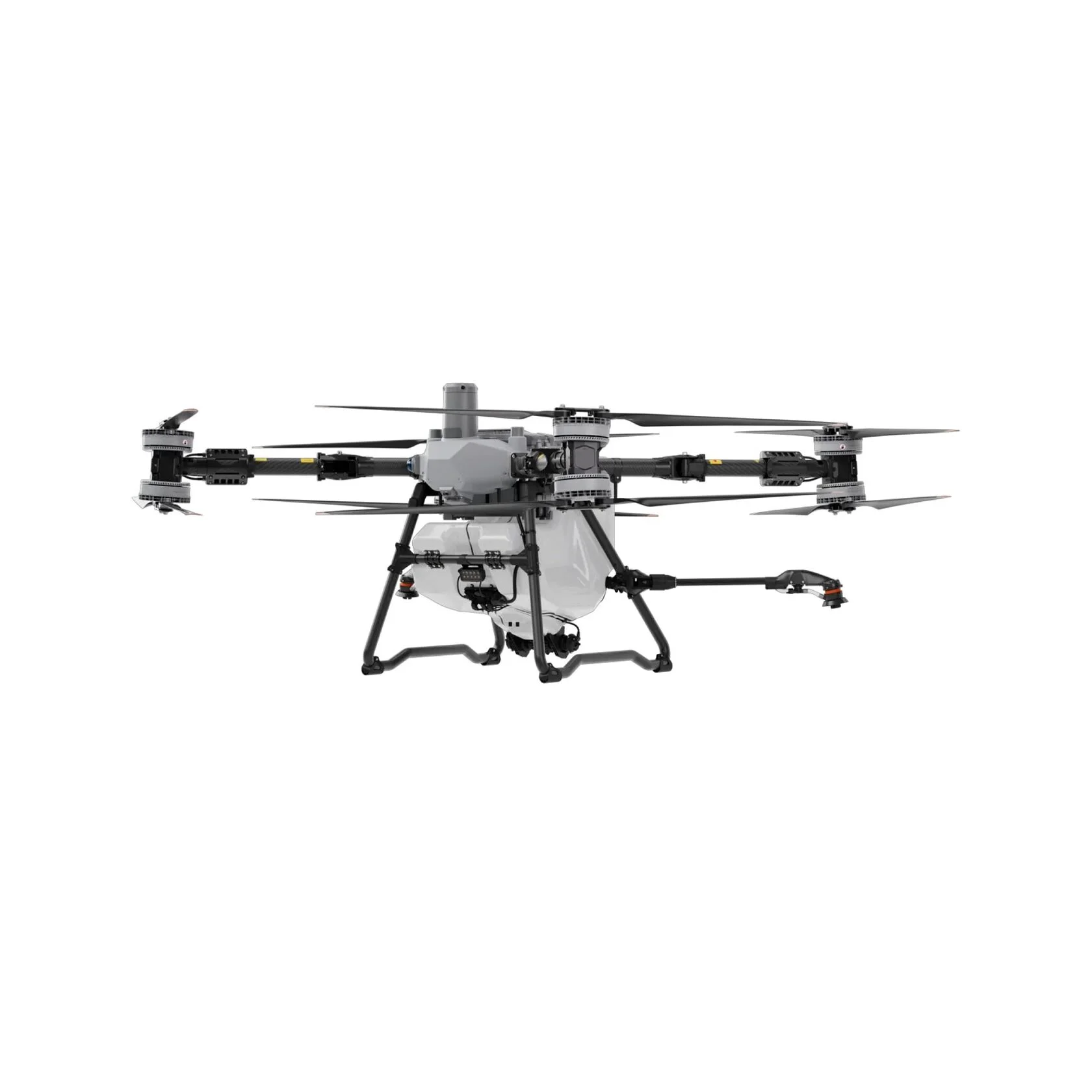
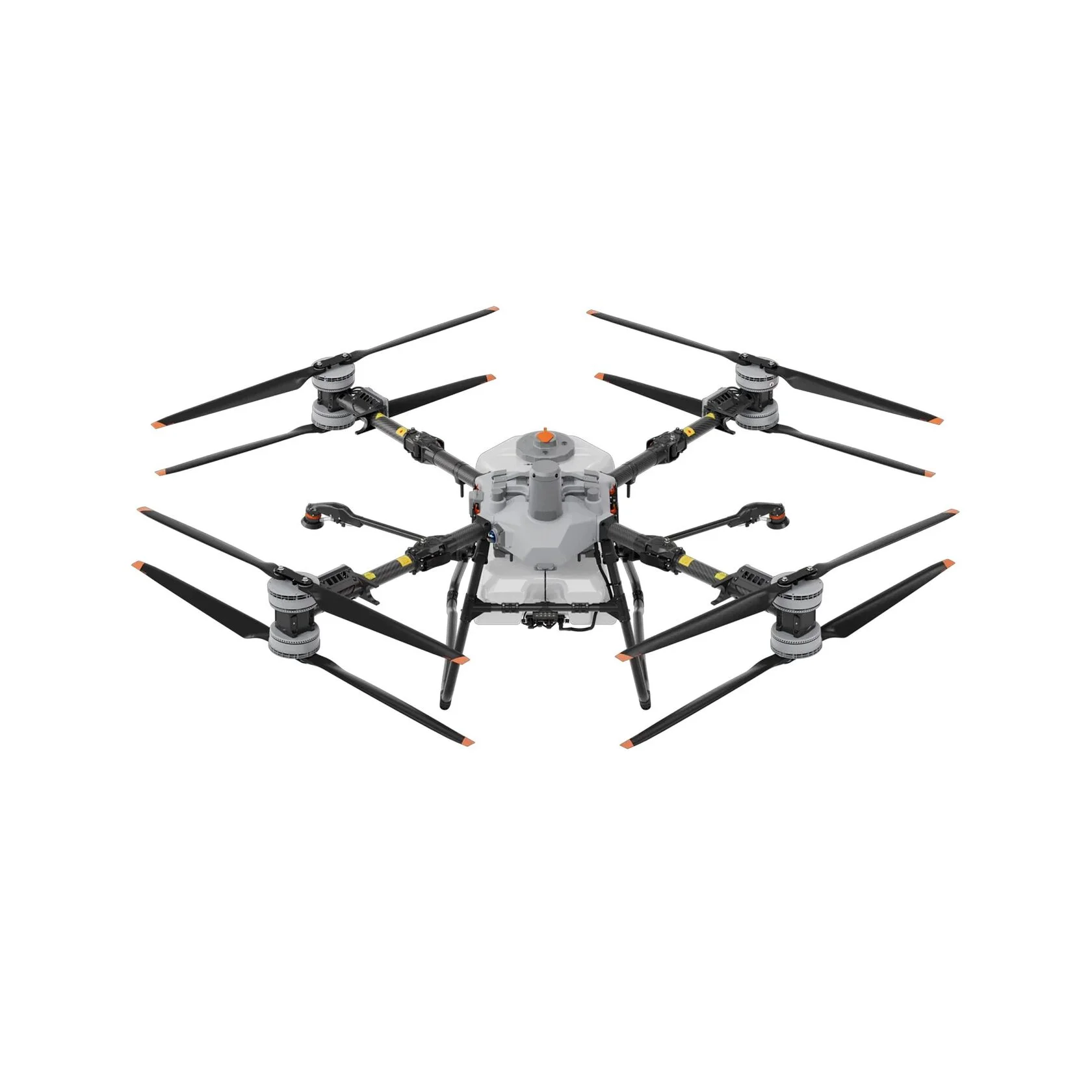
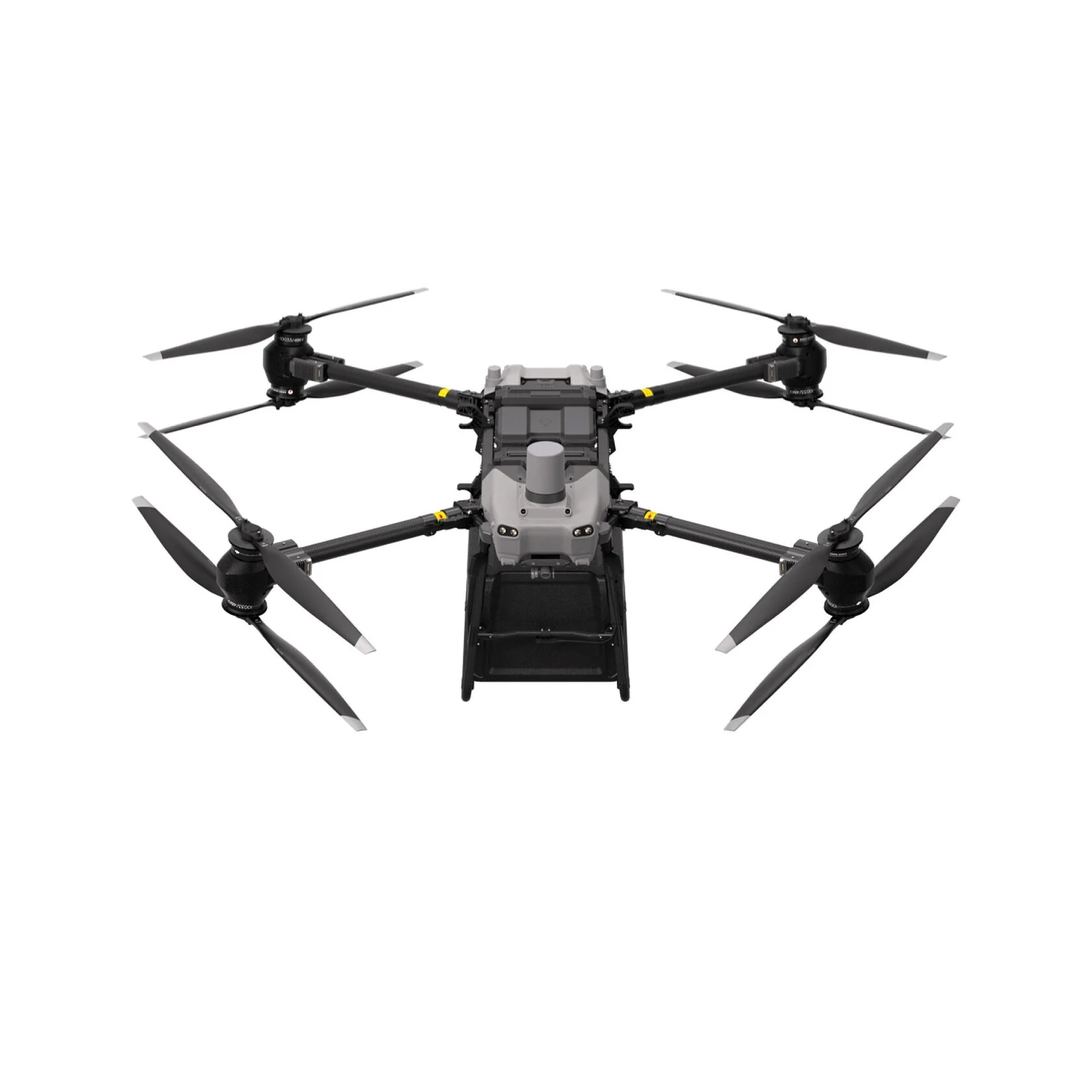
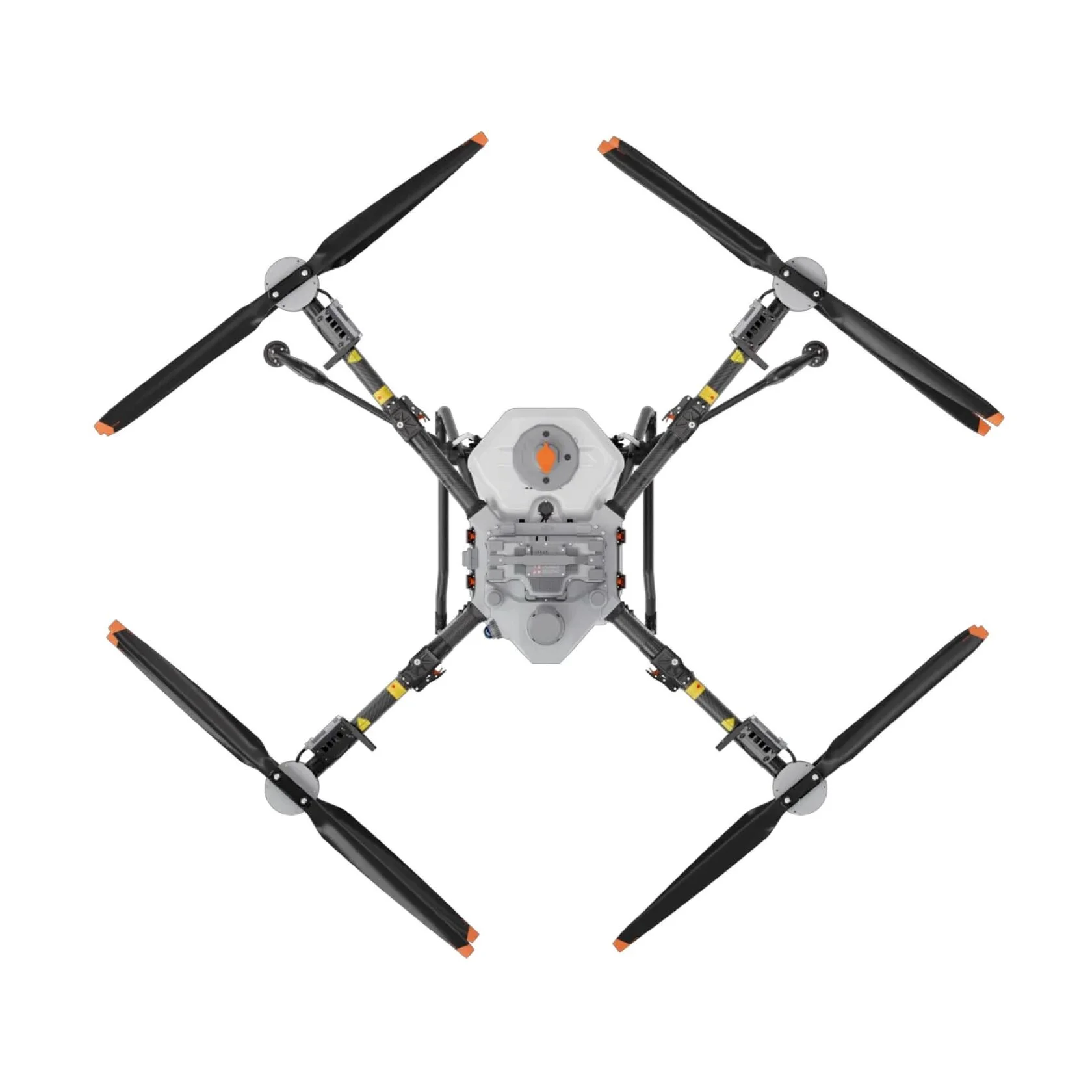
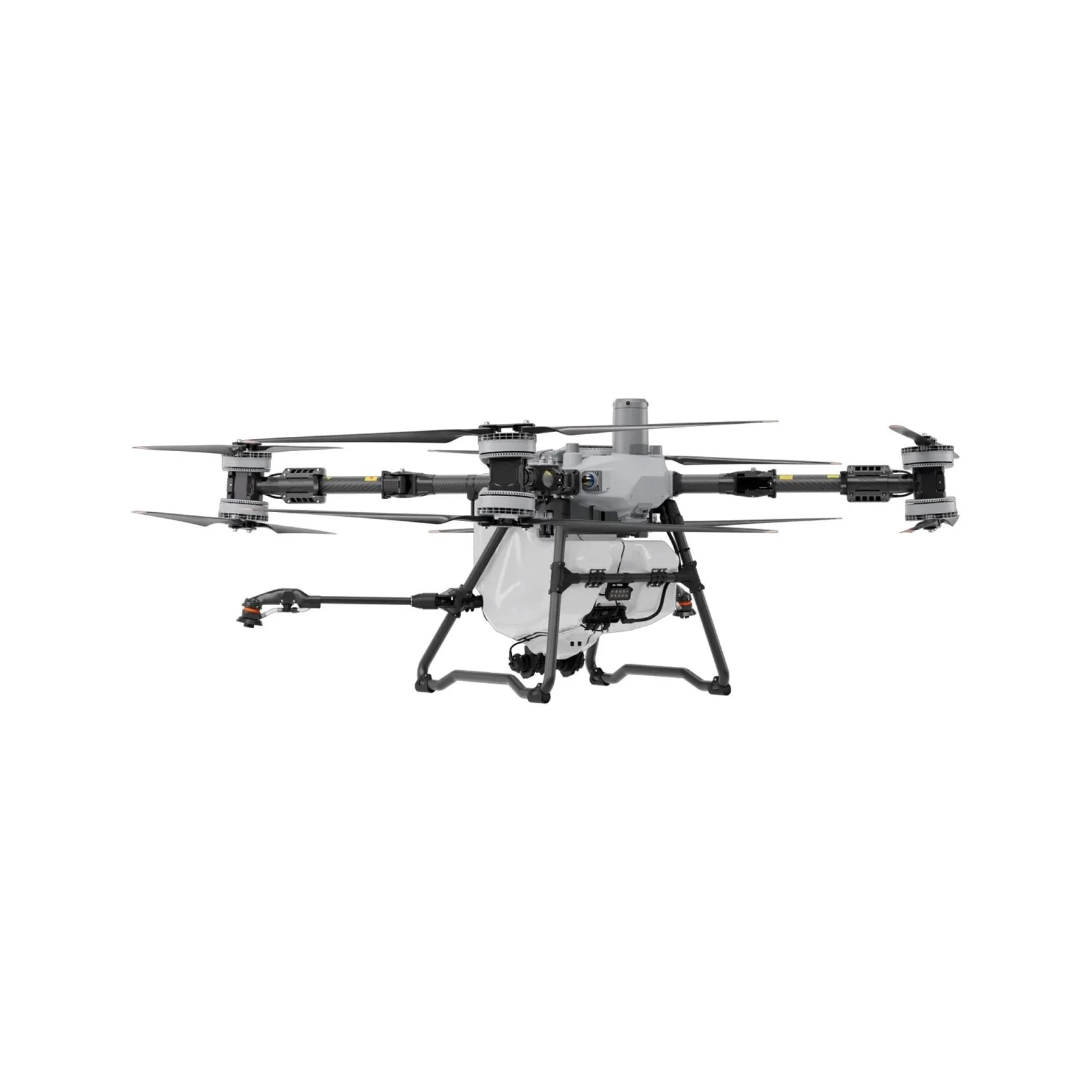
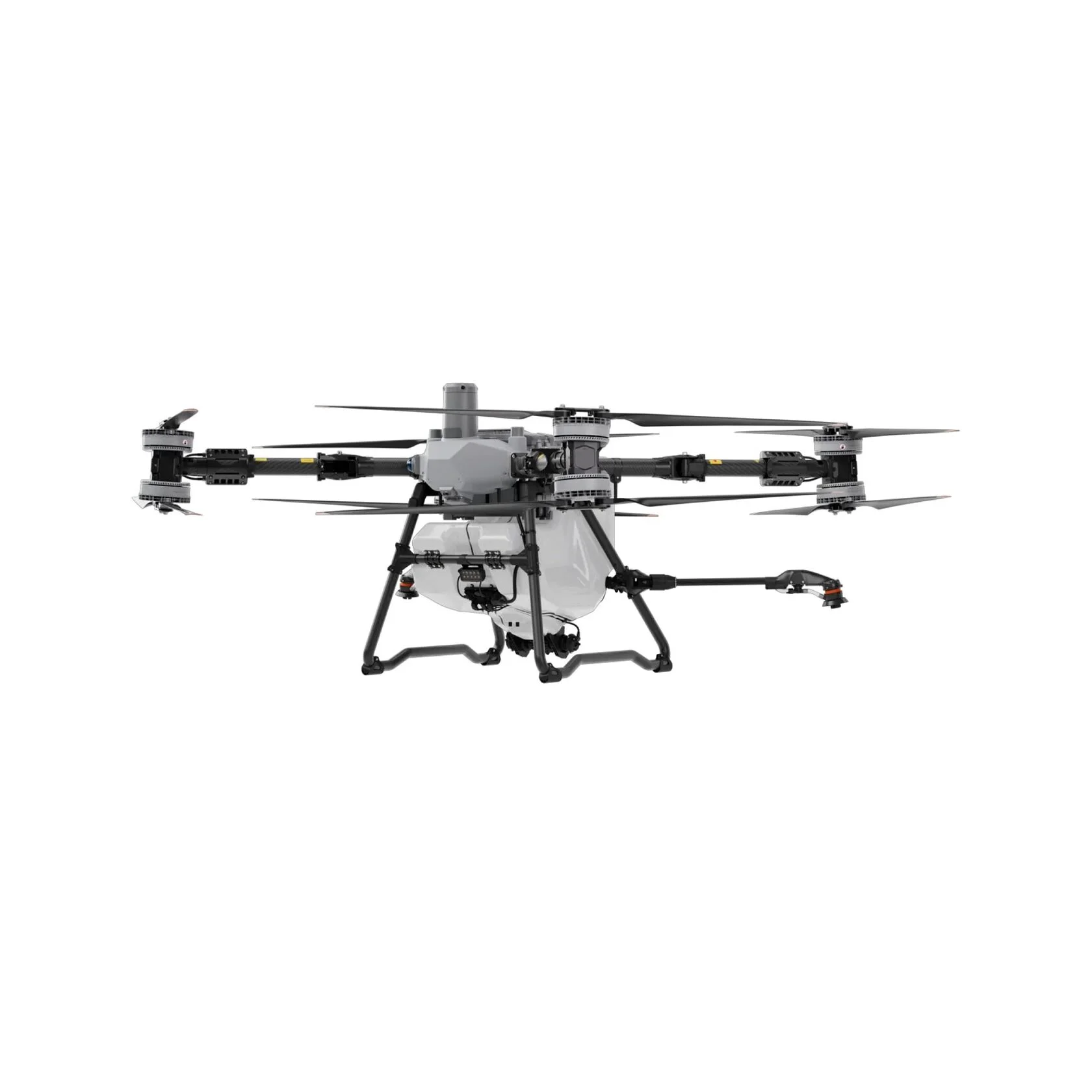
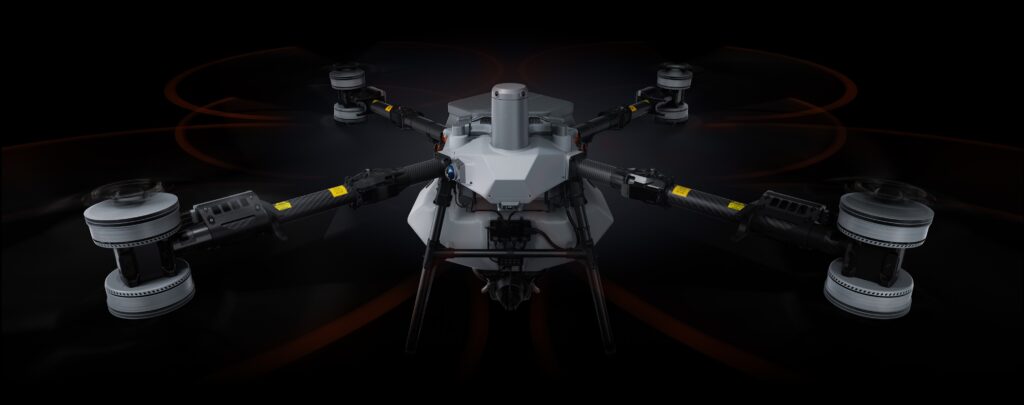
The T100 Agricultural Drone, a groundbreaking creation twelve years in the making, boasts a maximum payload of 100 kg[1]. Its operational efficiency is doubled, supporting multiple application scenarios, including spraying, spreading, and lifting tasks. Featuring industry-leading safety systems[2] and advanced algorithms, it delivers unparalleled safety performance and an intelligent operational experience.

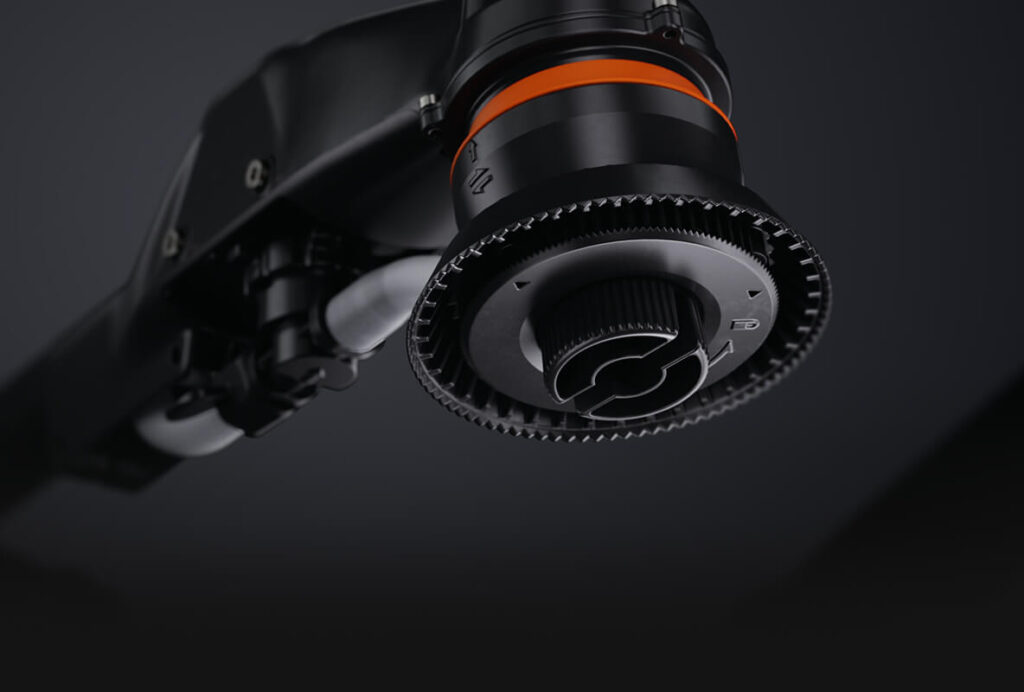
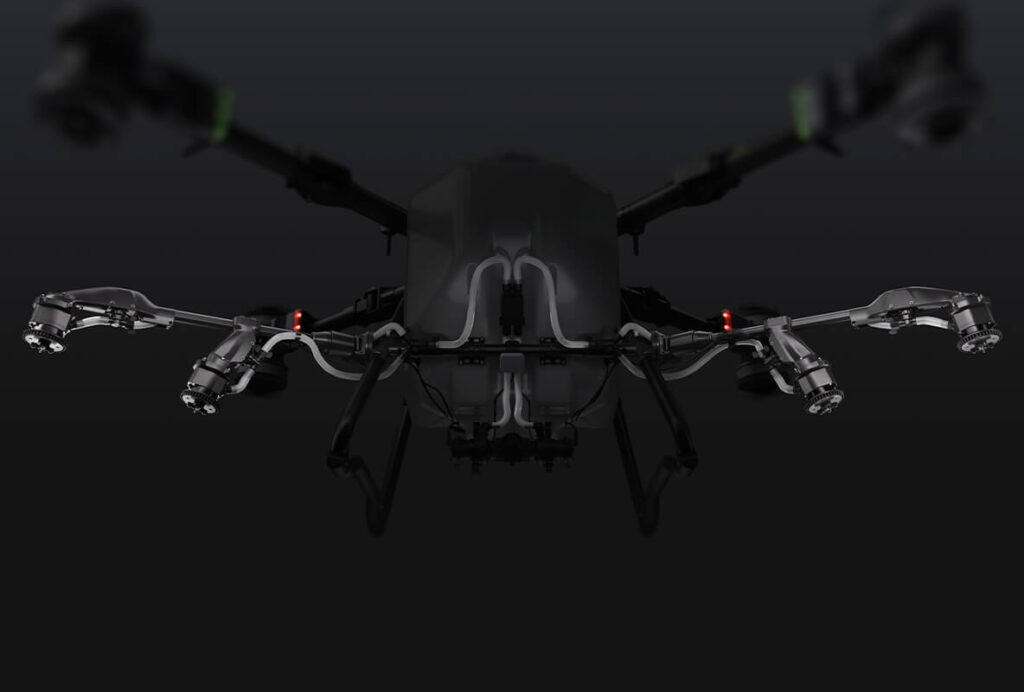
The T100 comes equipped with a 100 L tank and dual atomizing centrifugal sprinklers, enabling faster flight speeds, wider spray coverage, and higher operation efficiency for large-scale field applications. Orchard users can choose an optional mist sprinkler set, which upgrades flow rates and atomization effects to penetrate dense canopies and reach the undersides of leaves on tall, thickly-canopied trees, ensuring outstanding versatility and performance across various agricultural tasks.
36 %
Increase in Operation Efficiency[27]
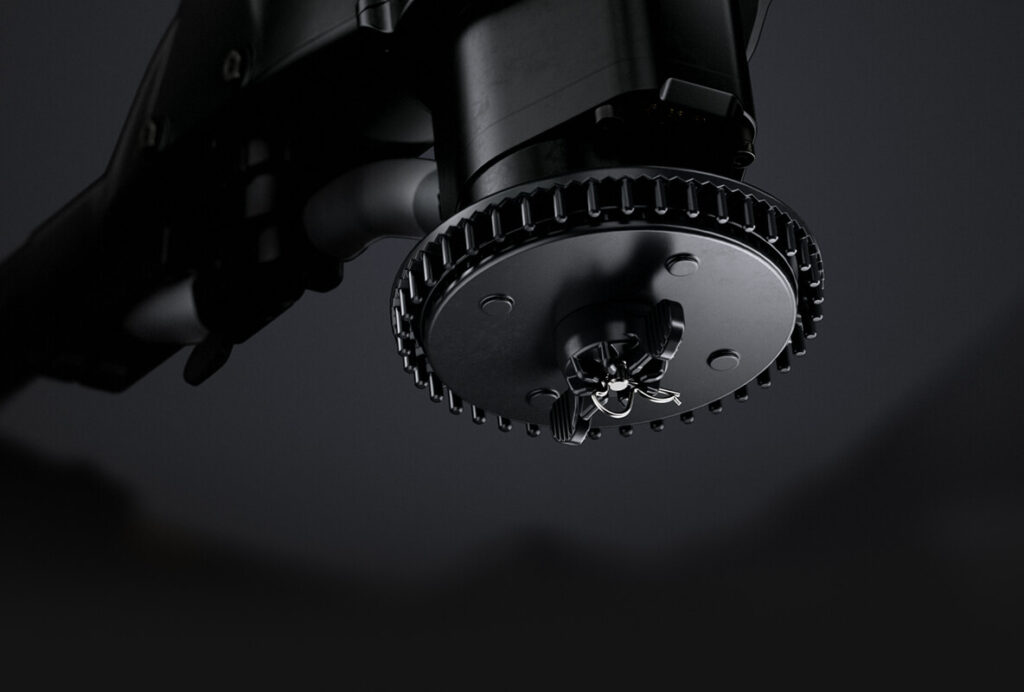
Spreading accuracy doubled, flow rate increased by 270%[7], and granulars applicability further enhanced.


Provides real-time, accurate display of granular quantity, allowing for precise usage and refilling, effectively minimizing waste. Automatic flow rate calibration and cloud-save operation templates, making spreading operation more accurate and convenient.
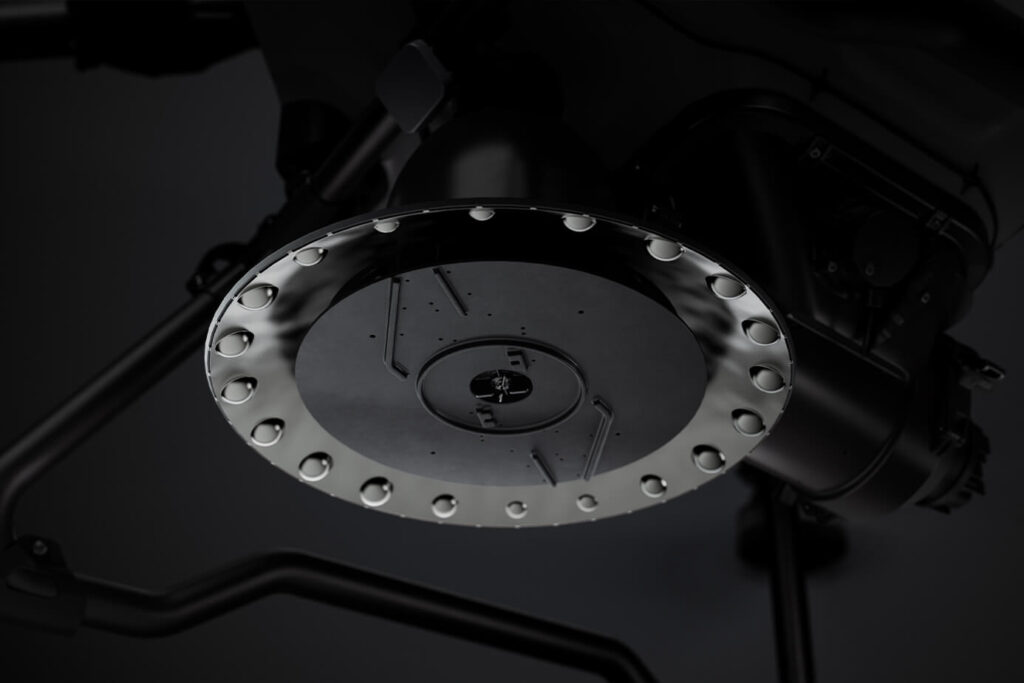
Ensures uniform spreading across the entire flow range with outstanding results. Features a stainless steel cap for durability and strength.
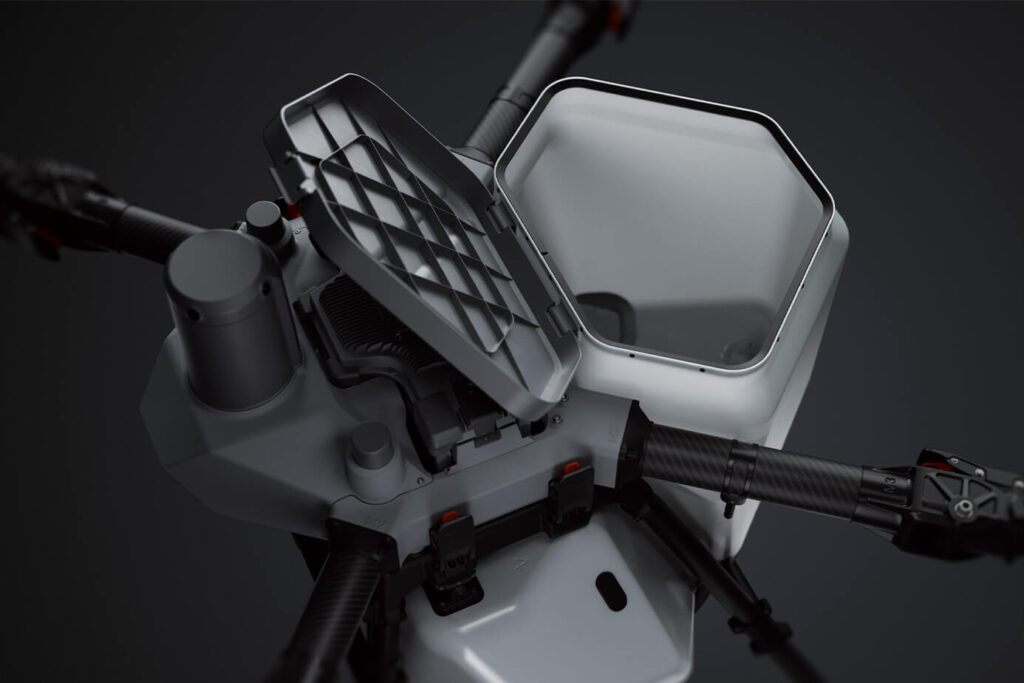
Allows for easy and convenient bulk loading.
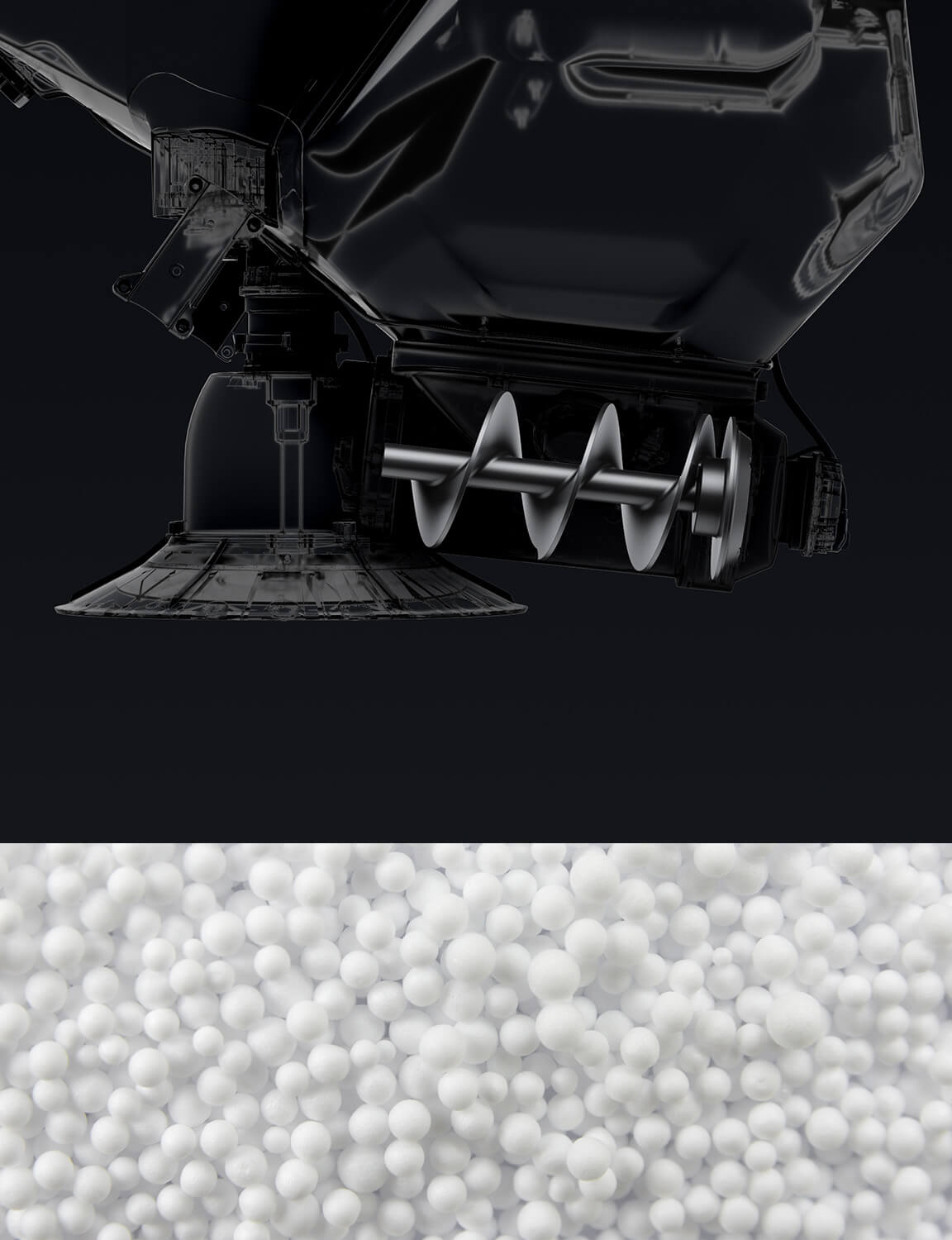
Suitable for granulars such as fertilizers, wheat seeds, granular fungicides, feed, etc. Recommended application rate: 75-750 kg per hectare. Recommended particle size: 0.5-10 mm
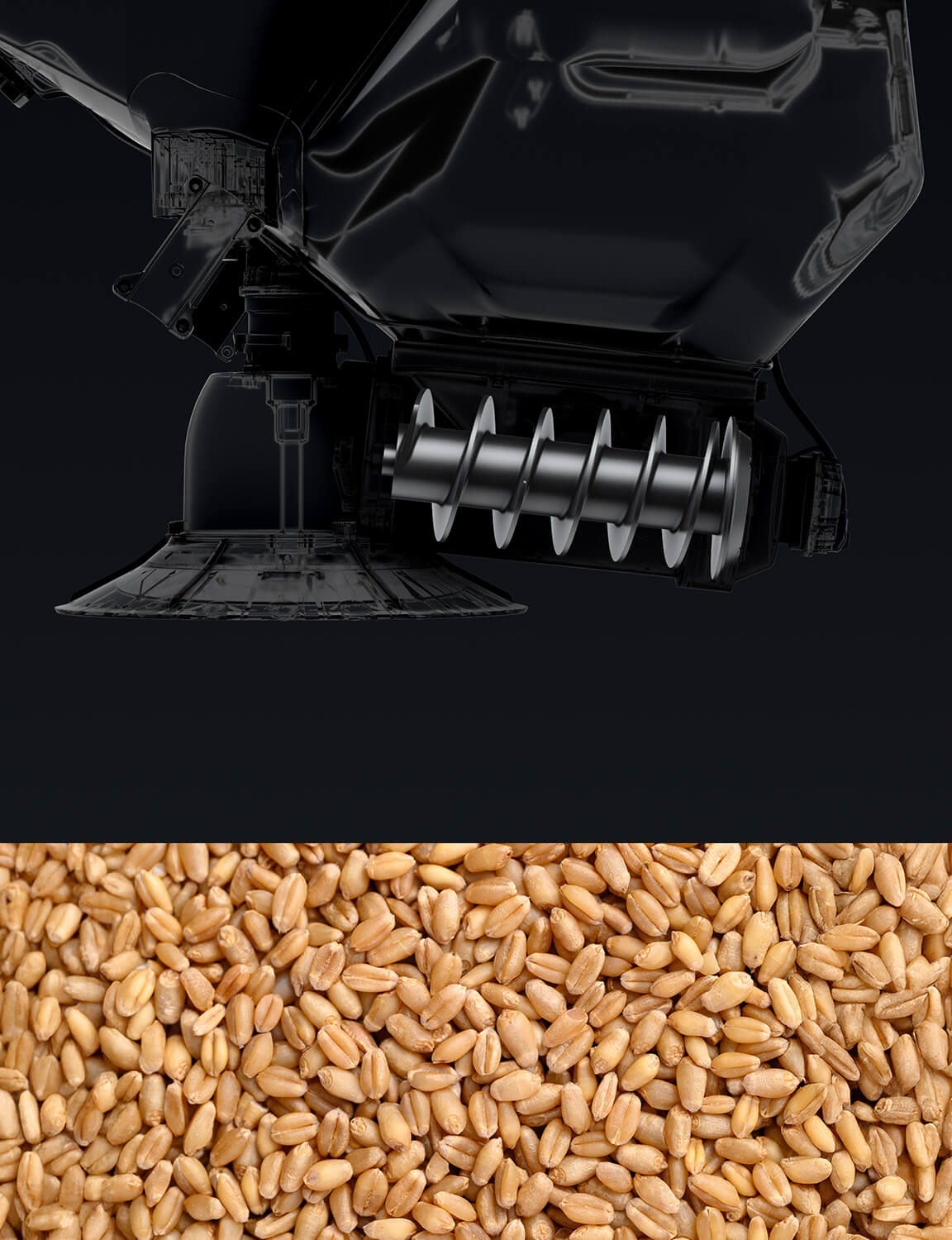
Suitable for granulars such as rice seeds, cover crop seeds, etc. Recommended application rate: 75-270 kg per hectare. Recommended particle size: 4-10 mm
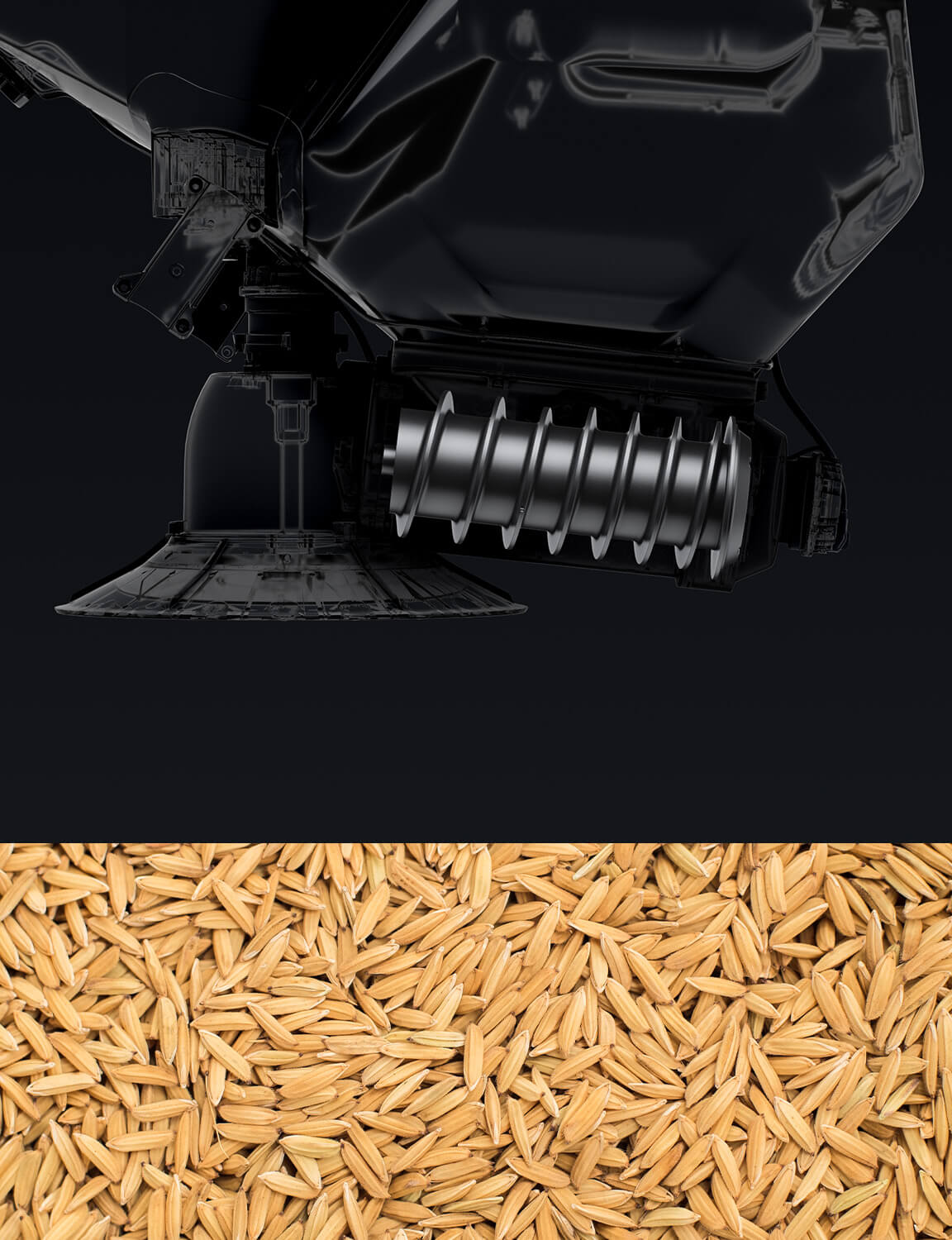
Suitable for granulars such as rice seeds. Recommended application rate: 22.5-120 kg per hectare. Recommended particle size: 4-6 mm

Suitable for granulars such as rapeseed, granular herbicides, grass seeds, granular insecticides, etc. Recommended application rate: 3-22.5 kg per hectare. Recommended particle size: 0.5-4 mm.
Capable of capturing dense spatial point cloud up to 300,000 points per second, providing a detailed view of complex terrains.
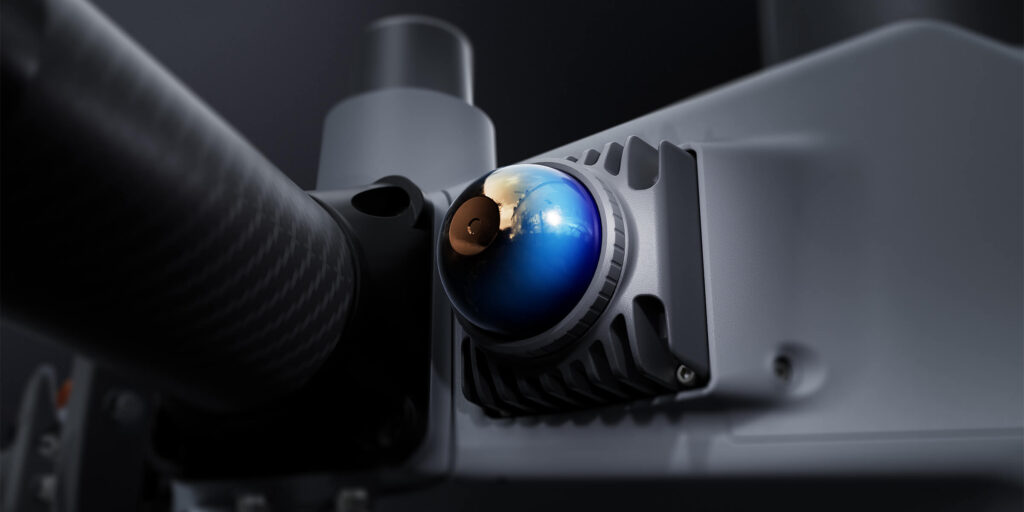

The front radar performs 5,000 vertical airspace scans per second combined with 360° horizontal mechanical rotation scanning, along with a rear radar[12] offering a more comprehensive detection range.
The quad-vision system, paired with an FPV low-light full-color camera, facilitates unrestricted viewing of flight scenes in front, behind, left, right, and below, while intelligently detecting obstacles. The FPV camera employs virtual gimbal technology, offering an ultra-wide field of view complemented by stabilization algorithms, to achieve electronic image stabilization for smoother, more fluid footage.
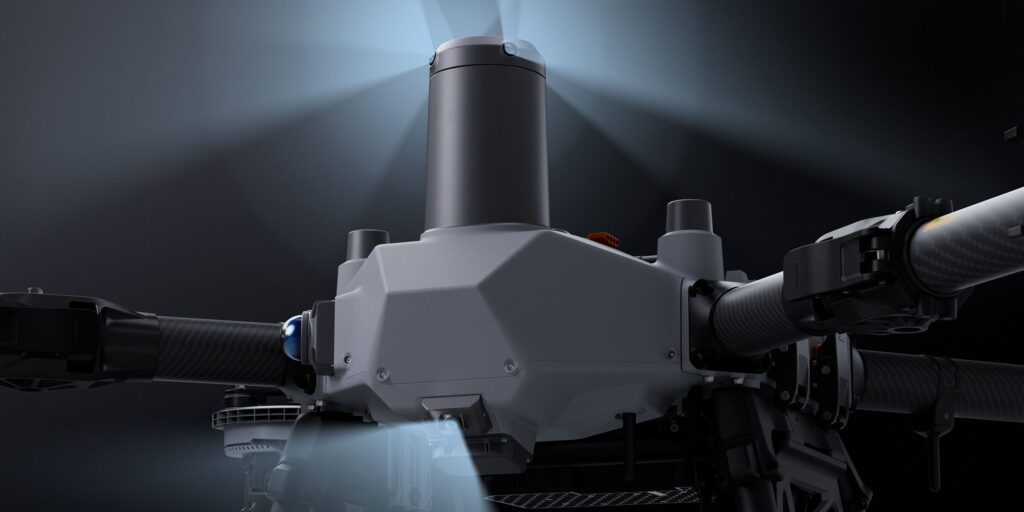
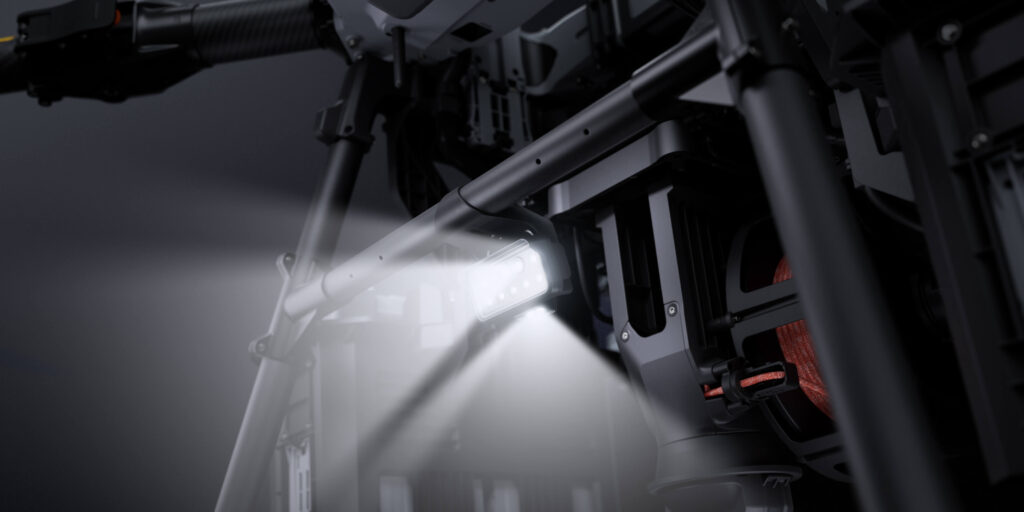
In addition to the existing low beam lights, new front-facing high beams and downward supplemental lighting have been added, ensuring safer nighttime operations.
The system can detect various obstacle types, including wires[29], poles, high-voltage towers, and trees. It intelligently selects the optimal path, ensuring smooth and seamless bypassing around obstacles.
The system automatically remembers obstacle locations, enabling more precise bypassing during subsequent flights. Users can save obstacles to a field with a single click, increasing safety with every flight.
The system can achieve Terrain Following of slopes up to 90° without prior mapping. It also supports intelligent obstacle bypassing[2], addressing the operational requirements of most mountainous and orchard environments with efficiency and precision.
Real-time LiDAR point cloud visualization offers clearer and more intuitive obstacle detection compared to FPV. This is especially valuable when dealing with small obstacles or operating at night, ensuring enhanced operational awareness and safety.[2]
Detect utility pole and vehicles during takeoff and landing with AR visualization for enhanced safety. During flight, it further enables AR display of obstacle types and distances, ensuring precise and informed operations in real time [14].
The system generates AR flight paths to assist with route guidance, providing enhanced precision and efficiency for every operation.
AR display of return-to-home point locations and safe landing projections assist with return and landing operations, ensuring greater accuracy and safety for every operation.
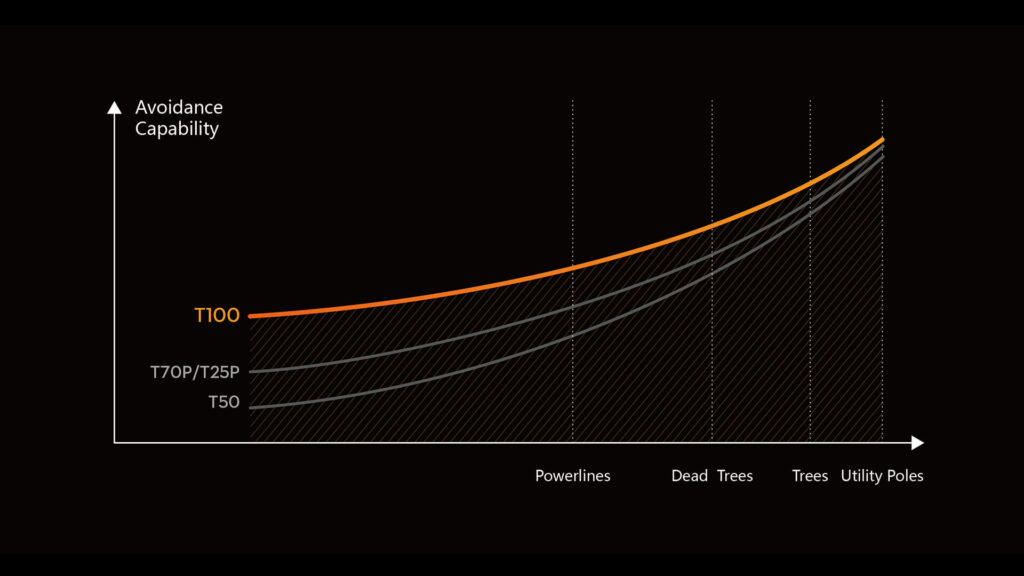
With advanced multi-sensor fusion and upgraded algorithms, the T100 achieves a higher success rate in avoiding various obstacles. Its precision in detecting smaller obstacles is significantly improved, ensuring safer and more reliable operations[2].
Utilizing a triaxial force sensor, the drone can automatically adjust its posture during flight to eliminate swinging, ensuring safer operations.
A triaxial force sensor provides real-time weight monitoring to prevent overloading and ensure operational safety.
Operators can use their mobile phones, in conjunction with the RTK module, to add load and unload points, which are then synced to the remote controller. Pilots can quickly locate destinations using AR projection on the controller.
Freely select loading and unloading points and reach them with a single click.
The optional dual battery version has a lifting capacity of 80kg[28], suitable for scenarios requiring long endurance. For extreme situations where hanging cargo gets trapped or tangled, you have the option to heat and cut the cable, freeing the drone.
82 kg Single-Axis Max Thrust
20 m/s Max Speed[6]
Compact Size, High Load Capacity
39%[7] Increase in Full-Load Power
Efficiency
Propeller Stop Protection
Low battery performance under heavy load
Increase in Spray Width[15]
Increase in Operation Speed[15]
Enhanced Penetration for Orchards
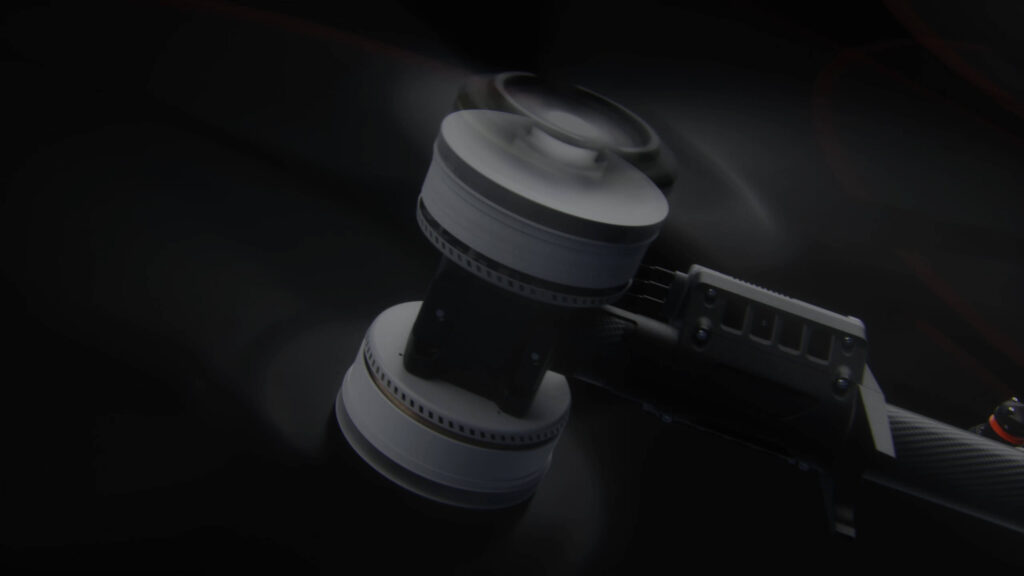
Carbon fiber propellers offer greater rigidity and lighter weight, resisting deformation even at high temperatures. With optimized airfoil and increased diameter, efficiency is improved by 32%[7].

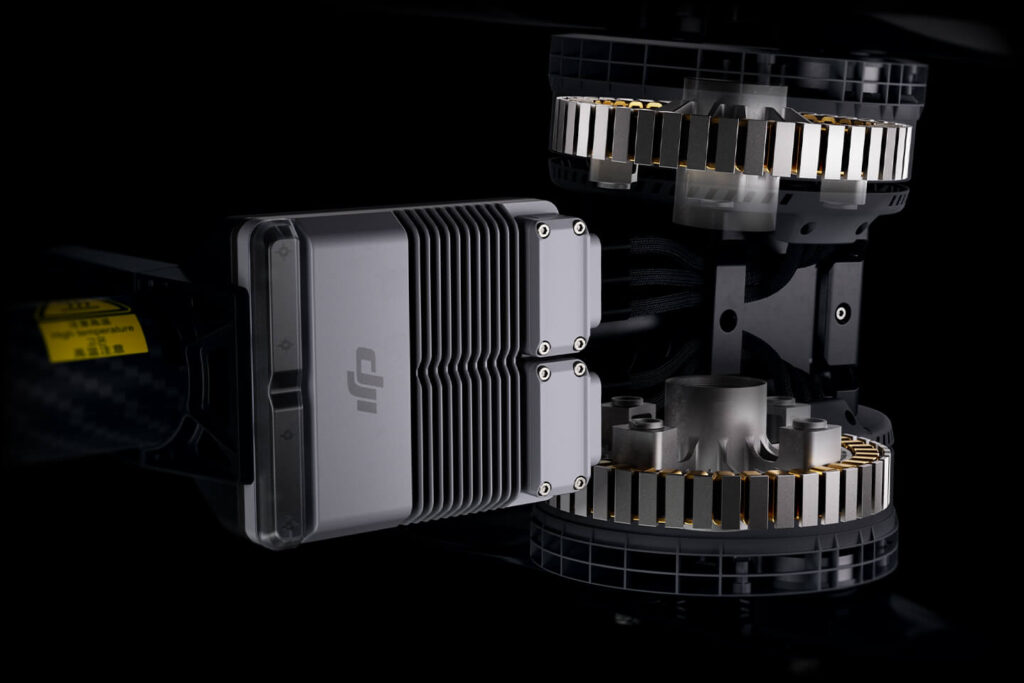
Larger motors, more torque. 420A electronic speed controllers ensure stable and reliable operation, delivering faster response times.
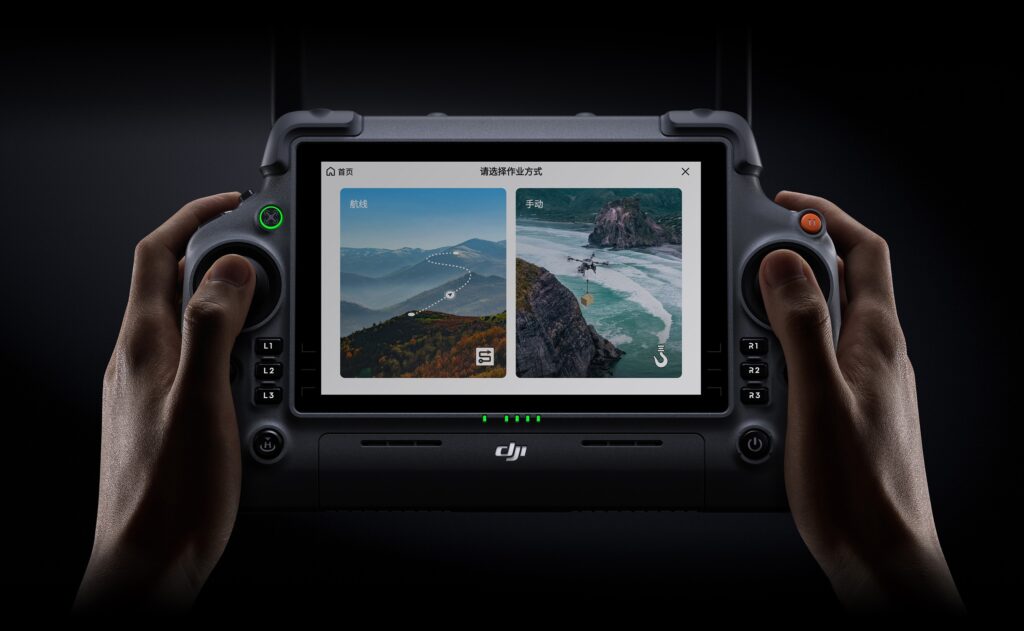
Simply complete the field planning, and operate with one click, without the need for manual intervention.
Choose from multiple planning methods. Once the field is planed, the flight path is automatically generated.
Easily call up parameter templates with a single click for convenience and speed.
Automatically returns home when out of pesticide or low on battery.
Efficiently plan multiple adjacent plots in a single go. Enabling continuous operations without interruptions (in fields or orchards).
Simplify operations on complex small plots with practical tools like one-click plot saving and one-click return to breakpoints, ensuring efficient and stress-free workflows.
Adapt effortlessly to diverse scenarios, including mixed crops, intercropping, and paddy fields. Achieve greater operational flexibility for more efficient workflows.
Mapping up to 20 hectares of large fields or 10 hectares of orchards per flight[17]. The map is reconstructed in real-time on the remote controller, with rapid delivery upon landing[18]. Point cloud density increased, power line detection rate improved by 80%[7].
An upgraded transmission algorithm enhances the range while maintaining smooth and stable visuals for consistent performance.
Enabling plug-and-play centimeter-level positioning without the need to configure coordinates. It ensures precision across the entire operation.
Use in conjunction with the remote controller and smartphone for precise location marking.
A Relay can ensure smooth operations in scenarios that have signal interference.

*The product is only available in certain countries. The appearance of the product is subject to the actual product. For details, please contact your local dealer.
[1] Measured at sea level, DJI Agriculture App intelligently recommends the appropriate loading weight based on the current status of the aircraft, environmental conditions, and operational tasks. Users are advised not to exceed the recommended maximum weight of the loaded granulars, may impact flight safety.When using in Australia, please follow local regulations and keep the maximum takeoff weight at 149.9kg.
[2] The effective sensing range and its ability to avoid and bypass obstacles will vary depending on the ambient light, rain, fog, and the material, position, shape, and other properties of the obstacles. Downward sensing is used to assist in Terrain Following flight and altitude stabilization, while other directions assist with obstacle avoidance. Any collision between the bottom of the aircraft and obstacles shall be the customer’s responsibility. In scenarios without linear obstacles, if a collision occurs at speeds up to 13.8 m/s resulting in aircraft damage, responsibility can be determined through log analysis, and the aircraft may be eligible for free warranty if non-human causes are identified. If there are linear obstacles like wires or guy wires on utility poles, please mark them as obstacles; otherwise, failure to bypass them will be the customer’s responsibility.
– Note 1. Downward sensing assists in Terrain Following flight. If the bottom collides with obstacles, it is considered user responsibility. – Note 2. Due to limitations in safety system performance, the aircraft cannot automatically avoid moving objects, and accidents of this nature will be attributed to user responsibility.
[3] Different granular densities vary, and the maximum load should not exceed 100 kilograms.
[4] Measured with compound fertilizer. The maximum flow rate may vary due to differences in granule size, density, and surface smoothness of different fertilizers.
[5] A weight of 100 kg is measured below the triaxial force sensor (including the weight of the sling, and hook). Data was measured at sea level. The DJI Agras app will recommend the payload weight according to the current status and surroundings of the aircraft. When adding materials, the maximum weight should not exceed the recommended value, otherwise flight safety may be compromised. Users must comply with local regulations during operation.
[6] The actual operation speed of the drone is related to the terrain slope; the steeper the slope, the lower the operation speed. The maximum operating speed varies by country and operational mode, and is subject to local regulations and the actual firmware version.
[7] Compared to the Agras T50 drone and its supporting equipment. Test results may vary based on different testing conditions.
[8] The effective spray width of the spraying system depends on the actual working scenario.
[9] The droplet diameter is measured by a laser particle size analyzer, with a 50-micron diameter using the DV50 standard.
[10] Measured at an operating height of 3 meters with a spinning disc speed of 1,100 r/min and a uniformity requirement of CV < 30%. Higher disc speeds and flight altitudes increase the spreading width.
[11] Suitable for granulars ranging from 0.5 to 10 mm in size. Clumps, straw, woven bags, and impurities, as well as humidity, density, hardness, and shape, can affect spreading adaptability and precision.
[12] To ensure the radar’s sensing performance is fully utilized, make sure the radar surface is clean before operation. If necessary, wipe and clean it.
[13] Night Navigation Light is only for spraying and spreading payloads.
[14] AR safety assistance features serve only as supplementary hints; operators must confirm the surrounding environment’s safety during operation. Detection performance of sensors such as quad-vision and FPV cameras may vary depending on the ambient light, rain, fog, and the material, position, shape, and other properties of the obstacles.
[15] Compared to the Agras T50 drone during field spraying operations. Test results may vary based on different testing conditions.
[16] Mapping operation needs to work with RTK.
[17] The mapping area refers to the area enclosed by the flight path. Single-flight mapping area is affected by firmware version, starting charge level, mapping type, altitude, wind conditions, field shape, slope, etc. The mapping must be conducted with no payload.
[18] Mapping time for the remote controller depends on firmware version, survey type, and other variables.
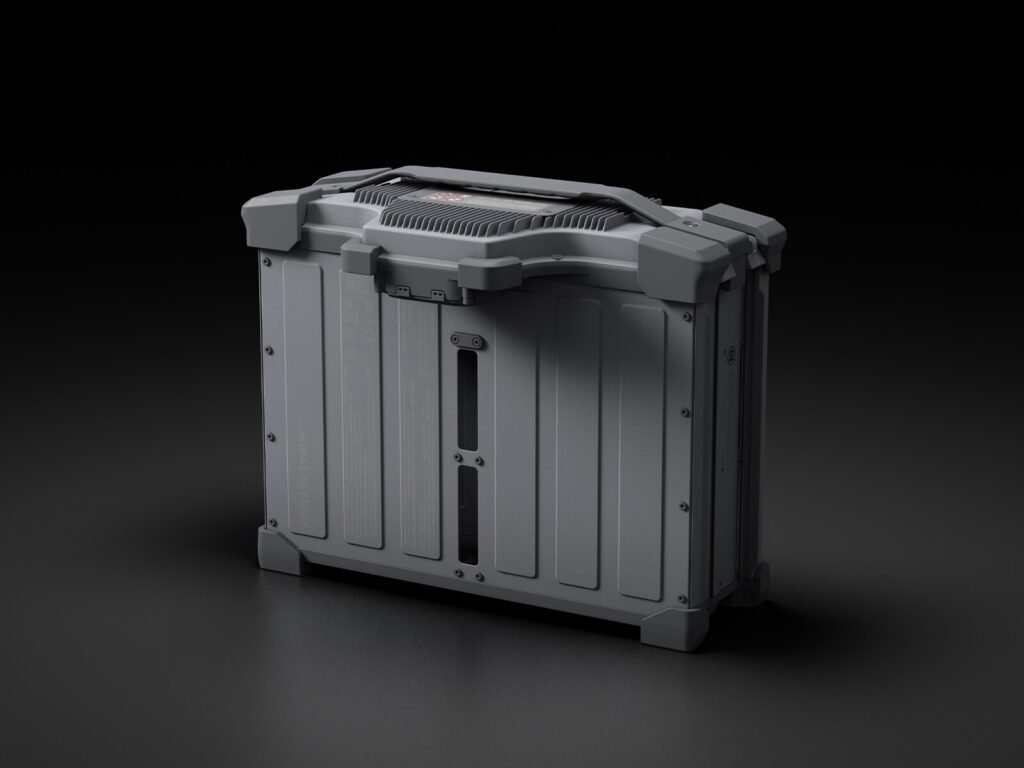
[19] Batteries are covered by warranty for up to 1,500 charging cycles or 12 months, whichever ends first.
[20] The output power of the charging station may be affected by altitude and fuel quality.
[21] Power output may vary due to local grid factors such as distance, wire material, and diameter.
[22] When using the C10000 Intelligent Power Supply to charge DB1580 and DB2160 intelligent flight batteries, it requires an adapter cable.
[23] Measured by laser particle size analyzer, a 50-micron diameter using the DV75 standard.
[24] Different granulars have different densities, the maximum load cannot exceed 70 kilograms.
[25] A weight of 65 kg is measured below the triaxial force sensor (including the weight of the sling, and hook). Data was measured at sea level. The DJI Agras app will recommend the payload weight according to the current status and surroundings of the aircraft. When adding materials, the maximum weight should not exceed the recommended value, otherwise flight safety may be compromised. Users must comply with local regulations during operation.
[26] Different granulars have different densities, the maximum load cannot exceed 25 kilograms.
[27] Compared to the T50 agricultural drone and its associated equipment, the operational speed was 13.8 m/s during the test. Overall efficiency conclusions may vary under different testing conditions.
[28] A weight of 80 kg is measured below the triaxial force sensor (including the weight of the sling, and hook). Data was measured at sea level. The DJI Agras app will recommend the payload weight according to the current status and surroundings of the aircraft. When adding materials, the maximum weight should not exceed the recommended value, otherwise flight safety may be compromised. Users must comply with local regulations during operation.
[29]Linear obstacle detection only supports spraying and spreading payloads.
| Weight | Weight for spraying: 75 kg (standard with 2 nozzles) Weight for spraying: 77 kg (optional with 4 nozzles) Weight for spreading: 75 kg (equipped with spreading system) Weight for lifting: 65 kg (equipped with lifting system) Weight for lifting: 90 kg (equipped with dual-battery lifting system) |
| Max Takeoff Weight[1] | Max takeoff weight for spraying: 175 kg (standard with 2 nozzles) Max takeoff weight for spraying: 177 kg (optional with 4 nozzles) Max takeoff weight for spreading: 175 kg (equipped with spreading system) Max takeoff weight for lifting: 165 kg (equipped with lifting system) Max takeoff weight for lifting: 170 kg (equipped with dual-battery lifting system) |
| Max Diagonal Wheelbase | 2330 mm (diagonal) |
| Dimensions | 3220 mm × 3224 mm × 975 mm(arms and propellers unfolded) 1820 mm × 1840 mm × 975 mm(arms unfolded and propellers folded) 1105 mm × 1265 mm × 975 mm(arms and propellers folded) |
| Hovering Accuracy Range (with strong GNSS signal) | RTK Enabled: ±10 cm (horizontal), ±10 cm (vertical) RTK not enabled: Horizontal ± 0.6 m, vertical ± 0.3 m |
| Max Configurable Flight Radius | 2 km |
| Operating Temperature | 0 °C to 40 °C |
| Max Wind Resistance | <6 m/s |
| Stator Size | 155 × 16 mm |
| KV | 60 rpm/V |
| Material | Carbon Fiber Composite |
| Dimensions | 62 inches |
| Quantity | 8 pairs |
| Model | LS100 |
| Dimensions | 880 mm × 870 mm × 810 mm (spray rod folded) 1020 mm × 1930 mm × 810 mm (spray rod unfolded) |
| Material | HDPE |
| Volume | 100 L |
| Operating Payload[1] | 100 kg |
| Model | LX07550SX (Standard Nozzle) / LX09550SX (Optional Mist Nozzle) |
| Quantity | 2 (Standard) / 4 (Optional) |
| Nozzle Distance | 1834 mm (Two Nozzles / Four Nozzles Outermost) |
| Droplet Size | 50 – 500 μm |
| Effective Spray Width[2] | 5 – 13 m |
| Type | Impeller Pump (Magnetic Drive) |
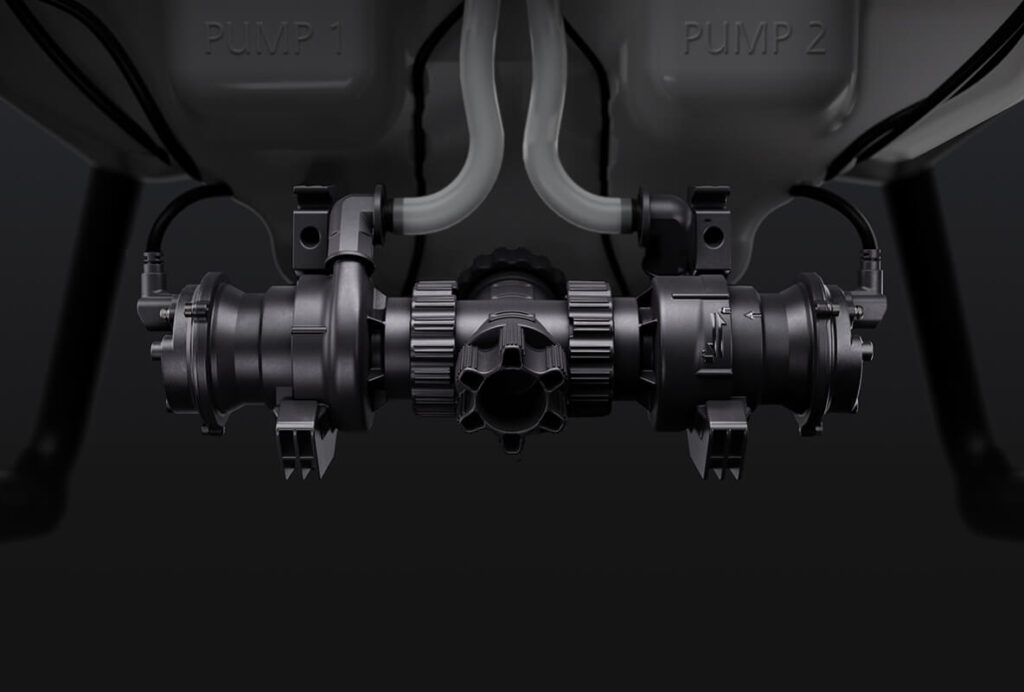
| Quantity | 2 |
| Max Flow Rate | 30 L/min (Standard 2 nozzles), 40 L/min (Optional 4 nozzles) |
| Dimensions | 900 mm × 820 mm × 920 mm |
| Compatible Material Diameter | Standard configuration: Extra-large auger: 0.5 mm – 10 mm granules (fertilizer, wheat, feed, etc.) Medium auger: 4 mm – 6 mm granules (rice) Optional: Large auger: 4 mm – 10 mm granules (rice, fertilizer) Small auger: 0.5 mm – 4 mm granules (rapeseed, granular herbicides, granular insecticides) |
| Spreading Tank Volume | 150 L |
| Spreader structure type | Centrifugal Disc |
| Discharge Structure Type | Screw Feeder Feeding |
| Max Discharge Rate | 400 kg/min (compound fertilizer) |
| Max load inside the spreading operation box | 100 kg |
| Effective spreading width[3] | 3 – 10 m |
| Dimensions | 805 mm × 764 mm × 669 mm |
| Load capacity[4] | 100 kg |
| Lifting Cable Length | 10 m (standard configuration) |
| Recommended cable length | 10 – 15 m |
| Operating Temperature | 0 °C to 40 °C |
| Dimensions | 805 mm × 960 mm × 669 mm |
| Load capacity[4] | 80 kg |
| Lifting Cable Length | 10 m (standard configuration) |
| Emergency Escape Mode | Cable Fuse Disconnection and Escape |
| Recommended cable length | 10 – 15 m |
| Operating Temperature | 0 °C to 40 °C |
| Millimeter wave radar EIRP | < 20 dBm (NCC / MIC / KC / CE / FCC) |
| Operating Temperature | 0 °C to 40 °C |
| Operating environment requirements | Adequate light and discernible surroundings |
| Field of View (FOV) | Laser radar: Vertical 272°, Horizontal 60° Front Radar: Horizontal 360°, Vertical ± 45° Downward Radar: Left and Right ± 12.5°, Front and Back ± 22.5° Rear Radar: Left and Right ± 45°, Front and Back ± 45° Quad vision system: Horizontal 360°, Vertical 180° FPV camera: Horizontal ± 86°, Vertical 108° |
| Measurement range[4] | ≤ 60 m |
| Effective safe obstacle avoidance speed[5] | ≤ 13.8 m/s |
| Effective Obstacle Avoidance Height | ≥ 1.5 m |
| Model | TKPL 2 |
| Screen | 7-inch LCD touchscreen; resolution: 1920 × 1200; brightness: 1400 cd/m² |
| Storage Temperature Range | Less than one month: -30° to 45° C (-22° to 113° F) One to three months: -30° to 35° C (-22° to 95° F) Three months to one year: -30° to 30° C (-22° to 86° F) |
| Charging Temperature | 5° to 40° C (41° to 104° F) |
| Internal Battery Runtime | 3.8 hours |
| External Battery Runtime | 3.2 hours |
| Charging Type | Use a USB-C fast charger with a maximum power of 65 W (maximum voltage 20 V), and it is recommended to use the DJI Portable Charger. |
| Charging Time | 2 hours for internal battery or internal and external battery (when remote controller is powered off and using a standard DJI charger) |
| Weight[1] | 14.7 ± 0.3 kg |
| Capacity | 41000 mAh |
| Nominal Voltage | 52 V |
| Output Channels | 1. DC recharge output 42 – 61.6 V/11500 W 2. Air-cooled radiator charge 12 V/6 A 3. AC output 220 V/1500 W |
| Recharge Time[6] | 8 – 9 minutes (DB2160 Intelligent Flight Battery, 30% – 95% charge) |
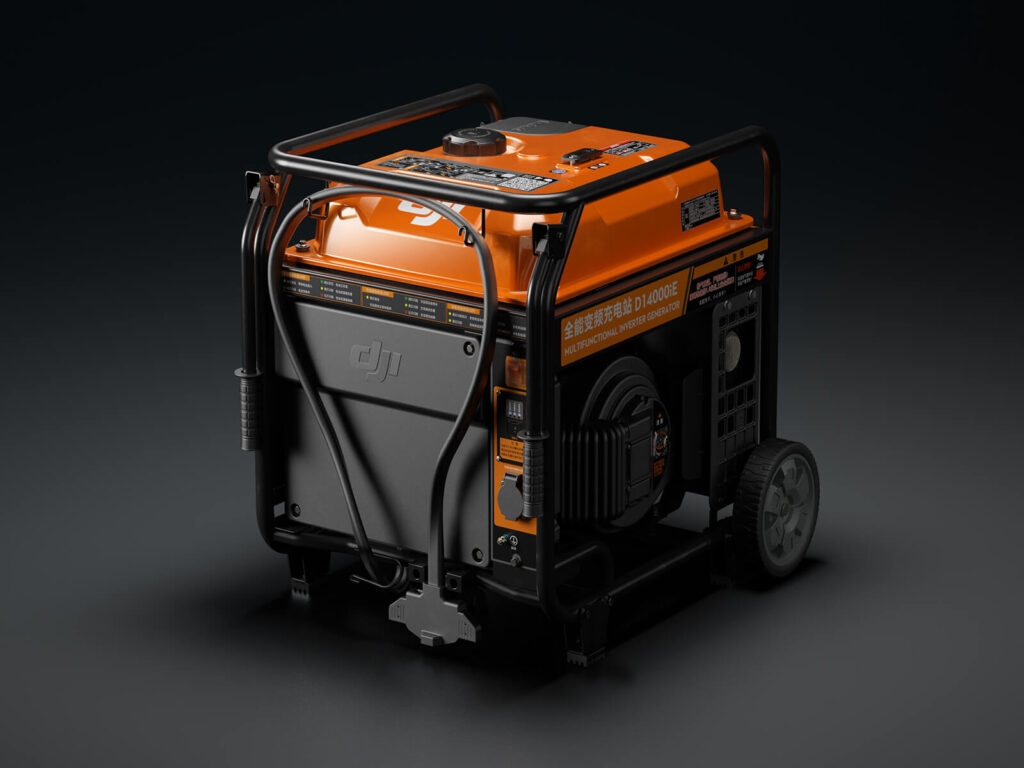
| Fuel tank capacity | 30 L |
| Starting Method | Starting the Generator via the One-Button Start Switch |
| Operating Temperature | 0 °C to 40 °C |
| Compatible Battery | DB1580 / DB2160 Intelligent Flight Battery |
| Dimensions | 757 mm × 704 mm × 677 mm |
| Weight | 87 ± 0.5 kg |
| Fuel type | Unleaded gasoline with RON ≥91 (AKI ≥87) and alcohol content less than 10% (*Brazil: unleaded gasoline with RON ≥ 91 and alcohol content of 27%) |
| Reference fuel consumption | 500 mL/kWh |
| Engine Oil Capacity | 1.3 L |
| Engine Oil Model | SJ 10W-40 |
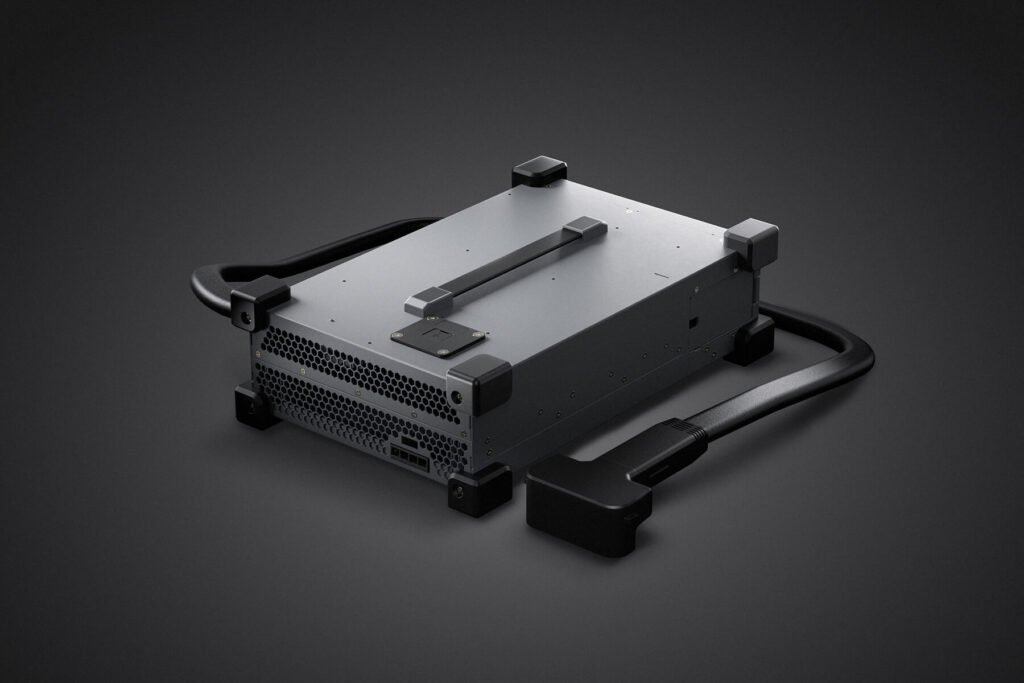
| Charger Model | CSX901-12000 |
| Dimensions | 456 mm × 291 mm × 107 mm |
| Weight[1] | 13.13 kg |
| Input Voltage | Three-phase AC input: 175 – 520 V Single-phase AC input: 200 – 264 V |
| Output Voltage | 62 V |
| Rated output current | 194 A |
| Rated Power | 12000 W (three-phase 380 V input)3000 W (single-phase 220 V input) |
| Recharge Time[6] | 8 – 9 minutes (DB2160 Intelligent Flight Battery, 30% – 95% charge) |
| Protection functions | Over-temperature, over-voltage, under-voltage, short circuit, fan stall, and other protection functions |
| Operating Temperature | 0° to 40° C |
| Output Channels | 1 |
| Compatible with Intelligent Flight Battery | DB1580 / DB2160 Intelligent Flight Battery |
| Dimensions | 112 mm × 112 mm × 51 mm (None Antenna) 120 mm × 112 mm × 101 mm (with antenna) |
| Weight[1] | 630 g |
| Input | 2.7 V – 24 V |
| Power consumption | 10.48 W (FCC), 8.8 W (SRRC) |
| Battery capacity | 6500 mAh |
| Operating Time | 5 hours |
| Operating Frequency | 2.4000 – 2.4835 GHz, 5.150 – 5.250 GHz, 5.725 – 5.850 GHz |
| Effective signal range | 5 km (SRRC), 4 km (MIC/KCC/CE), 8 km (FCC) (In an interference-free, unobstructed environment, flight altitude 2.5 m) |
| Charging Time | 2.5 hours (30W recharge) |
| Ingress Protection Rating | IP55 |
| Supports satellite systems | GPS: L1/L2/L5 BeiDou: B1I/B2I/B3I/B1C/B2A/B2B Galileo: E1/E5a/E5b/E6 GLONASS: G1/G2 QZSS: L1CA/L2C/L5 L-BAND |
| Dimensions | 345 mm × 244 mm × 300 mm |
| Weight[1] | 3.77 kg (including packaging) |
| Power consumption | 7 W |
| Battery capacity | 6500 mAh |
| Operating Time | 7 hours |
| Operating Frequency | Broadcast Mode: O4: 2.4G/5.8G Relay Mode: Not Supported |
| Effective signal range | FCC: 15 km SRRC: 12 km CE/JP: 8 km |
| Charging Time | 2.5 hours (30W recharge) |
| Ingress Protection Rating | IP67 |
| Positioning Accuracy[7] | PPP Satellite-Based Service Accuracy: Convergence Time: 20 mins Horizontal: 30 cm (RMS) Elevation: 40 cm (RMS) Network RTK Calibration: Horizontal: 0.8 cm + 1 ppm (RMS) Vertical: 1.5 cm + 1 ppm (RMS) 1 ppm: Accuracy decreases by 1 mm for every 1 km increase in distance between the aircraft and the base station. For example, if the aircraft is 1 km away from the base station, the accuracy is 1.1 cm. |
| [1] Measured at sea level, the DJI Agriculture App will intelligently recommend the loading weight based on the current aircraft status, environmental conditions, and operational tasks. Users should not exceed the recommended maximum loading weight, as it may affect flight safety. When using in Australia, please follow local regulations and keep the maximum takeoff weight at 149.9kg. [2] The effective spray width of the spraying system depends on the actual working scene. [3] Working height is 3 m, disc rotation speed is 1100 rpm, uniformity requirement (CV<30%) measured broadcast width is 10 m. The faster the disc rotation speed, the higher the flight altitude, the larger the broadcast width. [4] Includes the weight of ropes and hooks. Measured at sea level, the DJI Agriculture App will intelligently recommend the loading weight based on the current state of the aircraft, environmental conditions, and operational tasks. The maximum weight of the loaded material should not exceed the recommended value, as it may affect flight safety. [5] The effective working range of sensing distance, obstacle avoidance, and bypassing capabilities may vary due to different environmental lighting, rain, fog, and the material, location, and shape of the subject object. The downward sensing is used to assist in terrain-following altitude flight, while sensing in other directions is used for obstacle avoidance. Except for scenes without linear obstacles, if a collision occurs at speeds up to 13.8 m/s resulting in aircraft damage, responsibility can be determined through log analysis, and the aircraft may be eligible for free warranty if non-human causes are identified. If there are linear obstacles like wires or guy wires on power poles, please mark them as obstacles; otherwise, failure to bypass them will be the customer’s responsibility. Note:1. The downward perception is used to assist terrain-following altitude flight. If a collision with an obstacle occurs below, it is considered the customer’s responsibility.2. Due to the performance limitations of the safety system, the aircraft cannot actively avoid moving objects. Accidents in such scenes are considered the customer’s responsibility. [6] Sea level height, environmental temperature between 15-40 degrees Celsius, time to charge the battery from 30% to 95%; fast charging is supported when the battery cell temperature is within the range of 15-75 degrees Celsius; charging time varies depending on input power, ASL, initial charge level, and other factors. [7] Positioning accuracy and reliability are affected by various factors, including equipment tilt, signal obstruction, multipath, number of satellites, geometric distribution, and atmospheric conditions. It is recommended to set up the equipment in open scenes, away from electromagnetic interference and multipath environments. |
Inquire price for DJI Agras T100