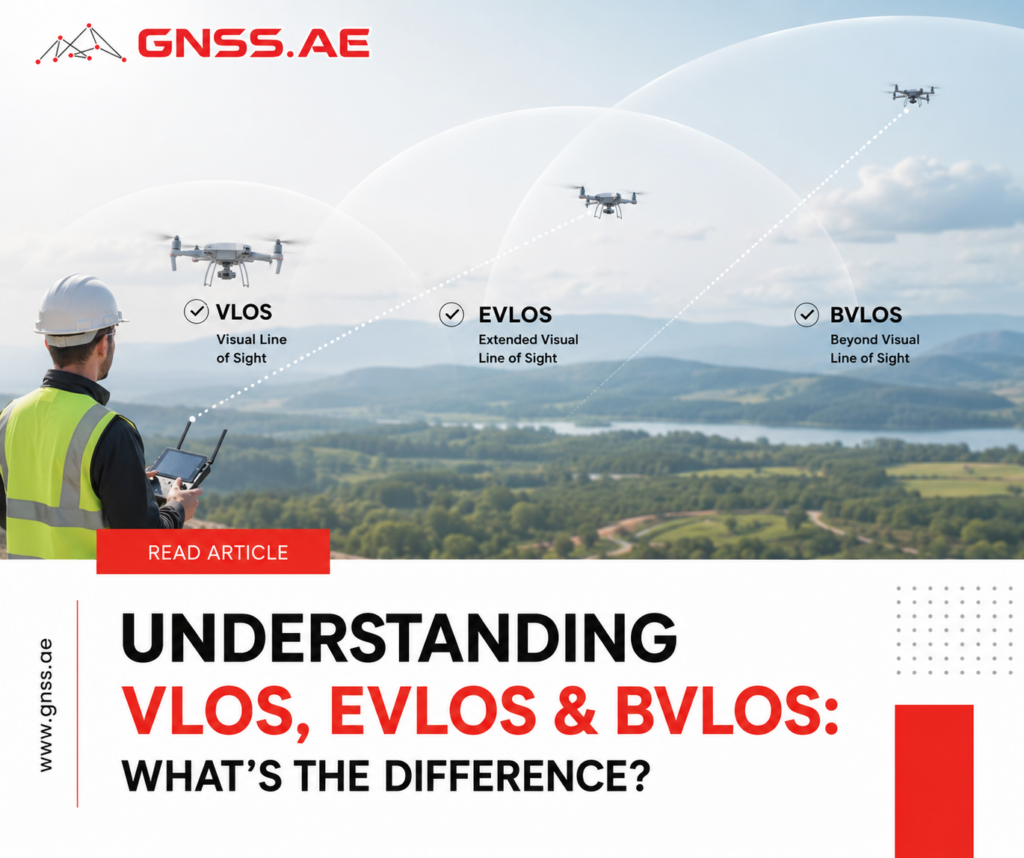
If you’ve worked with commercial drones, you’ve probably come across the terms VLOS, EVLOS, and BVLOS. They appear in aviation regulations, manufacturer specifications, and mission planning documents, but the differences between them aren’t always obvious.
At their core, these terms describe how a drone is expected to be monitored while in the air. That distinction determines where the aircraft can operate, what safety measures are required, and which types of missions are permitted.
VLOS (Visual Line of Sight) means the remote pilot maintains continuous unaided visual contact with the drone throughout the entire flight. Corrective glasses or contact lenses are allowed, but binoculars, FPV goggles, or the live camera feed do not replace direct visual observation.
The purpose of VLOS is to ensure the pilot can always:
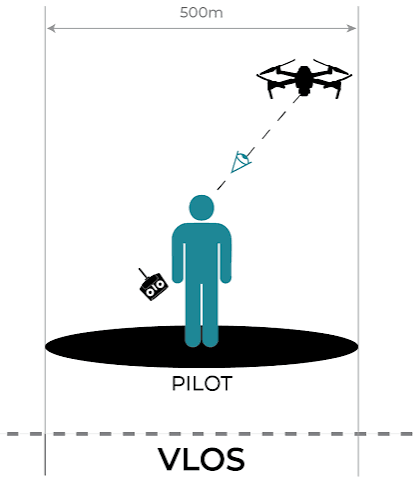
A common misconception is that flying with a live video feed is the same as maintaining visual line of sight. It isn’t. While the camera provides a detailed view of the mission area, it only captures what it’s pointed at. It cannot provide full awareness of the surrounding airspace.
VLOS isn’t defined by a specific distance. A drone might remain clearly visible several hundred meters away over an open field, yet become difficult to see much sooner in an urban environment or behind terrain and vegetation. Weather conditions, lighting, aircraft size, and visibility all influence whether visual line of sight can be maintained.
VLOS is the most common operating mode because it suits a wide range of commercial applications, including:
For these missions, enterprise drones with accurate positioning and specialized sensors are usually sufficient.
For many day-to-day drone operations, VLOS remains the simplest and most practical approach from both an operational and regulatory perspective.
EVLOS (Extended Visual Line of Sight) allows drones to operate beyond the pilot’s direct visual range while still relying on human visual observation.
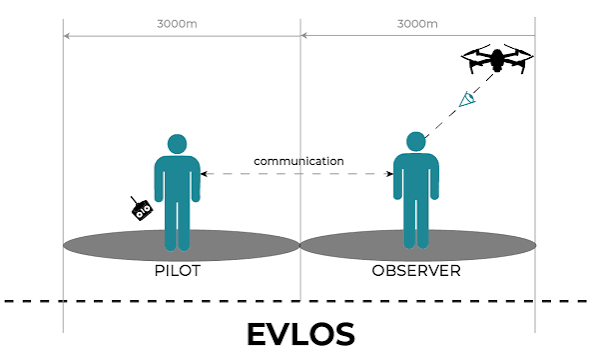
Instead of a single pilot keeping the aircraft in sight, one or more visual observers are positioned along the planned flight path. Once the drone leaves the pilot’s direct line of sight, these observers maintain visual contact and relay information to the remote pilot using established communication procedures.
This approach extends the operational area while ensuring the aircraft remains under continuous visual observation by trained personnel.
EVLOS operations require more coordination than standard VLOS flights. Everyone involved must clearly understand their role, maintain reliable communication throughout the mission, and be prepared to respond if the flight needs to be aborted or the aircraft must return safely.
EVLOS is commonly used for missions that follow long, linear routes, such as:
These missions usually require the same type of enterprise drones used for VLOS, but with additional operational coordination.
A typical setup may include:
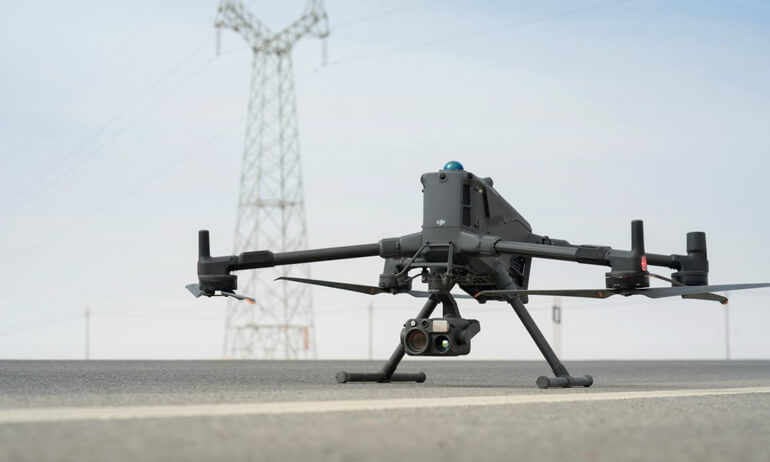
For example, a power line inspection may combine a DJI Matrice 400 with payloads such as Zenmuse H30T for visual and thermal inspection or Zenmuse L3 for large-scale mapping. The drone collects the required data, while observers help maintain situational awareness along the flight path.
An interesting point is that EASA is gradually moving away from treating EVLOS as a completely separate operating category. In recent guidance, these operations are increasingly considered a form of BVLOS supported by Airspace Observers, since the pilot no longer maintains direct visual contact with the aircraft.
BVLOS (Beyond Visual Line of Sight) refers to operations where the drone flies outside the pilot’s direct visual observation.
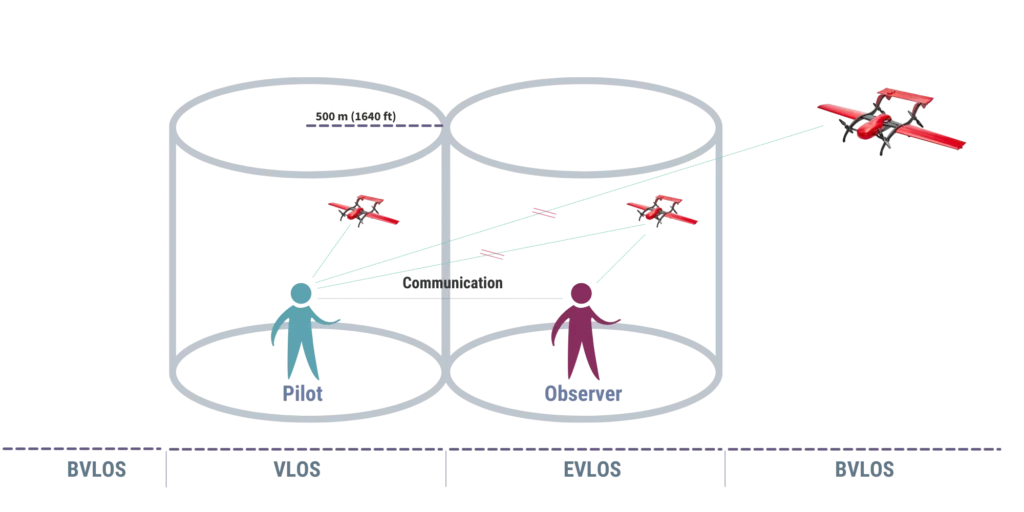
Unlike VLOS or EVLOS, the flight is no longer dependent on continuous visual monitoring by the pilot or observers. Instead, safe operations rely on a combination of onboard technology, operational procedures, and formal risk assessments.
Because the pilot cannot rely on direct observation, BVLOS operations typically require additional safeguards, including:
Regulatory requirements vary by country, operating environment, and mission type, but BVLOS flights are generally subject to stricter approval and oversight than VLOS operations.
BVLOS makes it possible to perform operations that would be difficult—or simply impractical—under VLOS requirements, including:
BVLOS missions require a stable command and control link to monitor the aircraft and respond to unexpected situations.
Systems such as DJI Dock 3 enable automated drone operations with scheduled missions, remote monitoring, and repeatable workflows.
Before moving from VLOS to BVLOS operations, operators should consider several key areas:
Mission planning
☐ Define the flight area and operational objectives
☐ Analyze airspace restrictions and potential hazards
☐ Prepare emergency scenarios
Equipment readiness
☐ Verify communication link reliability
☐ Confirm navigation accuracy and RTK performance
☐ Configure failsafe settings
☐ Check battery and redundancy systems
Operational requirements
☐ Complete risk assessment
☐ Define roles and responsibilities within the team
☐ Prepare required documentation and approvals
☐ Ensure pilots and operators have appropriate training
Although the three operating modes share the same goal—safe drone operations—they differ significantly in how that safety is maintained.
Feature | VLOS | EVLOS | BVLOS |
Pilot maintains direct visual contact | ✔ | No | No |
Visual observers | Optional (depending on regulations) | Required | Not typically used for visual monitoring |
Operational area | Limited | Extended | Virtually unrestricted within the approved mission |
Mission complexity | Low | Medium | High |
Planning requirements | Basic | Moderate | Extensive |
Typical applications | Building inspections, local mapping | Corridor inspections, linear infrastructure | Long-range inspections, autonomous operations, logistics |
The biggest difference is not flight distance but how situational awareness is maintained. VLOS relies on the pilot, EVLOS relies on coordinated visual observers, while BVLOS replaces continuous human observation with carefully planned procedures and supporting technologies.
Understanding the difference between VLOS, EVLOS, and BVLOS is essential for anyone planning commercial drone operations. Each operating mode is designed for a different level of mission complexity and comes with its own operational and regulatory requirements.
For localized inspections and mapping, VLOS remains the standard choice. EVLOS extends operational coverage while keeping trained observers in the loop. BVLOS unlocks entirely new applications—from long-range infrastructure inspections to autonomous drone operations—but also requires the highest level of planning, risk management, and regulatory compliance.
As regulations continue to evolve alongside UAV technology, understanding these operating concepts will help operators choose the right approach for every mission and prepare for the growing adoption of advanced drone operations.