Power outages, damaged transmission lines, burst water mains, pipeline failures, and transportation incidents rarely happen during business hours. When critical infrastructure fails after dark, repair crews often have to respond immediately. Every hour of downtime can disrupt essential services, affect thousands of people, and increase operational costs.
Working at night creates additional challenges. Limited visibility makes inspections more difficult, increases safety risks, and slows repair work around damaged infrastructure and heavy equipment.
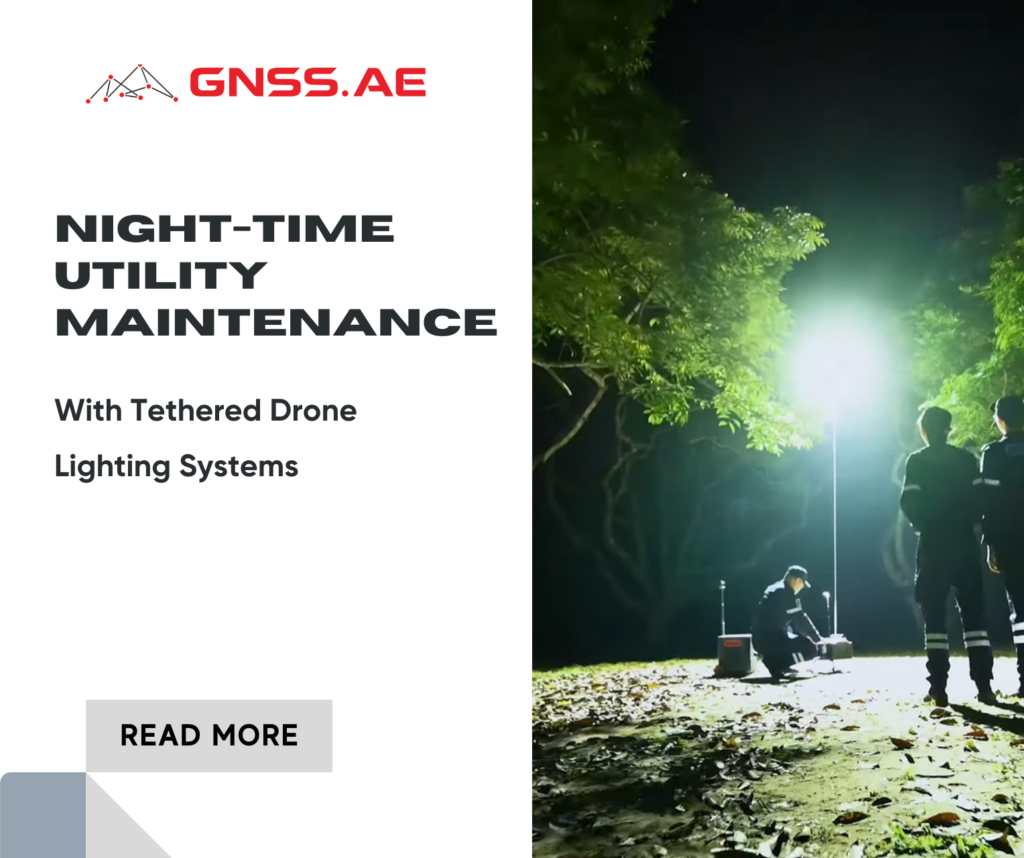
To address these challenges, utilities are increasingly deploying tethered drones equipped with high-power LED lighting. Acting as elevated lighting platforms, they provide continuous overhead illumination across large work areas while supporting inspections and emergency response.
This article explains how tethered drone lighting systems work, why they are well suited for utility maintenance, and how they are being used in real operations.
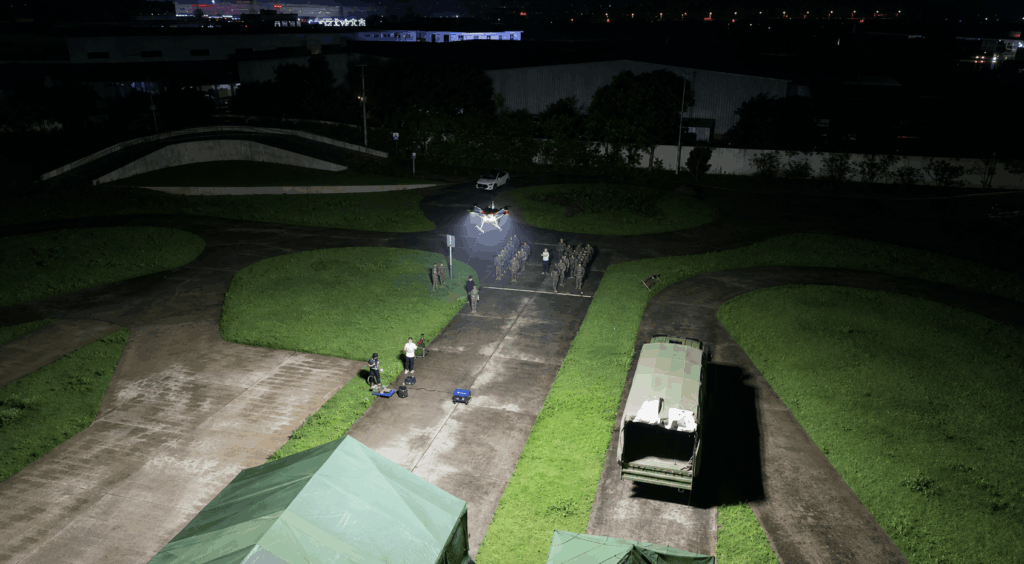
Most utility maintenance is designed around daylight conditions. Whether inspecting transmission towers, repairing substations, or locating pipeline leaks, crews depend on clear visibility to identify defects and work safely.
Portable floodlights remain the standard solution but have several limitations. They require transportation, setup time, generators or external power, and sufficient space for deployment. In narrow utility corridors, on busy roads, or at disaster sites, positioning lighting equipment is often difficult.
Ground-based lighting also creates long shadows behind vehicles, structures, and equipment, leaving parts of the worksite poorly illuminated. During inspections, these shadows can hide damaged insulators, cracked concrete, loose fittings, or other defects.
As repairs progress, lighting equipment often has to be repositioned, interrupting work and delaying restoration. For time-critical utility operations, fast-deploying overhead lighting offers a more flexible and efficient alternative.
Instead of placing lights around the perimeter of a worksite, tethered drone systems position the light source directly above the operation.
The main advantage is more uniform illumination:
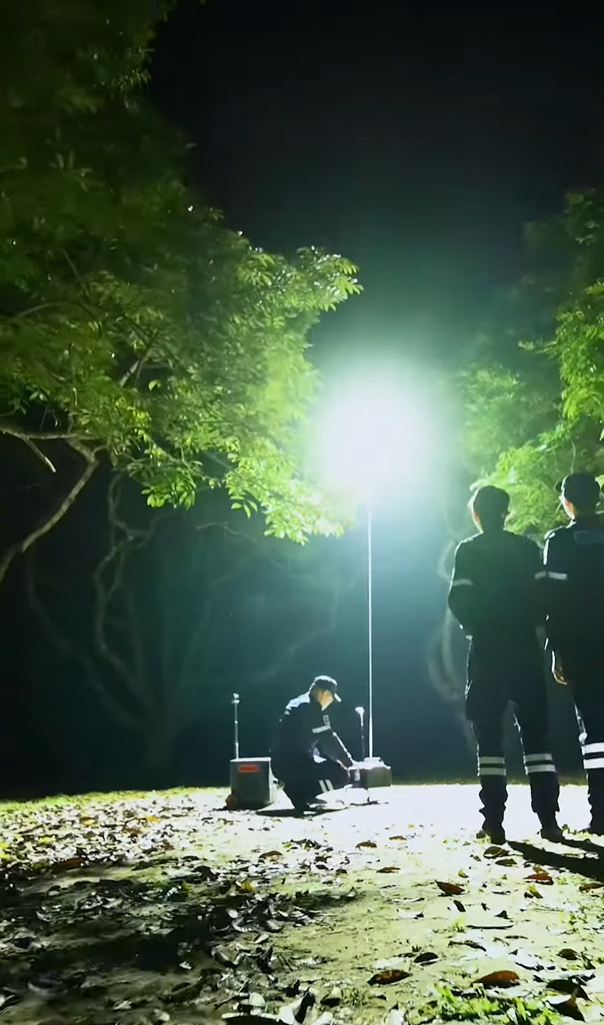
Using drones as airborne lighting platforms is not a new concept. Many industrial UAVs can carry high-power LED searchlights capable of illuminating large work areas. The limitation is flight time.
A conventional multirotor typically remains airborne for 30–50 minutes, depending on payload, weather, and operating conditions. High-power lighting further reduces endurance by increasing power consumption.
That may be sufficient for short inspections, but not for utility repairs that often continue for several hours. Frequent battery changes interrupt operations and require additional batteries, charging equipment, and personnel to keep lighting available throughout the night.
Tethered drone systems eliminate these limitations by providing continuous power from the ground, allowing aircraft to remain airborne for extended periods without battery replacements.
A tethered drone receives continuous power from a ground-based unit through a lightweight cable instead of relying solely on onboard batteries.
The power unit can be connected to the electrical grid or a portable generator, allowing the aircraft to remain airborne for hours—or even an entire work shift under suitable conditions—without battery replacements. The tether also provides a secure physical connection between the drone and the ground station.
To keep the cable lightweight, power is transmitted at high voltage and converted onboard to the voltage required by the propulsion system and payloads. Automated tether management systems maintain cable tension during takeoff, landing, and repositioning, helping prevent tangles while ensuring stable flight.
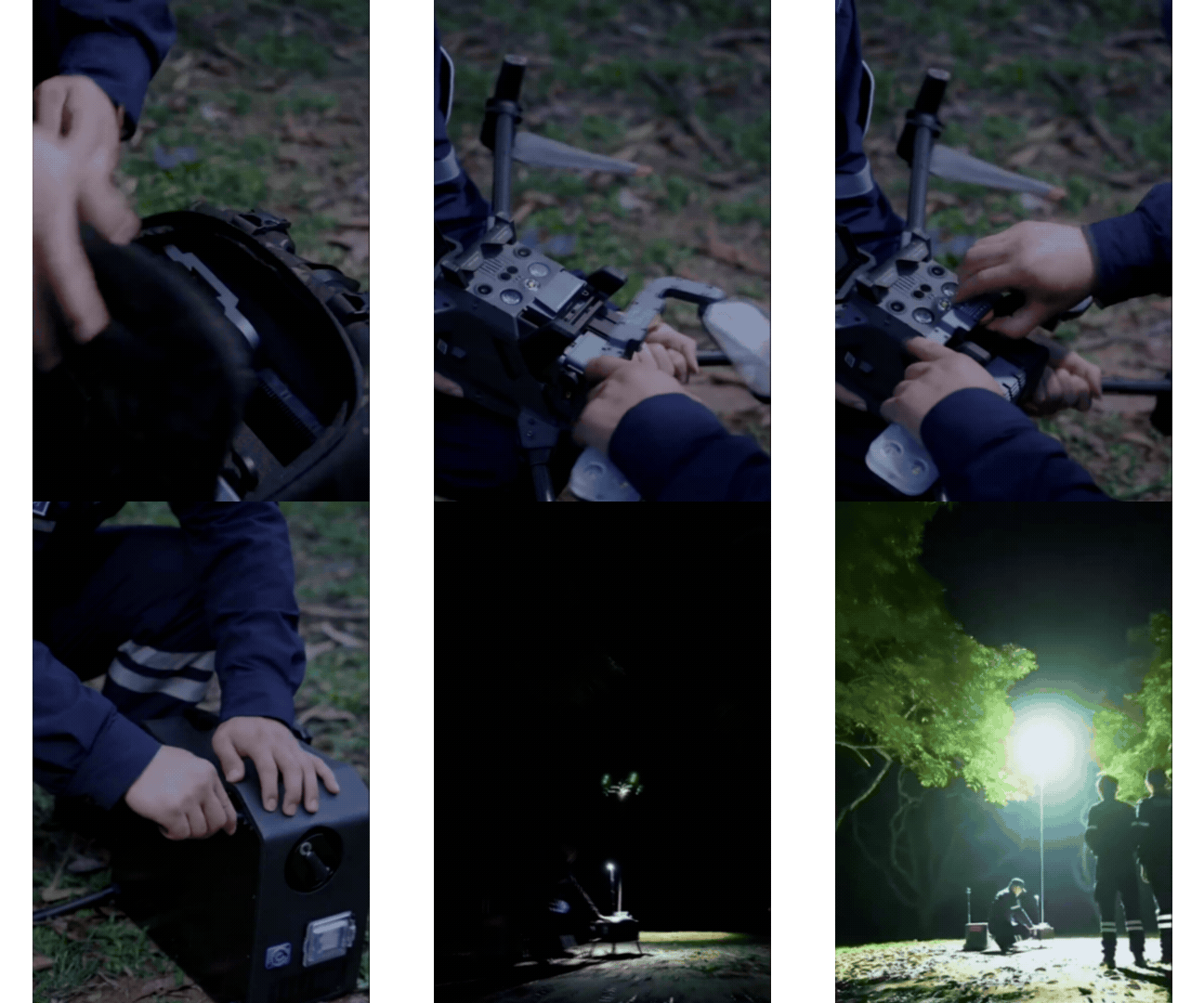
Although the tether limits the drone’s operating range, this is rarely an issue for stationary applications such as worksite lighting. Instead of serving as a mobile inspection platform, the drone functions as an elevated lighting point positioned 50–100 meters above the work area.
This setup also simplifies field operations. Once deployed, the system provides continuous illumination without the battery changes required by conventional drones.
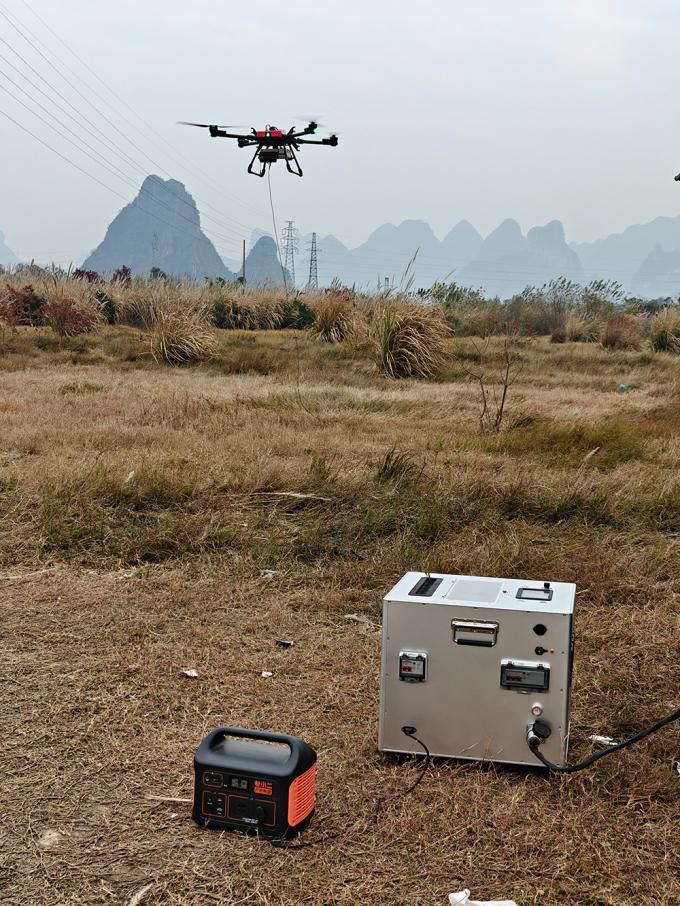
Flight endurance is only part of the solution. The performance of the lighting payload is equally important.
Industrial drone searchlights use high-output LED arrays with precision optics that concentrate light on the target area rather than spreading it over a wide angle. Compared with the compact LEDs found on many commercial UAVs, they deliver significantly greater brightness and coverage.
Many systems feature stabilized gimbals that allow operators to direct the beam toward specific equipment or inspection targets while the drone remains in position. Brightness can be adjusted remotely to suit different tasks, from illuminating an entire repair site to focusing on individual structures.
Some models also include flashing modes for emergency signaling or search-and-rescue operations, extending their usefulness beyond utility maintenance. For example, the CZI GL60 Plus supports a powerful strobe mode alongside continuous illumination, while the CZI GL60 Mini combines a high-output searchlight with red and blue warning lights for emergency response missions.
Combined with continuous tethered power, these searchlights enable drones to provide reliable overhead illumination throughout extended nighttime operations.
Tethered drone lighting systems can support a wide range of utility operations where crews need reliable illumination after dark. Their main applications include:
Storm damage, equipment failures, and accidents can require urgent repairs at any time of day. Tethered drones provide stable overhead lighting for tasks such as conductor replacement, tower repairs, and substation inspections, while onboard cameras can help supervisors monitor work remotely.
Burst pipes, damaged pumping stations, and excavation work often take place in challenging nighttime conditions. Aerial lighting reduces shadows around machinery and trenches, giving crews better visibility in confined repair areas.
Remote pipeline sites often lack permanent lighting infrastructure. Tethered drones can be deployed quickly from support vehicles to illuminate repair zones and, when equipped with thermal or optical cameras, support inspection activities at the same time.
Railway maintenance is frequently performed during limited overnight access windows. Instead of repeatedly moving ground lighting equipment along tracks, operators can reposition tethered drones to provide continuous illumination as crews move between work areas
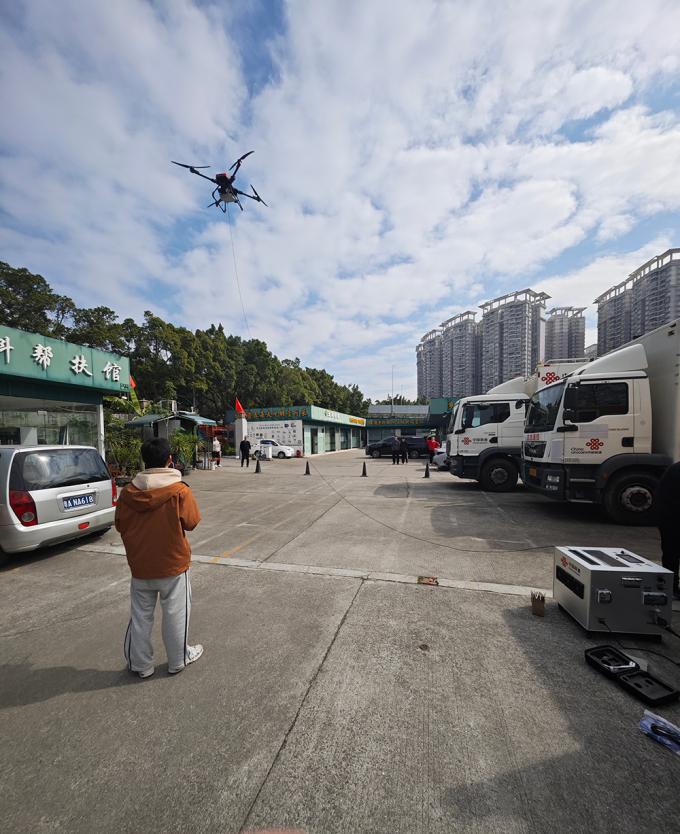
One example that demonstrates the practical value of tethered aerial lighting comes from emergency response operations following the 7.9-magnitude earthquake in Myanmar.
The earthquake damaged infrastructure, disrupted communications, and created dangerous conditions for rescue teams working among collapsed structures and unstable debris. As night fell, limited visibility became a major challenge for locating survivors and safely operating in affected areas.

To support nighttime operations, the Xiamen Dawn Rescue Team deployed a backpack-based tethered drone power system paired with a high-power searchlight: the CZI TK3 Backpack Tethered Power System and the GL60 Plus gimbal searchlight.
Unlike battery-powered drones that require regular landings for battery replacement, the tethered setup allowed the aircraft to remain airborne continuously while providing overhead illumination across the rescue area.
The GL60 Plus uses a 120 W LED light source with an effective illumination range of up to approximately 150 meters. Combined with ground lighting equipment, the aerial searchlight helped create more consistent coverage around the disaster site, reducing shadows and improving visibility in difficult areas.
Although the mission focused on disaster response rather than utility maintenance, the operational challenges were similar:
These same factors often affect utility teams responding to storm damage, floods, earthquakes, and other emergency restoration scenarios.
Like any technology, tethered drone lighting systems are not suitable for every operation.
Tethered drone lighting should also be considered a supplement rather than a replacement for traditional lighting. Ground-based systems remain useful for close-range tasks, while aerial illumination provides wider coverage and better visibility across larger work areas.
Nighttime utility maintenance has long relied on portable floodlights, lighting towers, and vehicle-mounted systems. While these solutions remain valuable, they can be limited by setup time, repositioning requirements, and uneven illumination.
Tethered drone lighting systems provide an alternative by placing the light source above the work area. Continuous power allows extended operation, while overhead illumination helps reduce shadows and improve visibility during repairs and inspections.
For utilities, the technology represents an additional tool for situations where fast deployment and reliable lighting are critical. From storm recovery and pipeline repairs to railway maintenance and emergency response, tethered drones can support crews working in challenging nighttime environments.
Rather than replacing existing lighting solutions, tethered drones expand the options available to maintenance teams by combining persistent illumination with aerial positioning and remote observation.