Global Navigation Satellite Systems (GNSS) determine positions by measuring distances between a receiver and multiple satellites. In geodesy, surveying, and Geographic Information Systems (GIS), the accuracy of these positions is critical, as even small errors can lead to significant operational, economic, and legal consequences.
DOP metrics such as HDOP and VDOP play a critical role in surveying by helping assess GNSS accuracy and enabling better planning of field observations.
Niyas Syed
GNSS accuracy is influenced by several factors, including satellite geometry, atmospheric delays (ionospheric and tropospheric), multipath interference, signal quality, and receiver performance. To evaluate and control these influences, a range of GNSS accuracy metrics is used.
These metrics can be broadly categorized into:
Among these, geometric metrics are particularly important because they define how measurement errors are amplified or minimized by satellite geometry, making them essential for real-time accuracy assessment.
Dilution of Precision (DOP) is a dimensionless parameter that describes the relationship between satellite geometry and positioning accuracy. It is derived from the mathematical model used in GNSS positioning, specifically from the geometry matrix that relates satellite positions to the receiver.
Unlike statistical metrics, DOP does not measure error directly. Instead, it represents the error amplification factor, indicating how measurement uncertainties propagate into positional errors.
DOP Type | Full Form | Description | Typical Good Value |
PDOP | Position Dilution of Precision | Overall 3D accuracy (horizontal + vertical) | 1 – 3 |
HDOP | Horizontal Dilution of Precision | Accuracy in latitude and longitude | < 1.5 |
VDOP | Vertical Dilution of Precision | Accuracy in altitude | 2 – 4 |
TDOP | Time Dilution of Precision | Receiver clock accuracy | Low is better |
GDOP | Geometric Dilution of Precision | Combined position and time accuracy | 1 – 3 |
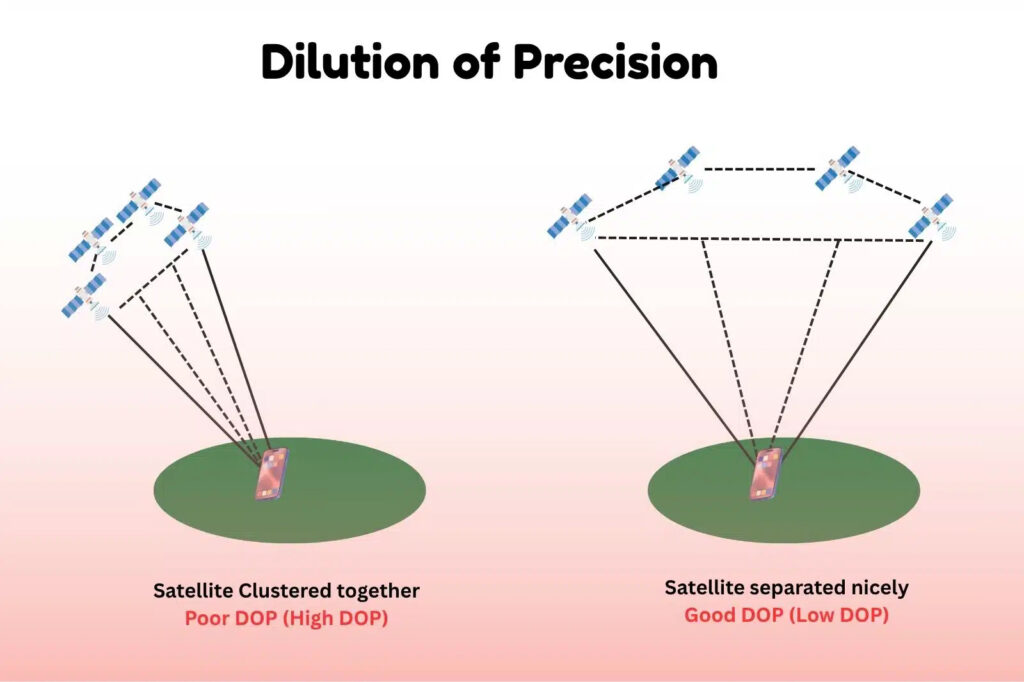
PDOP represents the overall three-dimensional geometric strength of the satellite configuration. It combines both horizontal and vertical components of positioning accuracy.
Low PDOP values indicate that satellites are well distributed across the sky, forming a strong geometric framework that minimizes error propagation. High PDOP values occur when satellites are clustered or poorly distributed, leading to increased positional uncertainty.
In surveying practice, PDOP is widely used as a primary indicator of GNSS solution quality, and thresholds are often defined during mission planning to ensure required accuracy levels are achieved.
HDOP focuses on horizontal positioning accuracy, specifically latitude and longitude. It is particularly important in applications such as cadastral surveys, mapping, and infrastructure layout, where planimetric precision is critical.
From a geodetic perspective, HDOP reflects the strength of satellite distribution in the horizontal plane. Poor azimuthal distribution of satellites increases HDOP, reducing the reliability of horizontal coordinates.
VDOP represents the uncertainty in vertical positioning (height). Due to the spatial distribution of GNSS satellites primarily located above the receiver, vertical geometry is inherently weaker than horizontal geometry.
As a result, VDOP values are generally higher than HDOP, and vertical measurements are more sensitive to errors. This has important implications for applications such as construction leveling, elevation modeling, and engineering surveys.
The relationship between DOP and positioning accuracy can be expressed as:
Position Error ≈ DOP × Measurement Error
This relationship highlights the importance of satellite geometry. Even when measurement errors are small, poor geometry (high DOP) can significantly amplify positional inaccuracies.
For example:
This amplification effect is critical in high-precision geodetic and surveying applications.
DOP metrics play a central role in professional surveying workflows:
By integrating DOP analysis into workflows, surveyors can improve accuracy, efficiency, and reliability.
To mitigate the impact of poor satellite geometry, modern GNSS practices include:
These approaches significantly enhance positioning performance, particularly in challenging environments.
In the United Arab Emirates, GNSS-based surveying is subject to strict regulatory frameworks to ensure accuracy and consistency in land and infrastructure development.
For example, Dubai Law No. 6 of 2017 mandates that all geodetic and cadastral surveys follow approved standards and utilize official survey control networks. These regulations emphasize the importance of accuracy, reliability, and traceability in spatial data.
In this context, maintaining low DOP values is not only a technical requirement but also a regulatory necessity. Poor satellite geometry can compromise positioning accuracy, potentially affecting land boundary determination, construction layout, and compliance with legal standards.
GNSS accuracy is a complex function of multiple factors, among which satellite geometry plays a fundamental role. PDOP, HDOP, and VDOP provide critical insight into how this geometry influences positioning accuracy by quantifying the amplification of measurement errors.
For geodesy and surveying professionals, understanding and monitoring these metrics is essential for ensuring reliable and high-precision results. By combining proper mission planning, advanced GNSS technologies, and adherence to regulatory frameworks, it is possible to achieve consistent accuracy even in challenging environments.
As GNSS technology continues to evolve, the importance of interpreting and managing DOP metrics will remain central to achieving robust and legally compliant positioning solutions.